

What if the traditional focus on amyloid-beta clearance has been masking more effective pathways for neuroprotection? For Australian researchers, the challenge of investigating peptides for neurodegenerative disease research is often compounded by the volatility of sensitive molecules and the logistical hurdles of international procurement. You recognise that maintaining the integrity of a study requires more than just a theoretical framework; it demands chemical precision and a supply chain that prioritises stability.
This technical overview provides a comprehensive analysis of emerging peptide compounds and their specific mechanisms within neuroregenerative models. We'll examine the role of mitochondrial-derived peptides like MOTS-c and the synergistic effects of neuromodulator blends such as KLOW. By establishing rigorous HPLC verification protocols and leveraging a domestic supply, your laboratory can bypass the risks of degradation and inconsistent purity. This briefing ensures you have the data and the reliable source required to advance your in-vitro or in-vivo neurological studies with absolute confidence.
Key Takeaways
- Evaluate the transition from symptomatic models to disease-modifying research targeting mitochondrial bioenergetics and neural plasticity.
- Identify the specific research applications of MOTS-C and KLOW when investigating peptides for neurodegenerative disease research in 2026.
- Recognise the necessity of HPLC-verified, >99% purity standards to mitigate the risk of off-target neuroinflammatory responses in sensitive models.
- Optimise laboratory workflows by establishing a reliable domestic supply chain that ensures cold-chain integrity and consistent delivery across Australia.
The Evolving Role of Peptides in Neurodegenerative Disease Models
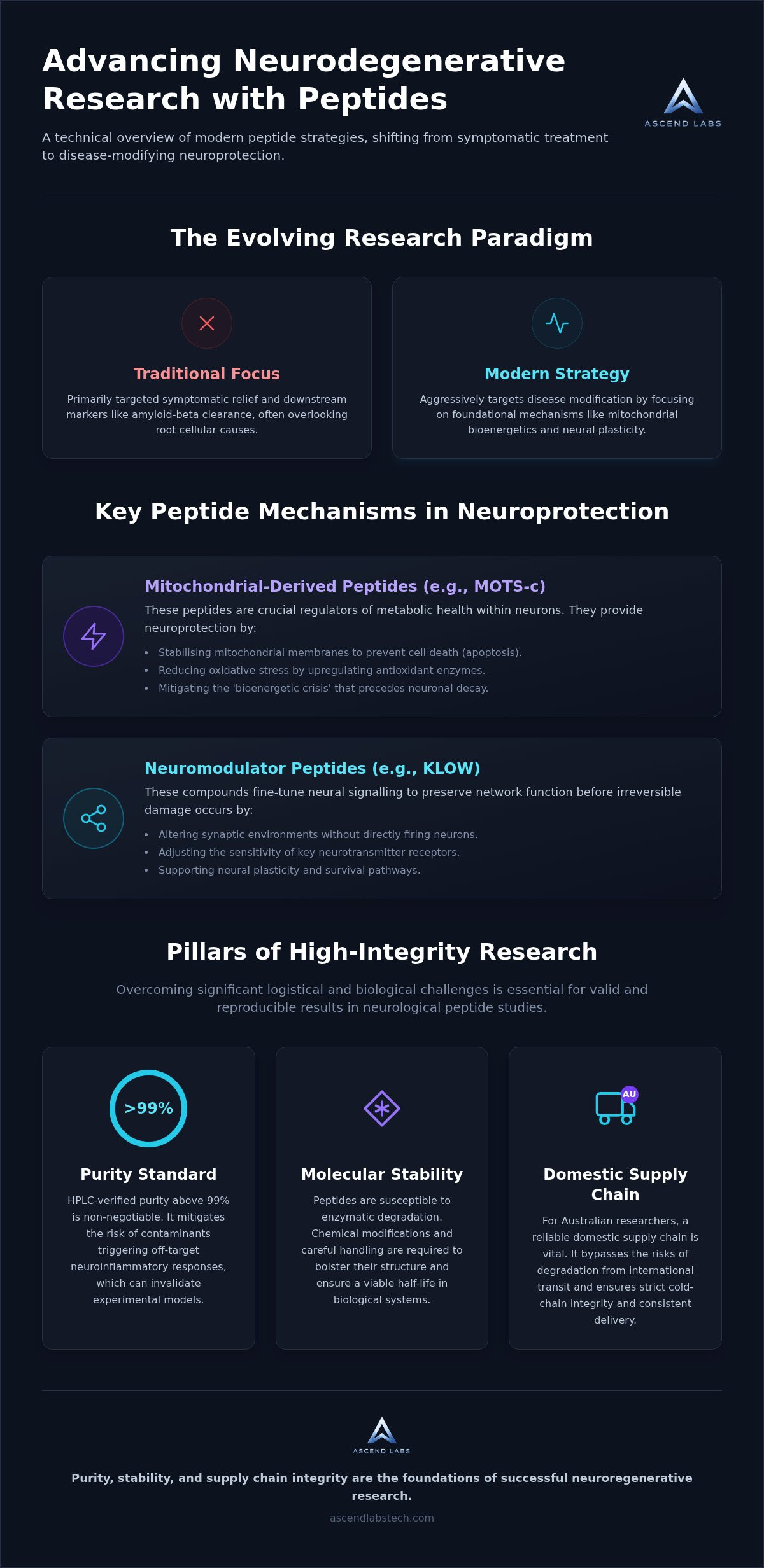
By 2026, the trajectory of Neuroscience has transitioned from palliative care toward aggressive disease-modifying strategies. Modern research environments now prioritise interventions that can halt or reverse neuronal decay. Using peptides for neurodegenerative disease research allows scientists to target the molecular foundations of Alzheimer’s, Parkinson’s, and Amyotrophic Lateral Sclerosis (ALS). These molecules offer a level of specificity that traditional small-molecule drugs often lack, making them indispensable in the current search for neuroprotective agents. They provide a vital bridge between cellular biology and clinical potential.
Peptides as Precision Research Tools
Peptides possess structural advantages that enable them to mimic endogenous neurotrophic factors accurately. Their inherent modularity allows for the design of ligands that interact with high affinity at specific receptor sites. In laboratory settings, peptide agonists are frequently used to modulate G-protein coupled receptors (GPCRs) within the brain. This interaction is critical for regulating neural plasticity and survival pathways. Because peptides typically exhibit high selectivity and low toxicity in in-vitro neural cultures, they provide a cleaner data set than many synthetic alternatives. They act as precise surgical tools at the cellular level, allowing researchers to isolate individual signalling events with minimal off-target interference.
Current Challenges in Neurological Peptide Delivery
Despite their potential, delivering these compounds effectively within research models presents significant hurdles. The blood-brain barrier (BBB) remains the most formidable obstacle, often necessitating the use of specialised delivery vectors or direct administration into the cerebrospinal fluid (CSF). Stability is another concern. Peptides are naturally susceptible to rapid enzymatic degradation, which can drastically shorten their half-life in biological systems. Researchers are currently investigating chemical modifications, such as N-methylation or backbone alterations, to bolster stability without compromising bioactivity.
For Australian research institutions, the integrity of the supply chain is as vital as the molecular design. International transit of sensitive compounds often leads to degradation due to temperature fluctuations or extended lead times. Sourcing high-purity research peptides from a domestic supplier like Ascend Labs ensures that the chemical profile remains stable. Utilising peptides for neurodegenerative disease research requires a commitment to purity. Any contaminant can trigger a neuroinflammatory response, which effectively ruins the experimental model and produces confounding results. Maintaining a strict HPLC-verified standard is the only way to guarantee that the observed effects are truly peptide-mediated.
Neuromodulator and Mitochondrial Peptides: Mechanisms of Neuroprotection
Neuromodulator peptides represent a sophisticated class of compounds that alter neural signalling and plasticity without directly inducing an action potential. They fine-tune the synaptic environment by adjusting the sensitivity of neurotransmitter receptors. This modulation is vital when investigating peptides for neurodegenerative disease research, as it addresses the functional decline of neural networks before irreversible structural damage occurs. Parallel to this, the mitochondrial-neurodegeneration axis has emerged as a primary focus. Bioenergetic failure often precedes structural decay in the brain. If the mitochondria cannot meet the metabolic demands of the neuron, apoptosis is inevitable.
Mitochondrial-derived peptides (MDPs) are essential regulators of metabolic homeostasis in neural tissue.
These MDPs exert neuroprotective effects through several distinct mechanisms. They primarily function as anti-apoptotic agents by stabilising the mitochondrial membrane and preventing the release of cytochrome c. Additionally, they significantly reduce oxidative stress by upregulating endogenous antioxidant enzymes. Research at the University of Queensland Neuropeptide Research centre highlights how these sequences can be manipulated to preserve cellular integrity under pathological stress. By mitigating the 'bioenergetic crisis' common in diseased neurons, these peptides provide a foundation for sustained cellular recovery.
Mitochondrial-Derived Peptides (MDPs) in Neural Health
Mitochondrial proteostasis is a cornerstone of neural longevity. MOTS-c, a prominent MDP, is currently being explored for its ability to bridge the gap between metabolic regulation and cognitive health. In models of metabolic-linked cognitive decline, MOTS-c appears to restore glucose homeostasis and reduce the accumulation of misfolded proteins. This research is deeply intertwined with The Role of Mitochondrial Peptide Research in Modern Longevity Science, as both fields prioritise the maintenance of bioenergetic efficiency. For labs seeking to replicate these findings, using high-purity research compounds is essential to ensure that metabolic observations aren't skewed by chemical impurities.
Neuromodulators and Synaptic Plasticity
Synaptic density is the primary correlate of cognitive function in neurodegenerative models. Growth factor peptides influence this density by promoting neural repair and enhancing dendritic branching. These sequences don't just support structural growth; they also play a critical role in modulating neuroinflammation. By suppressing pro-inflammatory cytokines, these neuromodulators create a permissive environment for regeneration. Detailed frameworks for these interactions can be found in our guide on Neuromodulator Peptides in Neuroscience Research. Effectively utilising peptides for neurodegenerative disease research requires a dual focus on both bioenergetic support and synaptic maintenance.
Analysing Key Research Compounds: MOTS-C, KLOW, and Beyond
The transition from theoretical frameworks to practical application requires a meticulous selection of chemical sequences. In 2026, researchers are increasingly focused on the intersection of systemic metabolism and central nervous system (CNS) health. By utilising specific peptides for neurodegenerative disease research, laboratories can isolate variables related to mitochondrial efficiency or cellular senescence. While previous decades focused on amyloid-beta in isolation, current models prioritise compounds like MOTS-c and KLOW to address the underlying bioenergetic and inflammatory drivers of decay.
KLOW represents a specialised category of research blends. It incorporates sequences designed to investigate cellular senescence and neural ageing within complex biological environments. Unlike single-sequence peptides, this blend allows for the study of multifaceted regenerative pathways, particularly in models where chronic neural inflammation is a primary variable. For practitioners, the choice between a mitochondrial regulator and a neuromodulator blend depends on whether the study's objective is metabolic restoration or structural resilience. Each compound serves as a distinct probe into the mechanics of neural survival.
MOTS-C and Cognitive Metabolic Research
MOTS-c operates primarily through the activation of the AMPK pathway in neural cells. This mechanism is critical for maintaining intracellular energy balances during periods of pathological stress. Within the context of Alzheimer’s models, often referred to as 'Type 3 Diabetes', MOTS-c provides a unique lens through which to study the link between insulin resistance and cognitive decline. By regulating metabolic flux, it may mitigate the proteotoxic stress that precedes plaque formation. For a deeper technical breakdown of these interactions, see our KLOW vs MOTS-C Research: A Comparative Analysis for Australian Laboratories.
Emerging Applications for Retatrutide and Tirzepatide
While originally developed for metabolic research, Retatrutide and Tirzepatide are gaining traction in neurological studies. Retatrutide, a triple agonist targeting GIP, GLP-1, and glucagon receptors, offers a complex profile for investigating neuro-metabolic pathways. Research suggests that these incretin mimetics exert potent anti-inflammatory effects within the CNS, potentially reducing microglial activation. Exploring this triple agonist mechanism allows scientists to observe how systemic metabolic signals influence neural survival. You can find more on this in our briefing on Retatrutide: The Frontier of Triple Agonist Research in Australia. These compounds represent the next phase of peptides for neurodegenerative disease research, where systemic health and cognitive integrity are studied as a unified system.
Purity Verification and HPLC Standards for Neurological Research
In neurodegenerative models, the margin for chemical error is non-existent. Precision in peptides for neurodegenerative disease research is non-negotiable. Achieving a purity level of >99% isn't just a quality benchmark; it's a prerequisite for data integrity. Even minor impurities can trigger off-target neuroinflammatory responses. These responses can activate microglia and astrocytes prematurely, effectively sabotaging the experimental model by introducing confounding variables that mask the peptide’s true neuroprotective effect. Consistent results depend entirely on the absence of these immunogenic contaminants.
High-Performance Liquid Chromatography (HPLC) serves as the primary tool for assessing chemical purity. By measuring the area under the peak, researchers can confirm the percentage of the target molecule relative to other substances in the sample. However, HPLC alone doesn't confirm identity; it only measures the relative quantity of the dominant compound. Mass Spectrometry (MS) must be used in tandem to verify the peptide’s exact molecular weight and amino acid sequence. Together, these analytical methods provide a definitive chemical fingerprint, ensuring that the research targets the intended biological pathway without deviation.
The Researcher’s Checklist for Peptide Verification
A rigorous verification process starts with the Certificate of Analysis (COA). Every batch must be checked against its specific batch number to ensure consistency across longitudinal studies. Researchers should be particularly wary of residual trifluoroacetic acid (TFA) and acetonitrile. These solvents are common by-products of the synthesis process and can be highly toxic to neural cultures if present in significant quantities. For a comprehensive breakdown of these verification standards, consult our guide on Peptide Purity Testing: A Professional Protocol for Australian Research Verification.
Cold-Chain Integrity and Degradation
Maintaining the structural integrity of sensitive molecules is a significant logistical challenge in the Australian climate. Temperature fluctuations during transit can lead to deamidation or oxidation, rendering the peptide inactive or, worse, biologically altered. Lyophilised peptides should be stored at -20°C or -80°C to maximise shelf-life, while reconstituted compounds require immediate use or strict aliquotting to avoid damaging freeze-thaw cycles. Domestic supply reduces the risk of thermal degradation in sensitive neuromodulator compounds by eliminating the prolonged exposure associated with international customs delays.
Sourcing High-Purity Research Peptides in Australia
Partnering with a domestic Australian supplier provides a distinct advantage for scientific inquiry. In 2026, the Therapeutic Goods Administration (TGA) has prioritised compliance for unapproved peptides, making international procurement increasingly complex and risky. A local partnership ensures that your laboratory remains compliant with Australian research chemical regulations while maintaining the highest standards of compound integrity. Using peptides for neurodegenerative disease research requires a supply chain that can guarantee cold-chain stability from the point of synthesis to the laboratory bench. Domestic transit avoids the prolonged thermal exposure and customs delays that frequently degrade sensitive neuromodulator sequences.
The Ascend Labs Advantage
Ascend Labs operates with the quiet confidence of an expert curator. We provide HPLC and Mass Spectrometry verified peptides, ensuring that every vial meets the rigorous demands of the domestic scientific community. Our commitment to laboratory-grade standards involves a meticulous verification protocol for every compound in our inventory. This transparency builds a sense of security and trust, allowing researchers to focus entirely on their molecular models. By eliminating the uncertainty of international shipping, we provide a reliable foundation for serious inquiry. You can explore our full range of high-purity compounds through the Ascend Labs Research Catalogue.
Supporting the Australian Scientific Community
Supporting the Australian scientific community means providing the tools necessary for ground-breaking discoveries. We supply advanced compounds like Retatrutide and MOTS-c to major institutions, including the Florey Institute and the University of Queensland. These compounds are essential for investigating the intersection of metabolic health and neural survival. Beyond chemical supply, we offer the technical support and documentation required for research grant applications. This includes providing detailed batch-specific data that satisfies the transparency requirements of peer-reviewed journals. The expansion of peptide science in Australian neurobiology relies on this infrastructure of quality and reliability.
Adhering to the regulatory landscape is a critical component of modern research. With dozens of new peptide-related businesses registered with ASIC in 2026, the need for a principled, authoritative partner has never been greater. We maintain strict operational discretion and professional ethics, ensuring that our products are used solely for laboratory research purposes. This disciplined approach protects the integrity of the broader scientific community. As the ARC Centre of Excellence for Innovations in Peptide and Protein Science (CIPPS) continues to drive innovation, the demand for high-purity peptides for neurodegenerative disease research will grow. Ascend Labs remains the premier partner for researchers who refuse to compromise on chemical precision.
Advancing the Frontier of Neurobiology
The landscape of 2026 demands a departure from outdated models. Effective peptides for neurodegenerative disease research must address the bioenergetic and synaptic complexities of the brain with absolute chemical fidelity. By prioritising mitochondrial-derived peptides and neuromodulator blends, Australian laboratories can unlock new insights into cellular resilience and recovery.
Success in these high-stakes environments relies on more than just molecular design. It requires a commitment to >99% purity standards and a supply chain that eliminates the risks of international transit. As an Australian-owned and operated partner, Ascend Labs provides strict HPLC and Mass Spectrometry verification to ensure your data remains untainted by synthetic impurities. Discreet domestic shipping preserves the integrity of every sequence, allowing your facility to maintain the highest standards of scientific rigor.
We look forward to supporting your next breakthrough in the evolving field of neurodegenerative science.
Frequently Asked Questions
Are peptides for neurodegenerative disease research available for human use in Australia?
Peptides for neurodegenerative disease research are strictly prohibited for human consumption or therapeutic use in Australia. These compounds are designated for in-vitro and in-vivo laboratory settings only. In 2026, the Therapeutic Goods Administration (TGA) has prioritised compliance regarding the unlawful supply of unapproved peptides. Researchers must ensure their procurement protocols align with institutional ethics and national regulations, maintaining a clear distinction between scientific inquiry and clinical practice.
What is the most promising peptide for Alzheimer’s disease research in 2026?
Current research identifies mitochondrial-derived and metabolic peptides as the most significant area of interest for Alzheimer’s models. While amyloid-beta was historically the primary target, 2026 studies frequently prioritise MOTS-c for its metabolic regulation and KLOW for its impact on cellular senescence. These sequences allow scientists to investigate the 'Type 3 Diabetes' hypothesis of cognitive decline. The most promising results often emerge from a multi-pathway approach rather than focusing on a single protein accumulation.
How does MOTS-C contribute to neuroprotective research models?
MOTS-c contributes to neuroprotective models by activating the AMPK pathway and promoting mitochondrial proteostasis. This metabolic regulation is vital for maintaining neural energy balances under pathological stress. By stabilising the mitochondrial-neurodegeneration axis, MOTS-c helps researchers observe how bioenergetic efficiency influences neural survival. It serves as a critical probe for understanding how systemic metabolic signals can mitigate the oxidative stress and proteotoxicity typically seen in advanced neurodegenerative models.
Why is HPLC verification critical for neuromodulator peptides?
HPLC verification is essential to ensure a purity level of >99%, which prevents off-target neuroinflammatory responses. Impurities in a peptide sample can trigger microglial activation, which effectively compromises the experimental data. For peptides for neurodegenerative disease research, even trace contaminants like residual TFA or acetonitrile can be cytotoxic to neural cultures. Rigorous HPLC testing guarantees that the biological effects observed in the study are solely attributable to the peptide sequence itself.
Can Retatrutide be used in neuro-metabolic research studies?
Retatrutide is an increasingly popular tool for neuro-metabolic research due to its triple agonist profile. It targets GIP, GLP-1, and glucagon receptors, providing a complex model for studying systemic metabolic influences on the central nervous system. Researchers use this compound to investigate how incretin mimetics reduce microglial activation and neuroinflammation. Its application in 2026 extends beyond metabolic studies to include comprehensive investigations into how triple agonism preserves structural integrity within the brain.
What are the storage requirements for research peptides in the lab?
Proper storage is critical for maintaining molecular stability and preventing enzymatic degradation. Lyophilised research peptides should be kept in a climate-controlled environment at -20°C or -80°C for long-term storage. Once reconstituted, the compounds are significantly more volatile and should be used immediately or divided into single-use aliquots. Researchers must avoid repeated freeze-thaw cycles, as these disrupt the peptide’s structural integrity and can lead to deamidation or oxidation, rendering the sample useless.
How long does domestic shipping take for research peptides in Australia?
Domestic shipping for research peptides in Australia is streamlined to minimise transit time and maintain cold-chain integrity. By bypassing the customs delays associated with international procurement, domestic suppliers ensure that sensitive compounds arrive without significant thermal exposure. Most shipments are processed and delivered within a few business days to support the active schedules of local laboratories. This rapid transit is essential for preserving the bioactivity of neuromodulator sequences during the final stage of delivery.
How do I interpret a COA for a research-grade peptide?
Interpreting a Certificate of Analysis (COA) requires verifying the batch number against the HPLC and Mass Spectrometry (MS) reports. The HPLC chromatogram should show a dominant peak representing the target peptide, with the area under the peak indicating the purity percentage. The MS report confirms the identity by matching the observed molecular weight to the theoretical weight of the sequence. Any discrepancies in these values indicate a failure in synthesis or purification, which would invalidate research results.


