

Can a research outcome ever truly be valid if the primary compound's molecular integrity remains unverified? For Australian scientists, the challenge of securing high-purity mitochondrial peptides is frequently compounded by inconsistent international batches and opaque documentation. You understand that experimental reproducibility relies entirely on the precision of your reagents, yet the current market often forces a compromise between lead times and laboratory-grade certainty.
This guide provides a definitive technical framework to buy MOTS-C peptide Australia with absolute confidence. It focuses on 2026 procurement standards that prioritise domestic reliability and rigorous HPLC verification. By shifting from generic sourcing to a clinical-grade domestic framework, you can eliminate the variables that jeopardise metabolic data. We will examine the critical importance of third-party COA transparency, the logistical advantages of local supply chains, and the specific analytical markers required to ensure your research remains beyond reproach. This is the essential protocol for streamlining laboratory procurement while maintaining the highest levels of scientific integrity.
Key Takeaways
- Define the molecular profile of MOTS-C as a 16-amino acid mitochondrial-derived peptide (MDP) and understand its unique function within modern endocrinology research.
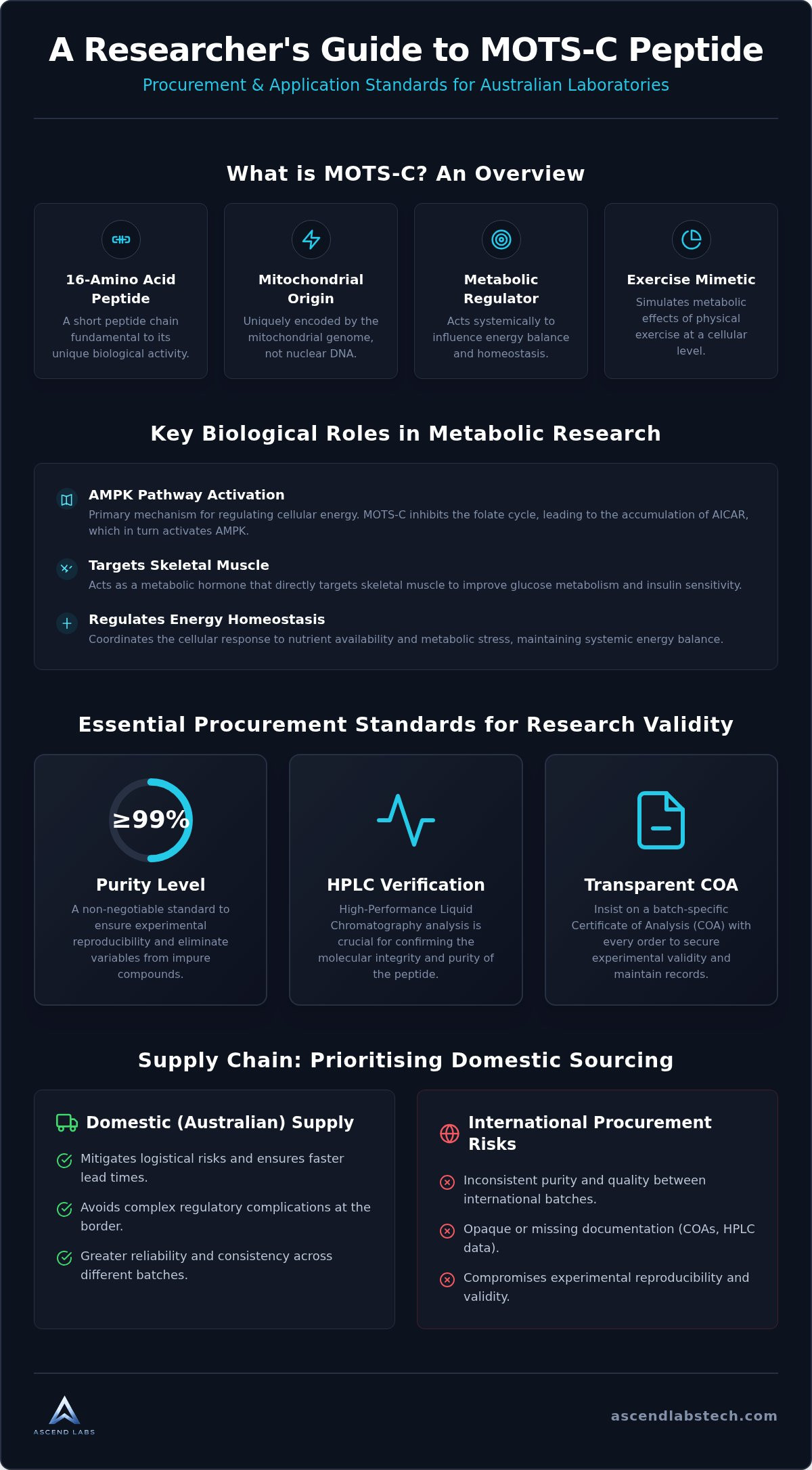
- Establish rigorous procurement standards by requiring ≥99% purity levels and comprehensive High-Performance Liquid Chromatography (HPLC) verification for all research compounds.
- Mitigate logistical risks and regulatory complications by prioritising domestic Australian supply chains over international procurement routes.
- Secure experimental validity when you buy MOTS-C peptide Australia by insisting on transparent, batch-specific Certificate of Analysis (COA) documentation for every laboratory order.
- Analyse the specific metabolic influences of MOTS-C in cellular models, focusing on its role in AMPK pathway activation and the regulation of fatty acid oxidation.
What is MOTS-C? A Mitochondrial-Derived Peptide Overview
MOTS-C, formally known as Mitochondrial Open Reading Frame of the 12S rRNA-c, is a 16-amino acid peptide that has redefined modern endocrinology. Unlike the vast majority of signalling molecules, it's encoded within the mitochondrial genome rather than nuclear DNA. This unique origin defines its status as a primary Mitochondrial-Derived Peptide (MDP). Researchers who intend to buy MOTS-C peptide Australia for metabolic inquiry often focus on its systemic regulatory functions. It's a critical component for maintaining cellular homeostasis under physiological stress and serves as a fundamental pillar in mitochondrial biology. To establish a baseline for their studies, researchers often consult What is MOTS-C? A Mitochondrial-Derived Peptide Overview for a foundational understanding of the peptide’s discovery and function.
The peptide serves as a potent metabolic regulator that acts both locally and systemically to influence energy balance. Its ability to influence nuclear gene expression via specific signalling pathways makes it a primary subject in longevity science and metabolic health studies. Because it provides a direct link between mitochondrial health and whole-body metabolic efficiency, it's become a priority for advanced biochemical studies. Scientists value its role in coordinating the cellular response to nutrient availability and environmental changes. It represents a significant shift in how we view mitochondria, transitioning from simple energy producers to active participants in endocrine signalling.
To better understand the biochemical mechanics of this peptide, watch this detailed masterclass:
The Discovery and Scientific Significance of MDPs
For decades, the mitochondrial genome was believed to encode only 13 proteins for the electron transport chain. The identification of MOTS-C shifted this view, revealing a complex "retrograde signalling" mechanism. This process allows mitochondria to communicate directly with the cell nucleus to coordinate metabolic responses and gene transcription. It's a bottom-up signalling pathway that contrasts with nuclear-encoded peptides, establishing a unique biological niche essential for cellular adaptation and the maintenance of mitochondrial integrity across various tissues.
Current Research Applications in Australian Laboratories
In the Australian research landscape, MOTS-C is frequently utilised to investigate insulin sensitivity and glucose metabolism within skeletal muscle models. Its function as an "exercise mimetic" makes it a compelling subject for physical performance and fatty acid oxidation studies. By integrating this compound into mitochondrial peptide research, laboratories can explore how MDPs regulate cellular energy balance. These applications are vital for scientists seeking to buy MOTS-C peptide Australia to understand metabolic resilience and the physiological impacts of age-related mitochondrial dysfunction.
The Biological Role of MOTS-C in Metabolic Research
MOTS-C operates as a metabolic hormone that targets skeletal muscle to regulate systemic energy balance. Its primary biochemical influence is exerted through the activation of the adenosine monophosphate-activated protein kinase (AMPK) pathway. When investigators buy MOTS-C peptide Australia for cellular modelling, they're often focusing on how this peptide facilitates a metabolic shift toward increased energy expenditure. This regulation is essential for maintaining cellular homeostasis under conditions of nutrient excess or metabolic stress. By acting as a sensor for mitochondrial health, the peptide coordinates the cellular response to maintain metabolic efficiency.
AMPK Activation and Energy Homeostasis
Just as mitochondrial health is central to metabolic efficiency, maintaining a balanced microbiome is essential for overall wellbeing; you can discover Velobiotics to see how they apply probiotic science to intimate health.
The mechanism begins with the inhibition of the folate cycle, which causes the accumulation of 5-aminoimidazole-4-carboxamide ribonucleotide (AICAR). This accumulation directly stimulates the phosphorylation of AMPK. Once activated, AMPK initiates a cascade of downstream effects that increase the metabolic rate and enhance energy consumption within research models. The AMPK-MOTS-C axis acts as a primary regulator of cellular energy. This pathway is particularly relevant in studies examining mitochondrial biogenesis, as AMPK activation is a known precursor to the synthesis of new mitochondria and the maintenance of cellular longevity.
Insulin Sensitising and Glucose Uptake Mechanisms
One of the most significant research applications of MOTS-C involves its ability to facilitate glucose uptake independent of traditional insulin pathways. It achieves this by stimulating the translocation of glucose transporter 4 (GLUT4) to the cell surface. This insulin-independent mechanism is a focal point for insulin sensitising peptide research within Australian laboratories. By bypassing traditional insulin signalling, MOTS-C provides a unique model for studying metabolic resilience in in-vitro environments.
Research detailed in High-Purity MOTS-C for Australian Scientific Inquiry highlights how the peptide mitigates metabolic stress by promoting fatty acid oxidation and lipid metabolism. These processes are vital for preventing the accumulation of lipid intermediates that contribute to cellular dysfunction. For scientists exploring cellular longevity, the peptide’s role in enhancing mitochondrial function offers a robust framework for investigating age-related metabolic decline. If you're seeking to integrate these compounds into your current protocols, you can view the available metabolic research compounds to ensure your laboratory utilises verified materials.
Purity Standards for Australian Research Grade Peptides
For MOTS-C research, purity isn't a variable; it's a prerequisite. Standard laboratory protocols require a minimum of 99% purity to ensure that metabolic observations are attributable solely to the peptide. High-Performance Liquid Chromatography (HPLC) is the primary tool for verifying the peptide sequence and identifying contaminants. It separates the compound based on its chemical properties, allowing for a precise measurement of concentration. Mass Spectrometry (MS) serves as the secondary layer of verification, confirming the exact molecular weight of the peptide to ensure the correct sequence was synthesised. A batch-specific Certificate of Analysis (COA) must accompany every procurement to validate these metrics and ensure experimental reproducibility.
Interpreting HPLC and Mass Spectrometry Reports
When you review an HPLC chromatogram, the "purity peak" should be a sharp, symmetrical spike with minimal baseline noise. Broad or multiple peaks indicate the presence of impurities, such as salts or residual solvents, which can interfere with cellular assays. These contaminants may trigger unintended biological responses, effectively compromising the validity of your data. Establishing a rigorous peptide purity testing protocol is essential for any laboratory that values precision. Confirming the MS data aligns with the theoretical mass of MOTS-C is the final step in molecular verification. If the mass peak deviates from the expected value, the compound's identity is in question, regardless of the HPLC purity percentage.
The Risks of Substandard Research Compounds
Substandard compounds often contain truncated sequences, which are shorter, inactive versions of the target peptide. These occur when the solid-phase synthesis process is incomplete. International suppliers often have a "standardisation gap" where batch-to-batch consistency is not guaranteed. Residual solvents like trifluoroacetic acid (TFA) can be cytotoxic in high concentrations, potentially killing the cell cultures you are attempting to study. This hidden toxicity creates a false narrative in your results, leading to conclusions that can't be replicated. This is why seasoned investigators always demand rigorous verification before they buy MOTS-C peptide Australia. Securing a domestic source that provides transparent, HPLC-verified materials is the only way to safeguard your experimental integrity against these hidden variables. Relying on unverified international batches introduces an unacceptable level of risk to your research timeline and budget.
Navigating Domestic Procurement and Logistics in Australia
Procuring research peptides within the Australian regulatory framework requires a strategic approach to logistics. For researchers who choose to buy MOTS-C peptide Australia, the distinction between domestic supply chains and international imports is significant. International shipments frequently encounter delays or seizures by the Australian Border Force (ABF) and are subject to stringent Therapeutic Goods Administration (TGA) oversight. These barriers can disrupt experimental timelines and compromise the continuity of longitudinal data. Domestic procurement eliminates these variables by ensuring that compounds have already cleared regulatory hurdles and are held in local, controlled environments.
The Advantage of Local Australian Stock
Maintaining a domestic inventory removes the uncertainty of international transit. When a laboratory relies on overseas suppliers, they face the risk of total loss through customs intervention. Local stock ensures that resupply is rapid and predictable, which is essential for maintaining strict dosage protocols in ongoing studies. Australian express post services provide a level of reliability that international couriers cannot match for the final leg of delivery. This proximity allows for precise scheduling of laboratory work, as lead times are reduced from weeks or months to a matter of days.
Stability and Storage Requirements for MOTS-C
MOTS-C is typically supplied in a lyophilised state, which significantly enhances its structural integrity. In this form, the peptide exhibits excellent stability at room temperature during transit, even when navigating the harsh Australian climate. However, once the material reaches the laboratory, long-term storage protocols are vital. Vials should be stored at -20°C for short-term use or -80°C for extended preservation to prevent degradation and maintain peptide potency.
Understanding the procurement of MOTS-C involves accounting for these environmental factors. While the lyophilised compound is resilient during the 24 to 48 hours required for domestic dispatch, prolonged exposure to high temperatures should be avoided. Domestic suppliers who specialise in the Australian market understand these thermal requirements and organise their dispatch schedules to minimise transit time. This ensures that the compound arrives in optimal condition, ready for reconstitution and use in metabolic assays.
Ascend Labs: High-Purity MOTS-C for Australian Scientific Inquiry
Ascend Labs operates as the authoritative scientific gatekeeper for mitochondrial research in Australia. We don't view ourselves as a mere vendor; we act as a disciplined curator of the high-purity compounds essential for metabolic inquiry. Our catalogue is defined by a commitment to scientific truth, featuring the meticulous curation of MOTS-C and KLOW. This specialised focus ensures that Australian researchers have access to reagents that meet the highest international benchmarks for molecular integrity. When laboratories choose to buy MOTS-C peptide Australia through our facility, they're engaging with a partner that values precision above all else.
The Ascend Labs Verification Standard
Our quality assurance framework is built on a foundation of transparency and rigorous analytical verification. Every batch within our metabolic research range undergoes comprehensive testing to ensure a purity level of ≥99%. We utilise independent High-Performance Liquid Chromatography (HPLC) to verify the peptide sequence and Mass Spectrometry (MS) to confirm the exact molecular weight. This dual-layer verification process ensures that every vial provides the consistency required for reproducible results. It's a protocol designed to eliminate the variables that often plague unverified international batches. Every vial is strictly for in-vitro laboratory research only.
Securing MOTS-C for Your Next Research Phase
Australian institutions require a supply chain that is as reliable as their data. We've refined the online procurement process to be efficient, direct, and focused entirely on the practicalities of laboratory service. Our commitment to a domestic-only model means that your materials are dispatched from within Australia, bypassing the regulatory hurdles and transit risks associated with overseas sourcing. We invite you to explore our full catalogue of metabolic research compounds, growth factor peptides, and neuromodulators. Our mission remains focused: providing the substance required for significant scientific breakthroughs. As a principled institution, we value operational discretion and professional ethics. By maintaining a meticulous eye for detail, we ensure your research remains the primary focus.
Advancing Metabolic Inquiry with Analytical Precision
The landscape of mitochondrial research in 2026 demands a transition from speculative sourcing to a framework defined by analytical certainty. Experimental reproducibility relies on two critical pillars: rigorous molecular verification and a reliable domestic supply chain. By insisting on HPLC and MS verified batch purity, you eliminate the contaminants and truncated sequences that frequently compromise international procurement. Precision is paramount. A commitment to clinical-grade standards ensures that your metabolic observations remain valid and beyond reproach.
Choosing to buy MOTS-C peptide Australia from a dedicated domestic source mitigates the logistical risks of customs intervention. It also provides the rapid resupply necessary for longitudinal studies. This strategic approach to procurement allows your institution to maintain focus on the essential task of scientific discovery. You shouldn't have to manage the complexities of international logistics when your data is at stake.
We remain committed to providing the precision reagents required for your next breakthrough. Your research deserves the highest standard of molecular integrity.
Frequently Asked Questions
Is MOTS-C legal to buy in Australia for research purposes?
Yes, MOTS-C is legal to procure in Australia provided it is utilised exclusively for laboratory research and scientific inquiry. The Therapeutic Goods Administration (TGA) maintains strict oversight regarding unapproved peptides, particularly those marketed for human use. By ensuring that the compound is designated for in-vitro or animal research models, laboratories remain compliant with domestic regulations. It's essential to buy MOTS-C peptide Australia from suppliers who adhere to these professional research standards.
How is MOTS-C purity verified by Australian suppliers?
Verification is achieved through a dual-layer analytical process involving High-Performance Liquid Chromatography (HPLC) and Mass Spectrometry (MS). HPLC determines the purity level by separating the peptide from any residual solvents or synthesis by-products, aiming for a threshold of ≥99%. Mass Spectrometry then confirms the molecular weight of the compound, ensuring the amino acid sequence precisely matches the theoretical structure of MOTS-C. This rigorous protocol is fundamental for maintaining experimental reproducibility.
What is the recommended storage temperature for MOTS-C vials in a lab?
Lyophilised MOTS-C vials should be stored at -20°C for standard laboratory use or -80°C for extended preservation. Maintaining these sub-zero temperatures prevents peptide degradation and ensures the structural integrity of the 16-amino acid sequence. Once reconstituted, the peptide is significantly more labile and should be utilised promptly or stored according to specific assay requirements. Researchers must avoid frequent freeze-thaw cycles, as these can lead to mechanical stress and molecular breakdown.
Can MOTS-C be shipped internationally from Australia?
No, Ascend Labs does not offer international shipping for any metabolic research compounds. Our operational model is strictly focused on the domestic Australian market to ensure full compliance with local regulatory frameworks and logistics standards. By maintaining an exclusively domestic supply chain, we eliminate the complexities of international customs and ensure that Australian researchers receive their materials with minimal transit time and maximum reliability. This focus prioritises the needs of the local scientific community.
What is the difference between MOTS-C and other mitochondrial-derived peptides like Humanin?
While both are mitochondrial-derived peptides (MDPs), MOTS-C is a 16-amino acid peptide focused on metabolic homeostasis and skeletal muscle regulation. Humanin is a 24-amino acid peptide primarily recognised for its neuroprotective and cytoprotective functions. MOTS-C acts as a signalling molecule that coordinates the cellular response to metabolic stress via the AMPK pathway. In contrast, Humanin is often studied for its role in preventing apoptosis and protecting against oxidative stress in various tissue models.
Does MOTS-C require reconstitution before research application?
Yes, MOTS-C is provided in a lyophilised state to ensure stability and must be reconstituted before laboratory application. Researchers typically use a sterile or bacteriostatic diluent to return the peptide to a liquid state for precise measurement in cellular assays. The volume of diluent is determined by the desired concentration required for the specific research protocol. It's important to handle the vial gently during this process to avoid denaturing the delicate peptide structure.
What documentation should I expect when I buy MOTS-C peptide Australia?
When you buy MOTS-C peptide Australia, you should receive a comprehensive, batch-specific Certificate of Analysis (COA). This document is the primary evidence of the compound's purity and identity. It should include the HPLC chromatogram showing the purity peak and the Mass Spectrometry report confirming the molecular mass. Access to this technical data is vital for any laboratory seeking to maintain high standards of scientific integrity and ensure that their metabolic data remains valid.
How long does domestic shipping take for research peptides within Australia?
Domestic shipping for research peptides within Australia typically takes between 1 and 3 business days. By utilising local express courier services, suppliers can ensure that vials spend minimal time in transit. This rapid delivery is particularly beneficial for maintaining the stability of the lyophilised compound during the final leg of the journey. Local procurement allows Australian institutions to schedule their research phases with greater precision, avoiding the long and unpredictable lead times of international shipping.


