

In the 2026 research landscape, a Certificate of Analysis is no longer a courtesy; it is the only viable baseline for scientific integrity. Many investigators have historically relied on international procurement, only to face the compounding frustrations of opaque testing documentation and the high risk of customs seizures. Selecting the right australian peptide suppliers now requires a transition from retail-level trust to cold, analytical verification. You likely recognise that inconsistent batch purity and lengthy shipping delays from overseas vendors can compromise an entire year of data.
This guide serves as an authoritative framework for navigating the domestic market with precision. We promise to provide the technical criteria necessary to secure compounds with ≥99% purity, backed by verifiable HPLC and Mass Spectrometry data. We'll evaluate the essential standards for laboratory-grade procurement, focusing on the logistical security of domestic shipping and the rigorous quality assurance protocols that define the current industry leaders in Australia. This evaluation moves from high-level verification principles to the practicalities of secure, professional-grade logistics for the serious researcher.
Key Takeaways
- Identify the analytical benchmarks required for laboratory-grade purity, specifically the necessity of ≥99% verification through HPLC and Mass Spectrometry data.
- Evaluate the logistical stability offered by domestic australian peptide suppliers; it's the most effective way to protect research timelines from international customs seizures and thermal degradation.
- Distinguish between professional scientific curators and grey-market retail vendors by assessing their commitment to a strictly research-only operational mandate.
- Learn how to navigate the 2026 regulatory landscape by prioritising transparency and batch-specific documentation in your procurement framework.
- Recognise the importance of specialised expertise when sourcing advanced metabolic compounds such as Retatrutide and Tirzepatide for sensitive laboratory assays.
Navigating the 2026 Australian Research Peptide Landscape
The Australian scientific community has witnessed a significant shift in the focus of peptide studies. What was once a niche area of biochemistry has evolved into a sophisticated metabolic frontier. As research into compounds like Retatrutide and Tirzepatide accelerates, the reliance on high-purity chemical peptide synthesis becomes paramount. For investigators, the choice of australian peptide suppliers is no longer just about procurement; it's about establishing a partnership with a curator who understands the technical requirements of in-vitro assays. This evolution reflects a broader global trend where precision and data-driven verification replace the anecdotal trust of previous decades.
To better understand the risks associated with unverified supply chains in the current market, consider this report on the domestic landscape:
Scientific Necessity vs. Market Noise
Professional inquiry demands a clinical approach to sourcing. Many retail outlets adopt hyperbolic marketing, promising rapid results with little analytical backing. In contrast, a laboratory-grade supplier prioritises transparency. They provide verifiable data rather than retail-style slogans. This meticulousness is essential for avoiding the pitfalls of the grey market, where batch-to-batch inconsistency can invalidate months of sensitive research. Substance must always precede style in the laboratory. True scientific partners don't just sell compounds; they curate them, ensuring each batch meets the rigorous demands of advanced metabolic and longevity studies. Specialised providers like 157Peptides exemplify this commitment by focusing on high-purity research compounds backed by analytical data.
The Australian Regulatory Context
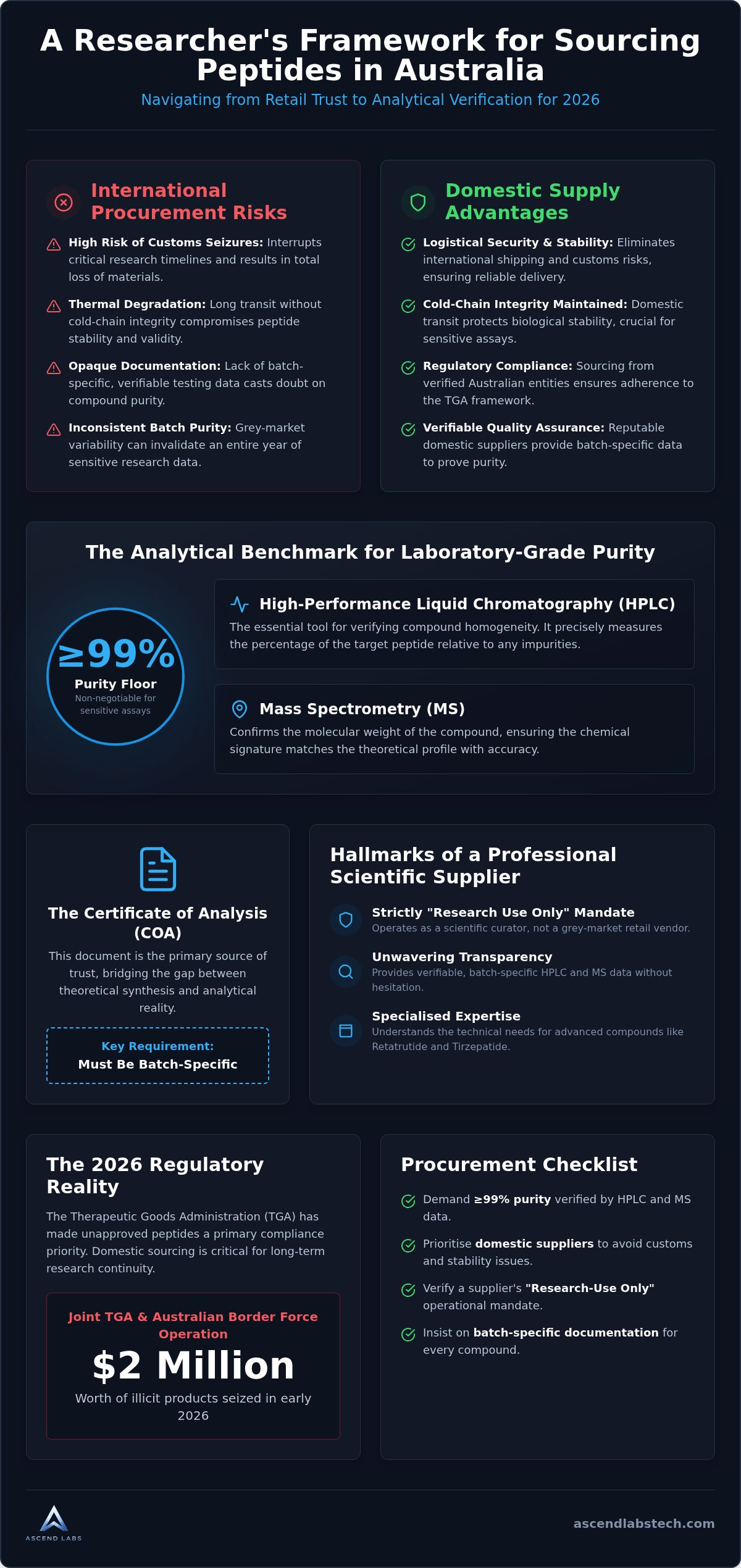
In August 2026, the regulatory environment for peptides in Australia is more stringent than ever. The Therapeutic Goods Administration (TGA) has made unapproved peptide products a primary compliance priority. Recent joint operations between the TGA and Australian Border Force resulted in the seizure of $2 million worth of illicit products in early 2026. For legitimate researchers, this highlights the critical need for domestic supply. Sourcing from verified Australian-owned entities ensures that materials remain within the "Research Use Only" framework while maintaining cold-chain integrity. Selecting reputable australian peptide suppliers who operate strictly within these legal parameters is the only way to ensure long-term research continuity. This domestic focus protects the conceptual framework of research timelines, ensuring that biological stability is never sacrificed for the sake of cheaper, unverified international alternatives that may have spent weeks in transit without temperature control.
Analytical Benchmarks for Laboratory-Grade Purity
In the context of advanced biochemical inquiry, the distinction between 98% and 99% purity is not merely academic; it's foundational. For researchers conducting sensitive assays, a single percentage point of impurity represents an unknown variable that can skew results or induce cellular toxicity. Establishing a ≥99% purity floor ensures that the biological response observed is attributable solely to the peptide sequence under investigation. Reputable australian peptide suppliers must provide the analytical data to support these claims, moving beyond surface-level assurances to provide deep technical transparency.
High-Performance Liquid Chromatography (HPLC) remains the essential tool for determining compound homogeneity. By measuring the area under the peak, researchers can verify the precise percentage of the target peptide relative to impurities. Complementing this, Mass Spectrometry (MS) confirms the molecular weight of the compound, ensuring the chemical signature matches the theoretical profile. The Certificate of Analysis (COA) serves as the primary document of trust in peptide procurement, bridging the gap between theoretical synthesis and analytical reality.
Interpreting the Certificate of Analysis (COA)
A valid COA must be batch-specific rather than a generic template. Researchers should scrutinise the chromatogram to ensure the primary peak is sharp and well-defined, indicating a high degree of purity. This level of scrutiny aligns with the standards set by leaders in Australian peptide and protein research, where precision is non-negotiable. To ensure the integrity of your data, it's vital to follow a professional protocol for peptide purity testing. This includes cross-referencing batch numbers and seeking independent, third-party verification to confirm that the supplier's internal findings are accurate and unbiased.
Contaminant Screening and Stability Testing
The presence of residual trifluoroacetic acid (TFA), a common byproduct of chemical synthesis, can significantly impact research outcomes by altering the pH of a solution or affecting cell viability. Meticulous australian peptide suppliers implement rigorous desalting processes to minimise these residues. Additionally, the stability of lyophilised powders is critical during national transit. High-grade peptides are stored under vacuum in a climate-controlled environment before dispatch to prevent degradation from moisture or temperature fluctuations. By maintaining these strict protocols from synthesis to the laboratory door, suppliers preserve the efficacy of metabolic research compounds. For those requiring verified compounds for their next study, exploring a curated range of research peptides ensures access to materials that meet these exacting analytical benchmarks.
The Logistics of Domestic Supply: Security and Stability
Sourcing from international vendors introduces uncontrolled variables. Customs intervention remains a primary concern for the scientific community. As confirmed by the $2 million seizure of peptide products in early 2026, the border environment is increasingly restrictive. Domestic australian peptide suppliers eliminate this specific risk. They ensure that sensitive materials, such as metabolic research compounds, reach the laboratory without the threat of legal forfeiture or transit-related degradation.
Timelines are the backbone of scientific inquiry. A three-week delay at a customs facility isn't just an inconvenience; it's a threat to biological integrity. Even lyophilised peptides are susceptible to thermal degradation if left in unconditioned shipping containers during peak Australian summer. Local inventory management allows for a stable supply chain. It insulates researchers from global fluctuations and geopolitical disruptions. This stability is essential for maintaining the conceptual framework of long-term studies.
Ensuring Cold-Chain and Transit Integrity
The Australian climate presents unique challenges for peptide stability. High-grade suppliers utilise vacuum-sealed, lyophilised protection to mitigate moisture ingress and oxidation. However, the duration of exposure to ambient temperatures must be minimised. This is why professional laboratories now require same business day dispatch. Reducing the transit window ensures that the chemical signature remains intact from the point of synthesis to the research facility. Secure, discreet packaging further protects these sensitive metabolic compounds from environmental stressors during their journey.
Domestic Verification and Accountability
Traceability is a fundamental requirement for clinical-grade procurement. Utilising Australian postal and courier networks allows for precise, real-time tracking within a familiar infrastructure. For researchers in remote Australian facilities, maintaining the digital connection required for this tracking often involves signal enhancement hardware from Telco Antennas. This establishes a clear chain of custody. Unlike international orders that often disappear into opaque last-mile handovers, domestic shipments remain accountable. Additionally, having access to Australian-based technical support ensures that enquiries regarding batch numbers or storage protocols are handled by experts who understand the local regulatory environment. This level of accountability is what separates authoritative australian peptide suppliers from faceless global vendors. Professional inquiry requires a partner who is reachable, reliable, and grounded in the same domestic standards as the researchers they serve.
Transitioning from analytical theory to practical procurement requires a disciplined approach. Evaluating australian peptide suppliers involves more than a surface-level price comparison; it necessitates a rigorous audit of their operational standards. A disciplined procurement framework ensures that every vial entering the laboratory meets the standards required for reproducible data. This process begins with the verification of batch-specific data and ends with the confirmation of domestic logistical security.
The first step is the verification of batch-specific HPLC and Mass Spectrometry data. Generic templates are insufficient for professional inquiry. If a supplier cannot provide a unique chromatogram for the current batch, the compound's identity remains unverified. Secondly, researchers must assess the supplier's mandate. Reputable australian peptide suppliers maintain a strictly research-only boundary. Any deviation into therapeutic advice or human consumption claims is a critical failure of professional ethics and a significant regulatory risk.
Catalogue depth and stock status serve as the final filters. A supplier's ability to provide advanced metabolic compounds like Retatrutide and MOTS-C suggests a high level of technical immersion. Furthermore, investigators must confirm that the stock is physically held within Australia. International "drop-shipping" disguised as domestic supply is a common pitfall that reintroduces the very customs risks researchers seek to avoid. To mitigate these risks across all research formats, investigators can also source high-purity softgels from domestic-focused providers like Biomod Peptides.
A sophisticated inventory reflects the current frontiers of metabolic and longevity science. This includes the availability of complex triple agonists and metabolic research compounds like Tirzepatide. Beyond metabolic study, a robust catalogue should encompass neuromodulator peptides and specialized growth factor sequences. This breadth of inventory indicates a supplier who functions as a scientific curator rather than a mere vendor. For those seeking a benchmark of professional-grade inventory, the Ascend Labs Product Catalogue provides a standard-setting example of research-focused compound selection.
Red Flags in Supplier Communication
Communication style is a reliable indicator of a supplier's integrity. Identify "market noise" early. Aggressive marketing tactics or unsubstantiated health claims are hallmarks of retail-grade vendors operating in the grey market. Reputable suppliers adopt a clinical, authoritative tone that prioritises analytical transparency over sales volume. If a supplier's communication lacks technical weight or avoids direct questions regarding purity verification, they don't possess the meticulousness required for scientific partnership. Professional inquiry demands a partner who speaks the language of the laboratory, not the language of the retail storefront.
Ascend Labs: Defining the Standard for Australian Science
Ascend Labs acts as an authoritative scientific gatekeeper, positioning itself as a disciplined curator for the domestic research community. Among australian peptide suppliers, we distinguish our operation through a commitment to scientific truth that transcends mere commercial exchange. We don't present ourselves as a retail vendor, but as a principled institution focused on analytical meticulousness. Every compound in our inventory is subject to the ≥99% purity floor, verified by batch-specific HPLC and Mass Spectrometry data to ensure absolute precision in your laboratory assays.
Our role is to serve as an expert guide for serious inquiry. We prioritise transparency and integrity, adopting a "substance over style" approach that advanced practitioners value. By maintaining a strictly domestic focus, we ensure that the biological stability of our compounds isn't compromised by the variables of international transit. This dedication to quality assurance makes Ascend Labs the preferred partner for researchers who require verifiable data and reliable domestic logistics.
Advanced Metabolic and Longevity Compounds
The specialized focus of our catalogue reflects the current metabolic frontier. We provide high-purity Retatrutide research compounds, which are essential for investigators exploring the complex interactions of triple agonist pathways. To understand the technical depth of this area, researchers can review our analysis on Retatrutide: The Frontier of Triple Agonist Research in Australia. Beyond metabolic studies, we curate compounds like MOTS-C and KLOW, which have become central to modern mitochondrial and anti-ageing research protocols. These peptides are meticulously synthesised to meet the exacting standards required for longevity studies, where even minor impurities can skew sensitive cellular data.
Meticulous Operations and Discreet Service
The Ascend Labs operational model is built on exclusivity and discretion. We operate a national-only logistics network, which allows us to maintain a secure chain of custody within the Australian border. This boutique approach caters to advanced practitioners who value a professional, high-end experience without the noise of hyperbolic marketing. Our procurement process is designed for accuracy. From the vacuum-sealed protection of our lyophilised powders to our same business day dispatch, every step is calculated to preserve compound integrity. We provide a reliable framework for scientific inquiry, ensuring that your research materials arrive with the analytical documentation necessary to support your findings. Integrity isn't just a claim; it's the foundation of our entire supply chain.
Advancing Scientific Integrity in the Australian Research Landscape
The transition from retail-based trust to analytical verification is the defining shift for the 2026 research landscape. High-purity compounds are no longer a luxury; they're a technical requirement for reproducible data. By prioritising australian peptide suppliers who provide batch-specific HPLC and Mass Spectrometry records, researchers can eliminate the variables that compromise sensitive assays. Secure domestic shipping and clinical authority in metabolic research provide the final layer of stability for long-term inquiry, ensuring that cold-chain integrity is never sacrificed for convenience.
Establishing a partnership with a disciplined curator ensures your materials meet the most rigorous laboratory-grade standards. Meticulousness in procurement is the hallmark of a serious investigator who values data over market noise. We remain committed to standardising scientific truth through transparency and operational excellence, providing the foundation for advanced metabolic and longevity studies.
We look forward to supporting your next metabolic or longevity study with the precision and integrity your work deserves.
Frequently Asked Questions
Are peptides legal to purchase in Australia for research purposes?
Are peptides legal to purchase in Australia for research purposes?
Legitimate scientific researchers can legally procure peptides in Australia provided they are used strictly for in-vitro or laboratory research purposes. These compounds are classified as "Research Use Only" and aren't intended for human consumption or therapeutic use. Reputable vendors operate within these regulatory boundaries, ensuring that all materials are handled as laboratory chemicals. Compliance with the Therapeutic Goods Act 1989 is essential for both suppliers and procurement officers, just as many Australian businesses rely on Trancher to manage their broader AML/CTF program obligations and maintain full regulatory compliance.
How can I verify the purity of peptides from an Australian supplier?
Verification requires a thorough review of batch-specific analytical data. You should request a Certificate of Analysis (COA) that includes High-Performance Liquid Chromatography (HPLC) chromatograms to confirm purity and Mass Spectrometry (MS) reports to verify molecular weight. Reputable suppliers provide these documents for every unique batch. Cross-referencing the batch number on the vial with the data on the COA ensures the chemical signature matches the theoretical profile.
What is the difference between research-grade and pharmaceutical-grade peptides?
The primary distinction lies in the intended application and the regulatory framework governing production. Pharmaceutical-grade peptides are manufactured under Good Manufacturing Practice (GMP) standards for human therapeutic use and require a prescription. Research-grade peptides are curated specifically for laboratory assays and in-vitro studies. While both require high purity, research-grade compounds are legally restricted to scientific inquiry and must never be used for human consumption or administered to living subjects.
How long does domestic shipping take for research peptides within Australia?
Domestic logistics for research compounds are designed for speed to preserve biological stability. Most professional australian peptide suppliers offer same business day dispatch for orders placed before a specific cut-off. Transit times typically range from 24 to 48 hours via express courier networks. This rapid turnaround is critical for maintaining the integrity of lyophilised powders, ensuring they spend minimal time exposed to ambient temperatures before reaching the laboratory's climate-controlled storage environment.
Why is HPLC testing essential for every batch of peptides?
HPLC testing is the gold standard for determining the precise purity of a peptide sequence. It allows researchers to identify the percentage of the target compound relative to any residual impurities or byproducts from the synthesis process. Without batch-specific HPLC data, the chemical homogeneity of the material remains an unknown variable. For sensitive research, even a 1% deviation in purity can significantly impact the validity of experimental data or induce unexpected cellular responses.
Can I buy Retatrutide for research in Australia?
Retatrutide is available as a specialised metabolic research compound through dedicated domestic suppliers. It's curated specifically for laboratories investigating triple agonist pathways and metabolic regulation. Because it's an advanced compound, investigators should ensure the supplier provides the full analytical suite, including HPLC and Mass Spectrometry verification. As with all research peptides, its use is strictly limited to scientific inquiry and it isn't available for human consumption or as a prescription medication.
What is the Certificate of Analysis (COA) and why is it required?
A Certificate of Analysis is a technical document that validates the identity and purity of a specific chemical batch. It serves as the primary instrument of trust between the supplier and the researcher. The COA provides critical data, including the purity percentage, molecular weight, and batch-specific identification numbers. It's required to ensure that the material meets the ≥99% purity threshold necessary for professional-grade research and to provide a clear audit trail for laboratory quality control.
Do Australian peptide suppliers ship internationally?
While some vendors may attempt global distribution, Ascend Labs operates exclusively within the Australian domestic market. This focus on national supply eliminates the significant risks associated with international customs, such as seizures and thermal degradation during long-haul transit. By restricting operations to Australia, we maintain a secure and discreet chain of custody. This ensures that researchers receive their compounds from australian peptide suppliers within a predictable timeframe without the complications of international regulatory interference.


