

In the precision-driven landscape of 2026, the success of regenerative studies no longer hinges on the mere presence of a compound; it depends entirely on the absolute integrity of its molecular sequence. For the Australian scientific community, the challenge isn't just finding a vendor, but securing a partner that prioritises clinical transparency over retail hyperbole. You likely recognise that inconsistent purity in imported research chemicals remains a significant barrier to reproducible results. When a Certificate of Analysis (COA) is difficult to interpret or lacks domestic verification, the validity of your peptides for tissue repair research is immediately called into question.
This guide provides a sophisticated analysis of the mechanisms, purity standards, and procurement protocols essential for advanced recovery models. It's designed to help you navigate the complexities of laboratory compliance and TGA regulatory priorities while establishing a reliable domestic supply chain. We'll explore the technical nuances of HPLC data, verify compound integrity through rigorous laboratory standards, and identify the most relevant peptides for specific tissue repair frameworks. By the end of this briefing, you'll have a clear, methodical path toward acquiring high-purity research compounds within Australia.
Key Takeaways
- Understand how precise molecular messengers like growth factor peptides drive mitogenic activity and cellular regeneration in modern laboratory models.
- Differentiate between metabolic receptor agonists and structural sequences to select the most relevant peptides for tissue repair research applications.
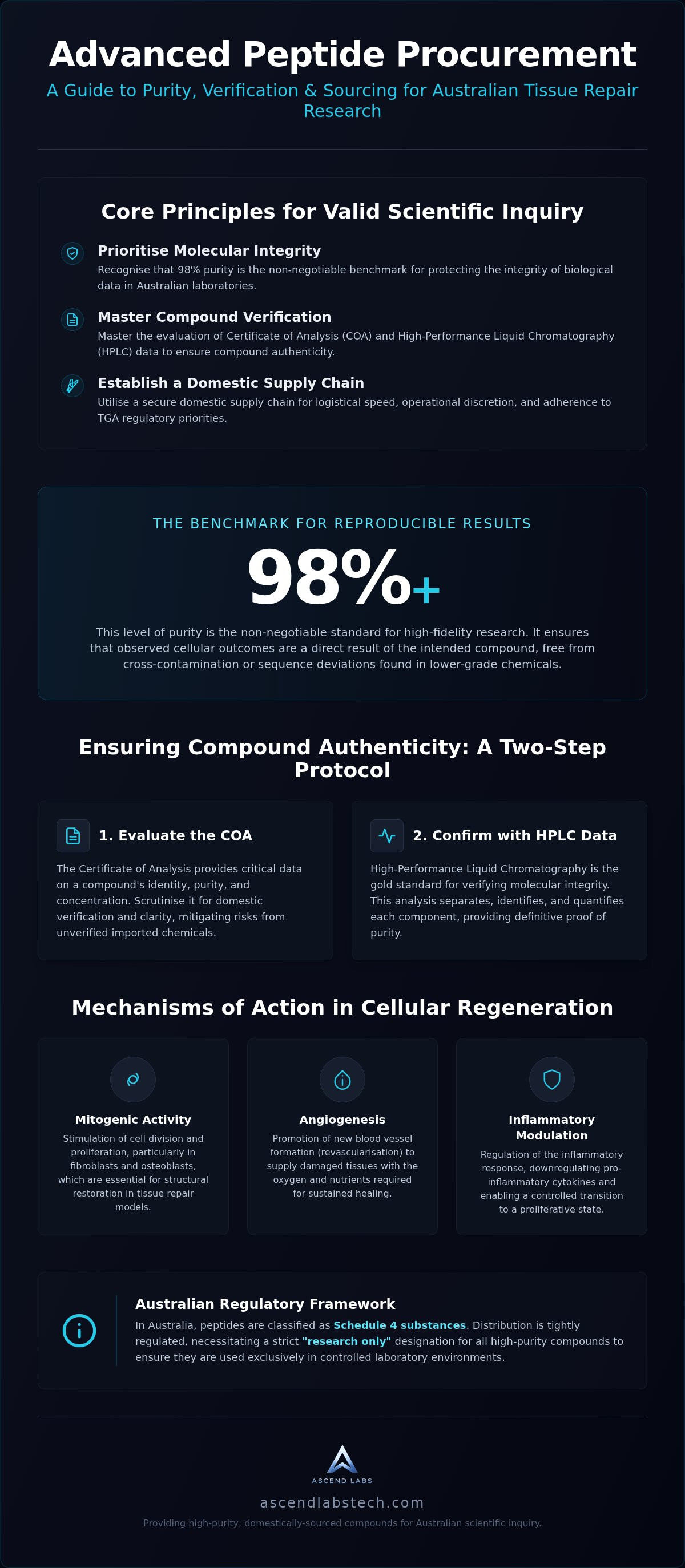
- Recognise why 98% purity remains the non-negotiable benchmark for protecting the integrity of biological data within Australian laboratories.
- Master the evaluation of COA and HPLC verification to ensure compound authenticity and mitigate the risks associated with unverified, imported chemicals.
- Establish a secure, domestic supply chain to ensure logistical speed and operational discretion for sensitive laboratory inquiries.
The Landscape of Peptides for Tissue Repair Research in Australia
Peptides are short-chain amino acid sequences that function as precise molecular messengers within biological systems. Unlike larger proteins, their smaller size allows for highly specific interactions with cellular receptors, making them invaluable tools for investigating regenerative pathways. In the current 2026 Australian biotechnology environment, there's a distinct shift toward targeted regenerative modelling. Researchers are moving away from broad-spectrum applications in favour of specific sequences that can modulate the extracellular matrix (ECM). This structural framework is vital for understanding how tissues respond to injury and how cellular environments can be manipulated to favour repair over scar formation.
Distinguishing between research-grade compounds and consumer-grade supplements is a primary requirement for any serious laboratory. While retail products often lack the necessary analytical verification, high-fidelity peptides for tissue repair research must meet stringent purity benchmarks to ensure experimental reproducibility. The 2026 landscape is defined by this commitment to molecular accuracy. It's no longer sufficient to simply possess a compound; the researcher must verify that the sequence is exactly as intended, free from the cross-contamination often found in lower-tier imported chemicals.
Molecular Signalling in Regenerative Science
At the cellular level, these compounds influence fibroblast proliferation and collagen synthesis in-vitro. Sequence specificity is paramount, as even a minor deviation in the amino acid chain can alter the research outcome or lead to unintended signalling cascades. For example, collagen hybridizing peptides are utilised to target and bind to denatured collagen strands, providing a window into the structural breakdown of the ECM. This level of precision allows for the mapping of damaged tissue with high resolution. The covalent peptide bond provides the fundamental structural stability required for these sequences to maintain integrity during 2026 laboratory protocols.
Research Applications vs. Clinical Use
The boundaries of laboratory-based research are strictly defined by both ethical frameworks and regulatory standards. In Australia, peptides are classified as Schedule 4 substances, which means their distribution is tightly regulated and possession without authorisation carries significant penalties. This necessitates a "research only" designation for high-purity compounds to ensure they're used exclusively in controlled environments for data collection. Investigating novel recovery sequences requires a disciplined approach to quality assurance. Ascend Labs acts as a gatekeeper in this space, providing research-grade peptides that meet the 98% purity benchmark required for valid scientific inquiry. By maintaining these standards, researchers can focus on cellular outcomes rather than questioning the integrity of their starting materials.
Mechanisms of Action in Cellular Regeneration and Recovery
Understanding the biological efficacy of peptides for tissue repair research requires a detailed analysis of cellular signalling. These compounds act as ligands, binding to specific cell-surface receptors to trigger downstream intracellular cascades. In regenerative models, the primary focus is often mitogenic activity. This process involves the stimulation of cell division, particularly in fibroblasts and osteoblasts, which are essential for structural restoration. By modulating these pathways, researchers can observe how molecular signals accelerate or inhibit the natural phases of recovery.
Angiogenesis represents another critical pillar in tissue repair studies. Without the formation of new blood vessels, or revascularisation, damaged tissues can't receive the oxygen and nutrients required for sustained healing. Research models often investigate how specific sequences promote vascular endothelial growth factor (VEGF) expression. Additionally, the modulation of the inflammatory response is vital. Effective repair isn't just about growth; it's about the controlled transition from an inflammatory state to a proliferative one. Key focus areas in these studies often include:
- Downregulation of pro-inflammatory cytokines such as TNF-alpha.
- Upregulation of anti-inflammatory signalling pathways.
- Recruitment of macrophage phenotypes conducive to structural repair.
Recent studies into cyclic peptides for wound healing highlight how structural stability enhances these interactions in-vitro. This stability is essential for maintaining the peptide's integrity long enough to interact with its intended target.
Growth Factor Signalling Pathways
Growth factor peptides are defined by their ability to mimic endogenous signalling molecules that govern cell growth and differentiation. MOTS-C, for instance, is a mitochondrial-derived peptide that regulates metabolic homeostasis and has shown significant potential in mitochondrial-derived repair signals. When these peptides interact with their cognate receptors, they often activate the MAPK/ERK or PI3K/Akt pathways, which are central to cellular survival. For a comprehensive breakdown of these mechanisms, consult our Growth Factor Peptides Australia: Scientific Research Guide. Securing high-purity sequences is essential for ensuring that these receptor interactions aren't confounded by impurities.
Metabolic Modulation and Repair
Modern research increasingly recognises the intersection of metabolic efficiency and tissue recovery. Compounds like Retatrutide, which function as GIP, GLP-1, and glucagon receptor agonists, are being studied for their impact on cellular stress. In-vitro models suggest that insulin sensitisation plays a fundamental role in how cells manage the energy demands of repair. This metabolic modulation ensures that cellular resources are prioritised for protein synthesis and structural integrity. Detailed technical data on these pathways can be found in our resource on Insulin Sensitising Peptide Research. For laboratories requiring verified compounds to explore these metabolic intersections, you can browse our research-grade catalogue to ensure your data remains robust and reproducible.
Evaluating Recovery Peptides vs. Growth Factor Peptides
Selecting the correct molecular framework is a prerequisite for generating valid data in peptides for tissue repair research. While the terms are often used interchangeably in retail contexts, the scientific distinction between growth factor sequences and metabolic agonists is significant. Growth factor peptides typically involve sequences that mimic endogenous proteins to stimulate mitogenic pathways and cellular proliferation. In contrast, metabolic agonists modulate the cellular environment, influencing insulin sensitisation and energy expenditure during the repair phase. Understanding these structural differences allows researchers to align their compound selection with the specific requirements of their biological models.
Suitability depends entirely on the tissue type being investigated. Connective tissues, such as tendons and ligaments, require sequences that prioritise extracellular matrix (ECM) stability. Muscle tissue models, however, focus on myogenic signalling and satellite cell activation. Modelling multi-peptide interactions in complex tissue systems is a growing trend in 2026, as researchers investigate the synergistic potential of combining structural repair sequences with metabolic modulators. This holistic approach reflects the multifaceted nature of biological recovery.
For Australian laboratories, a cost-benefit analysis reveals that high-purity compounds are a fiscal necessity. While lower-purity imports may seem cost-effective initially, the risk of confounding variables and discarded datasets far outweighs the upfront savings. Investing in 98% plus purity ensures that experimental results are a true reflection of the peptide's activity, not a reaction to residual contaminants.
Recovery Peptides for Connective Tissue Research
Research into connective tissue repair focuses heavily on the synthesis of Type I and Type III collagen. These structural proteins are the primary components of tendons and ligaments, which are notoriously slow to repair due to limited vascularity. Specialised recovery sequences are employed to model the acceleration of collagen cross-linking and fibroblast activity. By targeting these specific pathways, laboratories can observe the mechanical restoration of the ECM in-vitro. For a detailed technical analysis of these compounds, refer to our Peptides for Connective Tissue: 2026 Technical Roundup.
Growth Factors for Myogenic Studies
Myogenic research models prioritise the activation of satellite cells, which are the primary precursors to muscle fibre repair. Growth factor peptides influence the differentiation of myoblasts into mature muscle fibres, a process essential for investigating muscle atrophy and recovery. Within this category, compounds like KLOW and MOTS-C are frequently compared. While KLOW is often researched for its direct influence on myogenesis, MOTS-C provides a unique metabolic angle by supporting mitochondrial function during cellular stress. This distinction is vital for longevity-focused recovery research, where mitochondrial health is a key metric of success. Choosing between these sequences requires a disciplined understanding of whether the research goal is structural growth or metabolic efficiency.
Purity Standards and Verification in Australian Laboratories
A 98% purity benchmark isn't merely a preference; it's a scientific requirement for valid peptides for tissue repair research. In sensitive biological models, even a 2% variance can introduce confounding variables that compromise the integrity of your data. These impurities often consist of truncated sequences, residual solvents, or bacterial endotoxins that can trigger unintended inflammatory responses in-vitro. When investigating regenerative pathways, you must ensure that every observed cellular change is a direct result of the peptide sequence, not a reaction to a contaminant.
The Australian landscape for research chemical quality assurance is increasingly rigorous. Domestic procurement offers a significant advantage in maintaining cold-chain integrity, which is essential for preserving the secondary structure of delicate growth factor sequences. International transit often exposes compounds to fluctuating temperatures and prolonged customs delays, leading to peptide degradation. By sourcing domestically, researchers can ensure that the lyophilised powder arrives in its most stable form, ready for reconstitution and immediate application in recovery models.
Interpreting HPLC and Mass Spectrometry
Verifying compound integrity requires a sophisticated understanding of High-Performance Liquid Chromatography (HPLC) and Mass Spectrometry (MS). An HPLC report provides a visual representation of purity by displaying a primary peak; the area under this peak relative to secondary "noise" determines the purity percentage. Meanwhile, Mass Spectrometry confirms the molecular mass of the compound, ensuring the sequence has been synthesised correctly without amino acid deletions. For a detailed breakdown of these analytical methods, consult our Peptide Purity Testing Protocol. Detecting residual TFA (trifluoroacetic acid) or other salts is vital, as these can alter the pH of your culture media and distort experimental outcomes.
The Importance of the Certificate of Analysis (COA)
A legitimate Certificate of Analysis (COA) serves as the definitive record of a batch's chemical identity. It must explicitly state the batch number, the exact purity percentage, and the date of testing to be considered valid. Counterfeit or outdated documents are a persistent risk when dealing with unverified international vendors, often featuring generic data that doesn't correspond to the specific vial in your laboratory. Researchers should cross-reference the batch number on the vial with the COA to ensure total traceability. COA verification is the primary trust signal for Australian researchers because it provides a transparent, batch-specific record of chemical identity and purity.
Maintaining these standards is essential for anyone conducting peptides for tissue repair research within Australia. Operational discretion and meticulous documentation aren't just about compliance; they're about the pursuit of scientific truth. By prioritising verified domestic supply, you protect your research from the inconsistencies that plague the broader market.
Sourcing High-Purity Compounds from Ascend Labs
Ascend Labs functions as a disciplined curator for the Australian scientific community, providing clinical-grade purity for practitioners who value substance over style. By focusing exclusively on the domestic market, we eliminate the volatility and potential for degradation associated with international procurement. This ensures that your peptides for tissue repair research are delivered with their molecular integrity intact, meeting the rigorous standards required for 2026 laboratory protocols. Our commitment to transparency means we don't just act as a vendor; we operate as a principled institution dedicated to the integrity of your results.
Navigating our catalogue allows researchers to access a specialised selection of metabolic and regenerative compounds. Whether your research focuses on myogenic signalling or connective tissue repair, the compounds provided are strictly for laboratory use only. We maintain a sophisticated focus on growth factor and recovery peptides, ensuring that every vial meets the non-negotiable 98% purity benchmark. This level of precision is essential for ensuring that experimental outcomes are reproducible and free from the confounding variables introduced by lower-quality alternatives.
The Ascend Labs Quality Protocol
Our operational standards are built on a foundation of scientific truth. Every sequence in our catalogue undergoes meticulous batch testing, including High-Performance Liquid Chromatography (HPLC) and Mass Spectrometry (MS) to verify purity and molecular mass. This third-party verification isn't a secondary consideration; it's the core of our quality assurance process. Organising laboratory procurement through a specialised Australian boutique allows for a level of oversight that larger, international vendors cannot match. Researchers can explore the full Ascend Labs product range, which includes specialised sequences like Retatrutide, Tirzepatide, and MOTS-C, to identify the specific growth factors or recovery compounds required for their unique modelling needs.
Logistics and Operational Discretion
Speed and security are the hallmarks of our domestic-only supply chain. By bypassing international customs, we remove the risk of temperature fluctuations and prolonged delays that often degrade sensitive peptides. Our logistics framework is designed for efficiency, ensuring that your materials arrive promptly and in optimal condition across Australia. Operational discretion is equally paramount. We employ discreet packaging protocols to protect the privacy of your inquiry and the integrity of your research materials. This methodical approach ensures that you can focus entirely on your data, confident in the reliability of your supply chain.
Compliance with Australian laboratory research standards is a non-negotiable aspect of our operation. We act as an authoritative gatekeeper, ensuring that all compounds meet the meticulous verification standards discussed in this guide. By prioritising domestic procurement, you align your laboratory with a partner that values precision and operational integrity above all else. Secure your research compounds through a trusted Australian partner to ensure your peptides for tissue repair research remain at the forefront of the field.
Advancing Regenerative Modelling with Molecular Precision
The success of contemporary recovery studies depends on the uncompromising quality of the molecular signals employed. We've established that maintaining a 98% purity benchmark is the only way to ensure experimental reproducibility and protect the integrity of your biological datasets. By prioritising domestic procurement, you bypass the structural degradation and logistical delays inherent in international transit. This choice secures the cold-chain integrity of your sequences, allowing you to focus on cellular outcomes rather than compound variability.
Ascend Labs remains the authoritative gatekeeper for the Australian scientific community, providing COA and HPLC verified batches for every inquiry. Our operation is 100% Australian owned and operated, ensuring that your peptides for tissue repair research are handled with the meticulous care your laboratory requires. Through secure domestic shipping and operational discretion, we provide the foundational reliability needed for advanced inquiry.
Your commitment to scientific truth deserves a partner that values precision as deeply as you do. We look forward to supporting your next breakthrough in regenerative science.
Frequently Asked Questions
What are the primary peptides for tissue repair research in 2026?
The primary sequences include Growth Factor Peptides and Recovery Peptides, alongside specific compounds like KLOW and MOTS-C. These are utilised to investigate mitogenic signalling and the modulation of the extracellular matrix in laboratory models. In 2026, researchers are increasingly focused on targeted sequences that offer high specificity for cellular regeneration. Selecting the correct sequence is a prerequisite for generating valid data in peptides for tissue repair research and ensuring experimental reproducibility across multiple study phases.
How do growth factor peptides differ from metabolic recovery compounds?
Growth factor peptides primarily influence cellular proliferation and differentiation through mitogenic pathways. In contrast, metabolic recovery compounds like Retatrutide and Tirzepatide modulate cellular energy efficiency and insulin sensitisation during periods of metabolic stress. While growth factors are researched for structural growth, metabolic agonists focus on the energy demands of repair. Distinguishing between these two categories allows laboratories to select the most relevant molecular framework for their specific tissue repair frameworks.
Why is HPLC verification critical for Australian research laboratories?
High-Performance Liquid Chromatography (HPLC) verification ensures that a compound meets the non-negotiable 98% purity standard. For Australian laboratories, this data is essential to confirm that experimental results aren't confounded by residual solvents or truncated sequences. Using unverified materials introduces variables that can compromise the integrity of biological models. Meticulous HPLC reporting provides a transparent trust signal, allowing researchers to proceed with the confidence that their starting materials are chemically authentic.
Can these peptides be used for human clinical trials in Australia?
These compounds are strictly for laboratory and scientific research purposes only. In Australia, they are not approved for human consumption, clinical trials, or as prescription medications. Using these research-grade chemicals outside of a controlled laboratory environment carries significant legal and safety risks. Ascend Labs acts as a disciplined gatekeeper, providing high-purity compounds exclusively for in-vitro or animal-based research models to ensure total compliance with national regulatory standards and ethical frameworks.
What is the standard shipping timeframe for research peptides within Australia?
Standard domestic shipping timeframes apply, as Ascend Labs operates a strictly Australian-only supply chain. This domestic focus eliminates the prolonged delays and temperature fluctuations often associated with international customs processing. Most research materials are dispatched promptly to maintain the integrity of the lyophilised powder. By avoiding international transit, laboratories receive their compounds in optimal condition, ensuring that the secondary structure of the peptides remains stable for immediate reconstitution and research application.
How should research peptides be stored to maintain molecular integrity?
Lyophilised peptides should be stored in a freezer at -20°C to ensure long-term molecular stability. Exposure to moisture and light must be minimised to prevent degradation of the amino acid chain. Once a compound is reconstituted, it should be kept refrigerated and used within a short timeframe. It's vital to avoid repeated freeze-thaw cycles, as this process can break the delicate peptide bonds and render the research material useless for precise modelling.
What are the common contaminants to look for in a peptide COA?
Researchers should scrutinise Certificates of Analysis for residual trifluoroacetic acid (TFA), truncated amino acid sequences, and bacterial endotoxins. Truncated sequences occur when amino acids are deleted during synthesis, resulting in an incorrect molecular mass. A legitimate COA uses Mass Spectrometry to verify that the synthesised peptide matches the intended sequence exactly. Detecting these contaminants is essential, as even minor impurities can trigger unintended inflammatory responses in sensitive peptides for tissue repair research.
Are there specific peptides better suited for connective tissue vs. muscle research?
Recovery Peptides are typically researched for their influence on Type I and Type III collagen synthesis within connective tissues like tendons. Conversely, Growth Factor Peptides such as KLOW are better suited for myogenic studies focusing on satellite cell activation and muscle fibre repair. Identifying the primary tissue type in the research model is a prerequisite for selecting the correct peptide. This ensures that the molecular signalling matches the biological requirements of the structural repair being investigated.


