

A single millimetre of sub-par glass or a low-grade rubber stopper can quietly compromise months of meticulous laboratory work. While much of the focus in biotechnology remains on the purity of the compound itself, the vessel that contains it often determines the success or failure of a study. Most researchers understand that maintaining consistent results requires more than just high-quality reagents; it demands a total elimination of environmental variables. It's a common frustration to see a promising study falter because of unpredictable peptide adsorption or contamination from inferior seals that leach chemicals into the solution.
This guide provides the technical framework needed to master peptide stability after reconstitution australia, ensuring your research yields precise and repeatable data. You'll learn why Type I borosilicate glass is the non-negotiable standard for preventing chemical leaching and how to protect your compounds from the hidden risks of surface binding. We'll examine the specific requirements for sterile storage in the current Australian regulatory environment and outline how to secure a laboratory-grade supply chain that preserves the integrity of your most sensitive metabolic research compounds throughout 2026 and beyond.
Key Takeaways
- Understand why Type I Borosilicate glass is the mandatory standard for preventing chemical leaching and ensuring thermal shock resistance in laboratory settings.
- Discover specific protocols to maximise peptide stability after reconstitution australia, including pressure equalisation techniques and meticulous vial surface preparation.
- Learn to identify high-quality, self-healing septums that prevent oxidation and contamination during the repeated sampling required for long-term studies.
- Evaluate the technical benefits of a domestic Australian supply chain for maintaining the cold chain and ensuring the integrity of metabolic research compounds.
- Master the selection of specialised sterile equipment to eliminate variables caused by peptide adsorption, ensuring that your data remains precise and repeatable.
The Critical Role of Sterile Vials in Peptide Stability
Within the rigorous framework of in-vitro research, a sterile vial is defined as a primary packaging system that has undergone validated sterilisation processes to eliminate all viable microorganisms. For metabolic research compounds like Tirzepatide or MOTS-C, the vessel is just as critical as the reagent itself. Peptides are inherently delicate; their amino acid sequences are susceptible to environmental stressors that don't affect more robust chemical compounds. When a compound is housed in a sub-par container, the risk of structural compromise increases exponentially.
The primary threats to peptide stability after reconstitution australia include oxidation, UV degradation, and bacterial contamination. Even brief exposure to atmospheric oxygen or specific light wavelengths can trigger peptide cleavage or folding errors. If the container introduces even trace impurities, conducting accurate peptide purity testing becomes nearly impossible. Any data gathered from a contaminated sample is effectively void, as the researcher cannot distinguish between the purity of the original compound and the degradation caused by the storage environment.
Understanding Peptide Adsorption: The Silent Data Killer
Peptides often possess hydrophobic regions that naturally gravitate toward the polar surfaces of standard soda-lime glass. This phenomenon, known as adsorption, causes the molecules to "stick" to the vial walls rather than remaining in the solution. In studies involving low-concentration solutions, this can reduce the effective concentration by a significant margin. It's a silent variable that invalidates dosing protocols and skews longitudinal data. Using low protein binding (LPB) glass is a non-negotiable requirement to ensure that the peptide remains bioavailable within the liquid medium.
Maintaining Sterility in Long-Term Longitudinal Studies
Achieving meaningful data in long-term studies requires more than just "sterile-packed" equipment. Advanced research protocols demand vials manufactured in ISO-certified cleanrooms to ensure the absence of pyrogens and endotoxins. Australian researchers should verify the sterility certificates of their equipment to ensure compliance with the AS 5369:2023 standards. Maintaining this level of control is vital for peptide stability after reconstitution australia, as any breach in the seal or microscopic contaminant can lead to rapid microbial growth. A disciplined approach to sourcing ensures that the storage environment remains as pristine as the research compound it holds.
Material Science: Why Borosilicate Glass is Essential for Peptides
While standard soda-lime glass, or Type III glass, is sufficient for many pharmaceutical applications, it presents significant risks in a research environment. Soda-lime glass is prone to alkali leaching, which can cause subtle but damaging shifts in the pH of the solution. For delicate amino acid chains, even a minor increase in alkalinity can lead to denaturation or unwanted chemical reactions. Type I borosilicate glass, by contrast, is engineered for chemical neutrality and provides an inert environment that protects the structural integrity of the compound.
Thermal shock resistance is another critical factor. Most laboratory protocols involve storing lyophilised peptides at -20°C or colder, then bringing them to room temperature for reconstitution. Type I glass has a remarkably low expansion coefficient. This ensures that the vial does not crack and that the seal remains airtight during extreme temperature transitions. Achieving consistent peptide stability after reconstitution australia depends on this physical resilience, as a compromised seal introduces oxygen and moisture that accelerate degradation.
Type I Borosilicate: The Laboratory Gold Standard
The primary advantage of Type I glass lies in its high boron oxide content, which virtually eliminates the risk of ion exchange with the liquid medium. This stability is essential for maintaining the precise concentration of high-purity research compounds over several weeks of study. While Section 1 highlighted the risks of adsorption, the material science of Type I glass provides the solution; its smooth, non-reactive surface reduces the binding sites available to hydrophobic amino acids. Borosilicate Type I glass is the mandatory choice for high-purity peptide research.
Amber Glass and UV Protection for Mitochondrial Peptides
Certain sequences, particularly those studied in mitochondrial peptide research, are highly susceptible to photodegradation. Peptides like MOTS-C can undergo structural changes when exposed to specific UV wavelengths. High-quality amber vials filter out harmful light, providing a secondary layer of protection beyond the refrigerator door. The choice between amber and clear glass often involves a trade-off between visibility and protection. While clear glass allows for easy visual inspection, amber is essential for any compound where UV exposure could compromise the data. Adhering to peptide handling and storage best practices involves selecting the correct glass colour based on the specific light sensitivity of the compound being analysed.
Stopper and Seal Selection: Preventing Contamination and Oxidation
The closure system acts as the final barrier between a high-purity compound and the oxidative atmosphere. While the glass protects the solution from leaching, the stopper prevents the ingress of oxygen and moisture. For researchers managing peptide stability after reconstitution australia, the choice of elastomer is a critical technical decision. A high-quality septum must facilitate multiple needle draws without compromising the internal environment. If the seal fails, the integrity of the entire study is lost to contamination.
Coring remains a persistent risk when using high-gauge needles for frequent sampling. This fragmentation occurs when the needle shears off a small piece of the stopper, which then falls into the solution. Using self-healing, laboratory-grade stoppers minimises this risk. These specialised materials are engineered to maintain their structural integrity even after repeated punctures. This ensures the hermetic seal remains intact throughout the duration of the study, preventing the introduction of microscopic contaminants.
Butyl vs. Silicone: Choosing the Right Chemical Barrier
Butyl rubber is the preferred elastomer for peptide research due to its exceptionally low gas permeability. In contrast, silicone stoppers, while highly flexible, allow for significantly higher rates of oxygen transmission. This ingress can lead to the rapid oxidation of sensitive amino acid residues. To achieve the highest degree of chemical inertness, many laboratories utilise Teflon-faced (PTFE) stoppers. This fluoropolymer coating provides a physical barrier that prevents any potential interaction between the peptide solution and the base elastomer, ensuring the compound remains pristine.
The Mechanics of a Perfect Hermetic Seal
A true hermetic seal requires more than just a rubber insert; it demands precise crimp pressure. If the aluminium seal is too loose, evaporation can occur, leading to unintended shifts in concentration. Conversely, excessive pressure can distort the stopper and create microscopic gaps. Aluminium flip-off caps provide essential tamper-evidence and protect the septum surface from dust and laboratory contaminants until the moment of reconstitution. For compounds stored in a freeze-dried state, specialised lyophilisation stoppers with a "three-prong" design are used to allow vapour to escape during the drying process before being fully seated under vacuum. This meticulous attention to the sealing process is a fundamental requirement for maintaining peptide stability after reconstitution australia.
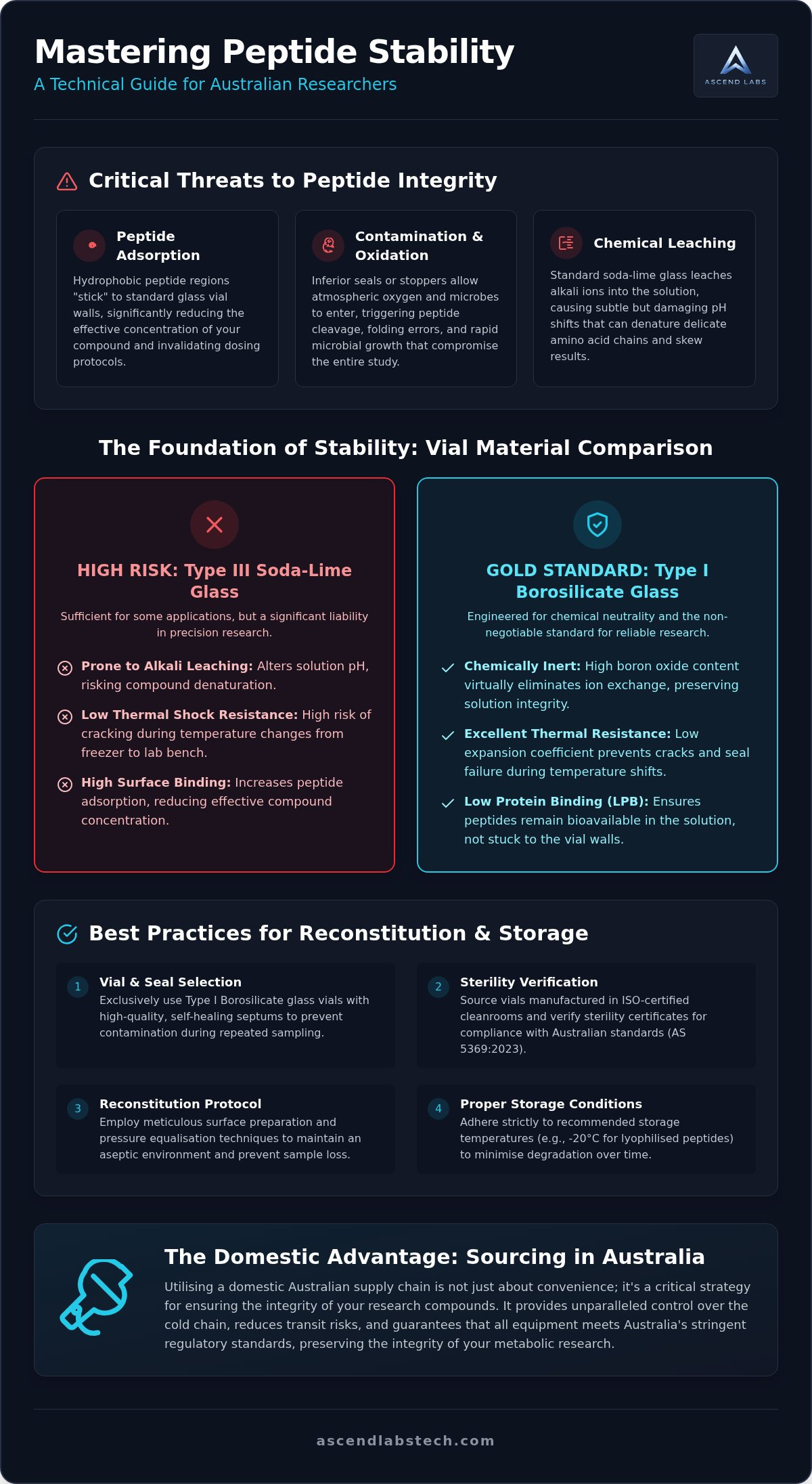
Best Practices for Reconstitution and Storage in Australian Labs
Precision in the laboratory environment is not limited to the compound; it extends to the manual handling of the vessel. Achieving maximum peptide stability after reconstitution australia requires a disciplined protocol that begins the moment a vial is removed from cold storage. Before any needle insertion, the septum surface must be treated as a potential site for cross-contamination. Even a microscopic breach during the draw can compromise the sterile internal environment and invalidate a longitudinal study. A systematic approach to handling ensures that the compound remains as stable as the material science intended.
One often overlooked aspect of vial management is the internal pressure. Many research compounds are sealed under a partial vacuum during the lyophilisation process. Introducing a solvent without equalising the pressure can cause a sudden, violent influx of liquid that may physically damage the peptide's delicate molecular structure. Conversely, a positive pressure build-up can lead to aerosolisation upon needle withdrawal, posing a risk to the researcher and the sample. Balancing these forces is a fundamental technical requirement for maintaining consistent data across multiple draws.
Reconstitution Protocols for Maximum Stability
- Step 1: Sanitise the septum with 70% isopropyl alcohol. Allow the surface to air dry completely to ensure no residual alcohol is introduced into the vial via the needle.
- Step 2: Introduce the bacteriostatic water or specialised solvent slowly. Aim the needle toward the vial wall so the liquid trickles down rather than splashing directly onto the lyophilised cake.
- Step 3: Swirl the vial with a gentle circular motion. Never shake the container, as the resulting kinetic energy can cause peptide shearing and lead to irreversible denaturation.
Handling the Australian Climate: Humidity and Heat Factors
Australia’s environmental conditions, particularly high ambient humidity in coastal regions, present unique challenges for storage. When a cold vial is moved to a warm lab bench, condensation forms rapidly on the exterior glass. If this moisture seeps under the aluminium flip-off seal, it can promote microbial growth on the septum surface. Utilising secondary containment, such as a sealed desiccated container within the laboratory fridge, provides a critical buffer against these atmospheric fluctuations. Proper labelling is also essential; use moisture-resistant labels that do not require aggressive adhesives, ensuring the glass integrity is never compromised by chemical residues or physical scratching.
Adhering to these handling standards is the only way to ensure peptide stability after reconstitution australia remains within the required parameters. By treating the vial as an active component of the research rather than a passive container, laboratories can eliminate the variables that lead to inconsistent results and lost resources.
Sourcing Research-Grade Equipment and Compounds in Australia
Securing high-specification equipment is the final variable in the research equation. Even with the most disciplined laboratory protocols, a study's success rests on the reliability of the supply chain. For those managing peptide stability after reconstitution australia, the choice of supplier is a strategic decision that affects data repeatability. A "substance over style" approach to procurement prioritises technical transparency and verified quality assurance over retail-centric marketing. This disciplined focus ensures that the storage environment matches the calibre of the compounds being investigated.
Vetting a supplier requires a look beyond the digital storefront. A reliable partner acts as a scientific gatekeeper, providing detailed technical specifications for every component, from the glass type to the elastomer composition of the stoppers. This transparency is vital for maintaining peptide stability after reconstitution australia, as it allows researchers to account for every potential interaction within the vial. When the supply chain is transparent, the risk of unverified variables skewing your data is virtually eliminated.
Domestic Supply vs. International Imports
International procurement introduces significant risks to the cold chain. Packages often languish in customs facilities where temperatures are unregulated, potentially exposing sensitive materials to extreme Australian heat. These delays can trigger early degradation in lyophilised compounds before they even reach the laboratory. Sourcing from Australian-owned suppliers like Ascend Labs ensures that research continuity is maintained through managed domestic logistics. Domestic shipping provides tracked, discreet, and rapid transit, which is essential for preserving the integrity of metabolic research compounds in a climate that is often unforgiving to biological reagents.
Aligning Vial Quality with Compound Purity
Investing in high-purity sequences like Retatrutide while using low-grade storage vessels is a false economy. If the container leaches alkali or allows oxygen ingress, the purity of the compound becomes irrelevant. The storage system must be viewed as an extension of the reagent itself. By reviewing the Ascend Labs product catalogue, researchers can align their compound requirements with verified laboratory standards. As you prepare for a new study in 2026, ensure your checklist includes the following:
- Verification of Type I Borosilicate glass for all primary vessels.
- Procurement of Butyl rubber stoppers with PTFE facing.
- Confirmation of domestic, temperature-controlled shipping routes.
- Validation of sterility certificates for all specialised vials and seals.
Maintaining this level of rigor in procurement is the only way to safeguard your research. It ensures that every milligram of the compound is preserved, allowing for the precise, repeatable data that modern biotechnology demands.
Advancing Precision in Australian Biotechnology
The transition from lyophilised powder to liquid solution represents the most vulnerable phase of any biochemical study. Achieving consistent peptide stability after reconstitution australia requires a holistic approach that integrates material science with meticulous laboratory protocols. By prioritising Type I Borosilicate glass and specialised butyl stoppers, researchers effectively eliminate the silent variables of adsorption and oxidation that frequently derail longitudinal data.
These technical requirements aren't merely suggestions; they're the foundational standards of modern biotechnology. A disciplined focus on the storage environment ensures that the structural integrity of your compounds remains intact from the first draw to the final analysis. Aligning your procurement with these specialised research-grade standards protects your investment and ensures that your findings are both precise and repeatable.
Maintaining this level of rigor within the Australian research community fosters a culture of transparency and scientific truth. With a reliable domestic supply chain and an authoritative scientific focus, your laboratory remains equipped to lead the next generation of metabolic inquiry with absolute confidence.
Frequently Asked Questions
What is the difference between Type I and Type III glass vials for research?
Type I borosilicate glass is the mandatory standard for high-purity research due to its chemical neutrality and resistance to thermal shock. Unlike Type III soda-lime glass, it does not leach alkali ions into the solution, which prevents the pH shifts that can denature sensitive compounds. This material integrity is vital for maintaining peptide stability after reconstitution australia, as it ensures the vessel remains an inert container throughout the duration of the laboratory study.
Can I reuse sterile vials for multiple peptide studies?
Reusing sterile vials is strictly prohibited in professional laboratory settings due to the high risk of cross-contamination. Once a seal is breached and a vial is used for one compound, the internal environment is no longer guaranteed to be sterile or chemically pristine. Residues from previous studies can interfere with the purity of new reagents, leading to inconsistent data. Always utilise fresh, ISO-certified vials for each new study to maintain rigorous quality assurance standards.
Why do my peptides keep sticking to the side of the glass vial?
Peptides often adhere to glass surfaces through a process called adsorption, where hydrophobic regions of the amino acid chain bind to the polar surface of the vial. This sticking can significantly reduce the effective concentration of the solution, skewing research results. To mitigate this, researchers should select low protein binding (LPB) borosilicate glass. This choice ensures that the compound remains in the liquid medium rather than binding to the container walls during long-term storage.
How much bacteriostatic water can a 10ml sterile vial safely hold?
A 10ml sterile vial is designed to hold 10ml of liquid, but it's essential to leave a small amount of headspace for pressure equalisation. Filling the vial to its absolute capacity can make it difficult to manage the internal vacuum during the reconstitution process. Proper headspace allows for the gentle introduction of bacteriostatic water or solvents. This prevents the physical shearing of delicate sequences and supports overall peptide stability after reconstitution australia by allowing for safe pressure management.
Are flip-off caps necessary for research-grade sterile vials?
Aluminium flip-off caps are a fundamental requirement for maintaining the sterility of the septum surface. They provide a physical barrier against dust and laboratory contaminants until the exact moment of needle insertion. Additionally, these caps offer clear tamper-evidence, ensuring that the vial has remained sealed since leaving the manufacturing facility. For high-purity research involving compounds like Tirzepatide or Retatrutide, these caps are essential for preserving the integrity of the storage environment.
What happens if a sterile vial is exposed to direct sunlight in the lab?
Exposure to direct sunlight can cause rapid photodegradation of sensitive amino acid sequences. UV radiation triggers chemical changes, such as oxidation or peptide cleavage, which irreversibly alter the structural integrity of the compound. In an Australian laboratory environment, where light intensity can be high, this exposure can invalidate a study within hours. Always store reconstituted vials in a dark, temperature-controlled environment or utilise high-quality amber glass to filter out harmful UV wavelengths.
How do I know if the seal on my sterile vial has been compromised?
A compromised seal is often indicated by a loose aluminium cap, visible signs of evaporation, or the presence of unexpected particulates in the solution. If the crimp pressure was insufficient, moisture from the atmosphere can enter the vial, leading to premature degradation. Researchers should also inspect the septum for signs of coring or fragmentation after multiple draws. Any doubt regarding the hermetic integrity of the seal should lead to the immediate disposal of the sample.
Is it better to store reconstituted peptides in clear or amber vials?
Amber vials are superior for light-sensitive research peptides, such as MOTS-C, as they provide an essential layer of UV protection. While clear vials allow for easy visual inspection of the solution's clarity and the presence of any undissolved particulates, they offer no defence against photodegradation. For most metabolic research compounds, amber glass is the safer choice to ensure long-term stability. Clear vials should only be used if the compound is known to be light-stable.


