

The integrity of a longitudinal study depends entirely on the molecular precision of the compounds involved. Within the evolving sphere of metabolic function research peptides australia, the margin for error has narrowed as investigators move toward complex triple agonists and mitochondrial-derived peptides. You likely understand the frustration of a stalled project caused by batch-to-batch inconsistency or the opaque documentation that often accompanies international shipments. These variables don't just delay timelines; they compromise the data that underpins scientific progress.
We recognise that securing a reliable, domestic supply of HPLC-verified compounds is essential for maintaining rigorous laboratory standards. This 2026 technical overview provides a comprehensive analysis of high-purity peptides, focusing on the mechanistic differences between emerging agonists and the necessity of transparent verification. We will examine the specific characteristics of triple GLP-1/GIP/glucagon agonists, the role of mitochondrial compounds such as MOTS-c, and the rigorous testing protocols required to ensure your in-vitro analysis remains accurate and reproducible.
Key Takeaways
- Analyse the foundational role of metabolic function research peptides australia in investigating cellular energy regulation and glucose homeostasis within in-vitro environments.
- Compare the technical profiles of dual and triple receptor agonists, focusing on the sophisticated multi-receptor interaction of Retatrutide for advanced metabolic studies.
- Evaluate the specific mechanisms of mitochondrial-derived peptides like MOTS-C and KLOW in regulating cellular metabolism and senescence.
- Define the essential verification standards, including HPLC and Mass Spectrometry, required to ensure the purity and molecular identity of research-grade compounds.
- Understand how domestic sourcing within Australia maintains cold-chain integrity and eliminates the risks associated with international customs delays.
Defining the Scope of Metabolic Function Research Peptides in Australia
Metabolic function research peptides australia represent a sophisticated class of laboratory compounds designed to interrogate complex biological systems. These amino acid sequences are utilised exclusively in scientific research to investigate cellular energy regulation and specific metabolic pathways. By Defining the Scope of Metabolic Function Research Peptides, we establish a foundation for understanding how these molecules interact with endocrine receptors to influence homeostasis. High-purity peptide sequences allow for the precise study of glucose homeostasis and lipid metabolism in-vitro; this precision ensures that data remains untainted by the batch-to-batch inconsistency often found in lower-grade research chemicals.
To better understand the broader context of peptide research in the Australian landscape, watch this helpful video:
Primary Pathways in Modern Metabolic In-Vitro Studies
Modern laboratory investigation focuses heavily on the agonism of GLP-1 and GIP receptors. These pathways are critical for understanding cellular responses to nutrient intake and energy expenditure. Beyond traditional hormones, researchers are increasingly exploring mitochondrial-derived peptides and their direct impact on cellular energetics. This includes studying how specific sequences might influence mitochondrial biogenesis or cellular senescence. The shift towards multi-pathway agonism allows for comprehensive metabolic profiling, reflecting the interconnected nature of biological systems rather than viewing metabolic pathways in isolation.
The Australian Scientific Context for Peptide Procurement
The regulatory landscape in Australia is precise and requires strict adherence to scientific standards. While many peptides fall under Schedule 4 classifications, their application in a non-therapeutic, laboratory setting necessitates a disciplined approach to procurement. Domestic supply is critical for laboratory logistics. It ensures compound stability by avoiding the unpredictable environmental stressors and customs delays often found in international transit. Maintaining an ethical "Research Use Only" position is a requirement for the scientific community. It ensures that these high-purity compounds are used solely for serious inquiry and in-vitro analysis. For investigators seeking verified sequences, the available range of research compounds provides the necessary technical specifications for high-end metabolic study.
Triple Agonist and Multi-Receptor Agonism in Metabolic Research
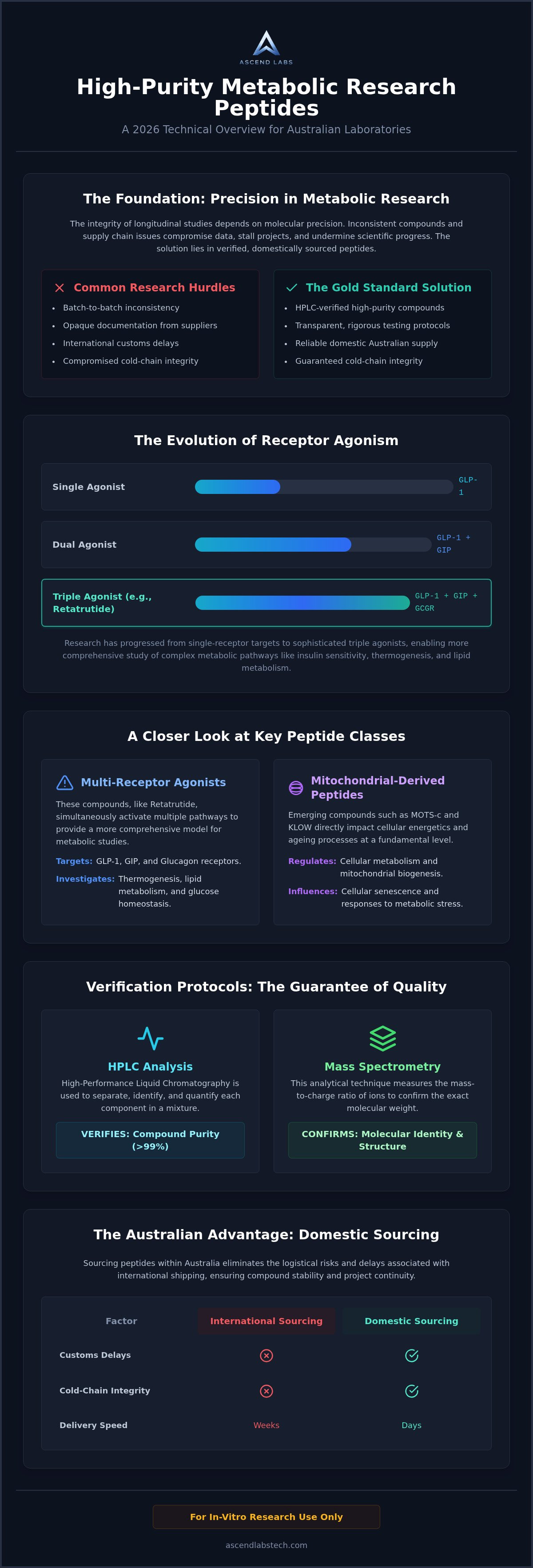
The landscape of metabolic function research peptides australia has transitioned from single-receptor targets to sophisticated multi-receptor agonists. This evolution reflects a deeper understanding of how concurrent pathway activation mimics complex physiological states. Whilst traditional agonists focused solely on the GLP-1 receptor, contemporary investigations now prioritise the synergistic effects of dual and triple agonism. These interactions are vital for exploring insulin sensitivity and the up-regulation of fatty acid oxidation in-vitro. Institutions like The Florey Institute's Insulin Peptides Group exemplify the high-level inquiry required to map these pathways effectively within the Australian scientific community.
Retatrutide: The Frontier of Triple Agonist Research
Retatrutide represents the current pinnacle of this multi-receptor approach. As a triple agonist, it targets the GIP, GLP-1, and glucagon (GCGR) receptors simultaneously. The inclusion of glucagon receptor agonism is particularly significant; it allows researchers to investigate thermogenesis and lipid metabolism in ways that dual agonists cannot replicate. This triple-action mechanism provides a more comprehensive model for studying energy expenditure and cellular metabolic shifts. For a detailed analysis of this compound, investigators should review Retatrutide: The Frontier of Triple Agonist Research in Australia.
Tirzepatide and GIP/GLP-1 Receptor Agonism
Tirzepatide remains a foundational dual agonist within metabolic research models. By activating both GIP and GLP-1 receptors, it provides a robust framework for studying nutrient-stimulated insulin secretion and glucose-dependent pathways. Researchers often utilise this compound as a benchmark for comparing the efficacy of newer triple agonists in laboratory settings. The synergy between these two receptors has been a primary focus for understanding glucose homeostasis over the last decade. More information on these specific interactions can be found in the GIP Receptor Agonist Research Compounds technical overview.
Investigating these complex interactions requires uncompromising purity. Even minor batch inconsistencies can lead to skewed data when multiple receptors are being activated simultaneously. High-purity compounds verified through HPLC and Mass Spectrometry are essential for maintaining the integrity of your metabolic function research peptides australia. You can browse our curated selection of metabolic research compounds to ensure your laboratory standards are met with precision and reliability.
Mitochondrial-Derived Peptides and Cellular Metabolic Regulation
Mitochondrial-derived peptides (MDPs) represent a distinct and highly specialised category within metabolic function research peptides australia. Unlike traditional hormone-mimicking metabolic agonists that primarily target extracellular receptors, MDPs originate directly from the mitochondrial genome. They function through a unique "Signal, Regulate, Adapt" framework. These molecules act as retrograde signals to the nucleus, regulate gene expression related to energy homeostasis, and allow the cell to adapt to environmental stressors. This intracellular mechanism of action makes them indispensable for investigators studying the fundamental drivers of metabolic efficiency and organelle health.
Longevity and healthspan research has gained significant traction in the Australian scientific landscape. Researchers are moving beyond simple glucose regulation to examine how mitochondrial integrity influences systemic metabolic decline. MDPs provide a direct pathway to investigate these processes, offering a level of cellular specificity that traditional peptides cannot replicate. High-purity MDP sequences are essential for maintaining the integrity of these complex in-vitro models.
MOTS-C: Investigating Exercise-Mimetic Mechanisms
MOTS-C (Mitochondrial Open Reading Frame of the 12S rRNA-c) is frequently utilised to investigate exercise-mimetic properties in laboratory settings. Research protocols often focus on its ability to enhance insulin sensitivity and promote metabolic flexibility. By facilitating mitochondrial-nuclear communication, MOTS-C allows researchers to observe how cells adapt to nutrient stress and energetic demands. This makes it a primary candidate for studies involving skeletal muscle metabolism and lipid oxidation. For those establishing precise laboratory protocols, Purchase MOTS-C Australia: A Technical Resource provides the necessary procurement specifications for high-end inquiry.
KLOW and Anti-Ageing Metabolic Research
KLOW is another emerging compound prioritised for investigating cellular senescence and metabolic decline. Its mechanism of action is central to metabolic protection studies, specifically those focusing on cellular recovery after oxidative stress. While MOTS-c is often the preferred choice for studying energetic flexibility, KLOW is frequently selected for its potential in anti-ageing metabolic research. It helps investigators understand how cells maintain metabolic integrity and resist senescence-related dysfunction over time. A detailed comparison of these two compounds is available in the KLOW vs MOTS-C Research Comparative Analysis. The shift towards these organelle-specific compounds marks an important milestone for metabolic function research peptides australia, as it allows for a more holistic understanding of metabolic health at the cellular level.
Verification Protocols for Australian Research Grade Peptides
Precision in metabolic function research peptides australia requires a verification framework that extends beyond surface-level purity claims. The complex nature of multi-receptor agonists and mitochondrial compounds means that even minor molecular deviations can lead to skewed laboratory results. High-purity sequences are the bedrock of reliable data; they ensure that the biological responses observed in-vitro are the result of the intended peptide interaction rather than residual contaminants or synthesis by-products. For the serious investigator, a robust verification protocol is not merely a preference but a fundamental requirement for scientific integrity.
A comprehensive Certificate of Analysis (COA) serves as the primary instrument for laboratory quality assurance. This document must provide transparent data on the specific batch being utilised, allowing researchers to verify that the compound meets the stringent requirements of their study. Batch-to-batch consistency is the hallmark of a reputable Australian supplier. It ensures that longitudinal studies remain valid and that results can be replicated across different phases of research without the interference of compound volatility.
Interpreting HPLC and Mass Spectrometry Results
High-Performance Liquid Chromatography (HPLC) is the essential tool for determining the purity of a peptide sequence. It functions by separating the target molecule from any impurities, providing a precise percentage of the intended compound within the sample. However, purity alone is insufficient. Mass Spectrometry (MS) must be used in tandem to confirm the molecular identity. By measuring the accurate mass of the peptide, MS ensures the sequence is exactly what was synthesised. Researchers should look for sharp, defined peaks in HPLC reports and mass-to-charge ratios that align perfectly with theoretical values. For a deeper understanding of these metrics, investigators can refer to Peptide Purity Testing: A Professional Protocol.
The Importance of Third-Party Verification
Independent testing provides an unbiased layer of security that manufacturer-provided data cannot replicate. For sensitive metabolic assays, ensuring a purity standard of ≥99% is critical to prevent cross-reactivity or cellular toxicity from residual solvents. Third-party verification establishes trust through transparency; it offers an objective confirmation that the compounds meet the advertised technical specifications. This meticulous approach to documentation allows Australian laboratories to maintain the highest standards of inquiry while mitigating the risks associated with unverified or inconsistently produced research chemicals.
Sourcing High-Purity Metabolic Compounds for Australian Laboratories
Selecting a supplier for metabolic function research peptides australia requires a commitment to technical precision that matches the complexity of the research itself. For Australian laboratories, the choice of a procurement partner is a decision that impacts the validity of every data point collected. A reliable supplier acts as a scientific gatekeeper; they ensure that every vial delivered meets the exact molecular specifications required for sensitive in-vitro analysis. This involves a rigorous assessment of verification standards, logistical capabilities, and a deep understanding of the local research environment.
Domestic Supply Logistics and Compound Stability
The stability of metabolic peptides is highly dependent on environmental control during transit. Traditional international sourcing often exposes these sensitive compounds to customs volatility and extended transit times, which can lead to significant degradation. By choosing a domestic supplier, researchers eliminate the risk of international delays that compromise cold-chain integrity. Domestic logistics allow for rapid, discreet delivery. This ensures that compounds such as Retatrutide or MOTS-C arrive in a state that preserves their biological activity. Australian-owned suppliers are uniquely positioned to understand these local logistical challenges; they provide a level of security that international vendors simply can't guarantee.
Ascend Labs: Professional Standards in Peptide Procurement
Ascend Labs operates with a clinical focus on substance over style, positioning itself as a disciplined curator of high-end research compounds. Our operation is strictly domestic, focusing entirely on the Australian market to ensure that research timelines aren't compromised by external variables. By reviewing the Ascend Labs product catalogue, investigators gain access to a meticulously verified range of metabolic research peptides, each backed by rigorous HPLC and Mass Spectrometry documentation.
Integrating these high-purity peptides into existing laboratory protocols requires confidence in the consistency of the supply. We prioritise transparency and integrity in every batch, providing the technical reliability necessary for advanced metabolic profiling. Partnering with a supplier that values scientific truth ensures that your focus remains on the inquiry itself, rather than the stability of your compounds. Our commitment to high-purity standards and rigorous verification makes Ascend Labs a reliable partner for serious Australian research institutions seeking to advance the boundaries of metabolic science.
Advancing the Precision of Metabolic Research in 2026
The landscape of metabolic function research peptides australia has transitioned toward an integrated understanding of multi-receptor pathways and mitochondrial energetics. We have analysed how triple agonists like Retatrutide and organelle-specific compounds like MOTS-C allow for unprecedented specificity in laboratory models. Maintaining this level of inquiry requires uncompromising verification standards. Independent HPLC and Mass Spectrometry testing ensure that every batch meets the molecular identity required for reproducible data.
As an Australian owned and operated institution, Ascend Labs prioritises these rigorous protocols to support the domestic scientific community. By eliminating the instability and customs risks associated with international transit through discreet national shipping, we ensure that your research compounds remain stable. Researchers don't need to manage the volatility of global logistics when sourcing high-purity sequences domestically. This disciplined approach to procurement allows you to focus entirely on the scientific inquiry at hand.
We remain committed to providing the technical foundation your laboratory needs to conduct serious, high-end inquiry into the future of metabolic regulation.
Frequently Asked Questions
Are metabolic function peptides legal for research in Australia?
Metabolic function research peptides australia are legal when utilised strictly for laboratory and scientific inquiry. While many of these sequences are classified as Schedule 4 substances under the Poisons Standard for therapeutic use, their procurement for in-vitro research is a standard practice in Australian biotechnology. Investigators must ensure that these compounds are never utilised for human consumption. Maintaining a Research Use Only framework is essential for complying with the ethical and regulatory standards of the scientific community.
What is the minimum purity standard required for metabolic research compounds?
A purity standard of ≥99% is the benchmark for high-precision metabolic research. When investigating complex multi-receptor agonists, even a 1% variance in impurities can lead to cross-reactivity or skewed cellular responses. High-purity sequences ensure that observed metabolic shifts are directly attributable to the peptide interaction. This level of accuracy is vital for longitudinal studies where data reproducibility is the primary objective. Anything below this threshold risks compromising the integrity of the laboratory assays.
How should research peptides be stored to maintain metabolic stability?
Research peptides should be stored as lyophilised powder in a temperature-controlled freezer at -20°C to ensure long-term stability. Exposure to light, moisture, or heat can lead to rapid degradation of the amino acid sequence. Once the compound is reconstituted for in-vitro study, it must be kept in a laboratory refrigerator between 2°C and 8°C. Researchers should avoid repeated freeze-thaw cycles, as these physical stressors can disrupt the delicate molecular structure of the peptide.
Does Ascend Labs provide COA and HPLC documentation for every batch?
Ascend Labs provides a comprehensive Certificate of Analysis (COA) featuring both HPLC and Mass Spectrometry results for every batch. We recognise that transparency is the foundation of scientific trust; therefore, we don't rely on generic manufacturer data. Every report confirms the exact purity and molecular identity of the compound. This meticulous documentation allows investigators to verify that their metabolic function research peptides australia meet the technical specifications required for sophisticated cellular energy regulation studies.
What is the difference between Tirzepatide and Retatrutide in a research context?
The primary difference lies in receptor agonism. Tirzepatide functions as a dual agonist targeting the GLP-1 and GIP receptors. In contrast, Retatrutide is a triple agonist that adds glucagon receptor (GCGR) activation to the GLP-1 and GIP pathways. This additional receptor interaction allows researchers to investigate thermogenesis and lipid metabolism in ways that dual agonists cannot mimic. Retatrutide represents a more complex model for studying comprehensive metabolic shifts within laboratory environments.
Can I purchase metabolic peptides for personal use in Australia?
No, metabolic research peptides cannot be purchased for personal use or human consumption. These compounds are strictly intended for laboratory investigation and scientific inquiry. Ascend Labs does not provide prescription medications, and we operate exclusively as a supplier for the research community. Adhering to these boundaries is essential for maintaining the integrity of the Australian scientific landscape. Any attempt to utilise research-grade compounds for therapeutic purposes is a violation of established safety and regulatory protocols.
How long does domestic shipping take for research peptides within Australia?
Domestic shipping for research peptides is designed to be rapid and discreet to preserve compound stability. Because Ascend Labs operates exclusively within Australia, we avoid the customs delays and temperature fluctuations associated with international transit. Our national shipping protocols ensure that sensitive metabolic compounds reach your laboratory without the risk of extended transit times. This domestic focus is critical for maintaining the cold-chain integrity required for high-purity sequences to remain viable for in-vitro analysis.
Why is Mass Spectrometry important for peptide verification?
Mass Spectrometry is essential because it confirms the molecular identity and sequence of the peptide. While HPLC measures the purity of a sample, it cannot verify that the substance is the correct amino acid sequence. Mass Spectrometry measures the accurate mass-to-charge ratio of the molecule, providing a definitive molecular fingerprint. This dual-verification process ensures that the compound synthesised is exactly what was ordered, eliminating the risk of using misidentified materials in sensitive metabolic experiments.


