

The integrity of a longitudinal tissue repair study is only as robust as the molecular purity of its foundational compounds. For those investigating wound healing research peptides australia, the primary hurdle isn't merely identifying a vendor; it's securing a domestic supply that adheres to stringent 2026 laboratory standards. You've likely faced the frustration of batch inconsistency or the logistical risk of international shipments that often lead to customs interference. In a field defined by precision, the difference between valid scientific discovery and a compromised dataset often rests on the authenticity of a single Certificate of Analysis.
This technical review explores the biochemical mechanisms driving the proliferation and remodelling phases of tissue repair. We'll examine the specific roles of recovery peptides and growth factors while focusing on the rigorous quality control protocols required for contemporary Australian inquiry. You'll learn how to identify reliable domestic suppliers and secure HPLC-verified compounds that ensure your laboratory results remain irreproachable. We also address the 2026 regulatory environment, ensuring your procurement processes align with the latest TGA compliance principles and domestic standards for high-purity research materials.
Key Takeaways
- Understand the fundamental role of short-chain amino acids in modulating cellular repair and the critical necessity of high-purity standards in Australian biotechnology.
- Identify the specific signalling pathways and biochemical mechanisms that orchestrate the four primary phases of tissue repair, from hemostasis to remodelling.
- Navigate the complex landscape of wound healing research peptides australia by categorising compounds into growth factors, recovery peptides, and metabolic regulators.
- Learn to interpret Certificates of Analysis (COA) and High-Performance Liquid Chromatography (HPLC) data to ensure batch consistency and research integrity for longitudinal studies.
- Secure high-purity research materials through domestic Australian channels to eliminate customs interference and maintain a reliable, professional-grade supply.
The Landscape of Wound Healing Research Peptides in Australia
Wound healing research peptides australia are defined as short-chain amino acids engineered to modulate the complex physiological phases of wound healing. These compounds serve as critical tools for investigators exploring the molecular triggers behind cellular proliferation and tissue remodelling. Unlike therapeutic agents intended for clinical administration, laboratory-grade peptides are curated specifically for in-vitro and in-vivo research settings. They allow scientists to isolate variables in chronic wound pathologies, such as diabetic ulcers or non-healing surgical sites, without the interference of uncontrolled biological factors. The 2026 research landscape in Australia is characterised by an increased focus on precision ligands that allow for the granular study of cytokine modulation and fibroblast activation, both of which are central to resolving stalled healing processes.
The Scientific Necessity for Peptide Purity
Scientific rigor in Australian biotechnology demands unwavering batch-to-batch consistency. In longitudinal studies, even a minor variance in purity can alter the signalling pathways of cellular models, leading to skewed data and non-replicable results. Laboratory-grade verification, typically conducted via High-Performance Liquid Chromatography (HPLC), is mandatory for any study intended for peer-reviewed publication. Impurities within a compound don't just compromise the current experiment; they introduce systemic errors that can invalidate years of foundational inquiry. When investigating the efficacy of a specific sequence, the presence of truncated peptides or residual solvents can trigger unintended inflammatory responses. High-purity recovery peptides must be verified by a batch-specific Certificate of Analysis (COA) to ensure the researcher is working with the exact molecular structure required for their hypothesis.
Regulatory Framework for Research Compounds in Australia
The Australian regulatory landscape for peptides is precisely defined to protect public health while facilitating scientific progress. While the Therapeutic Goods Administration (TGA) maintains strict oversight of therapeutic goods, research-grade chemicals occupy a distinct category intended for non-human application. Sourcing wound healing research peptides australia from domestic specialists ensures that compounds meet the expected 2026 HPLC standards without the risk of seizure or contamination common in international logistics. The distinction between therapeutic goods and research chemicals is not merely a legal technicality; it defines the operational boundaries of the Australian scientific community. Researchers bear the ethical responsibility of maintaining strict laboratory protocols, ensuring these high-purity materials are utilised solely within controlled environments. This professional discipline maintains the integrity of the broader scientific community and prevents the inadvertent introduction of unverified substances into the research ecosystem.
Mechanistic Actions: How Peptides Orchestrate Tissue Repair Phases
The physiological progression of tissue repair is a highly coordinated sequence. Within the context of wound healing research peptides australia, these molecules are studied for their ability to synchronise the transition between cellular phases. Peptides function as precise biochemical messengers. They do not just provide structure; they initiate specific signalling cascades that determine the speed and quality of the repair process. By modulating the local environment, these compounds help researchers understand how to resolve stalled healing cycles, particularly in models of chronic injury where the natural progression is interrupted.
Phase-Specific Peptide Interactions
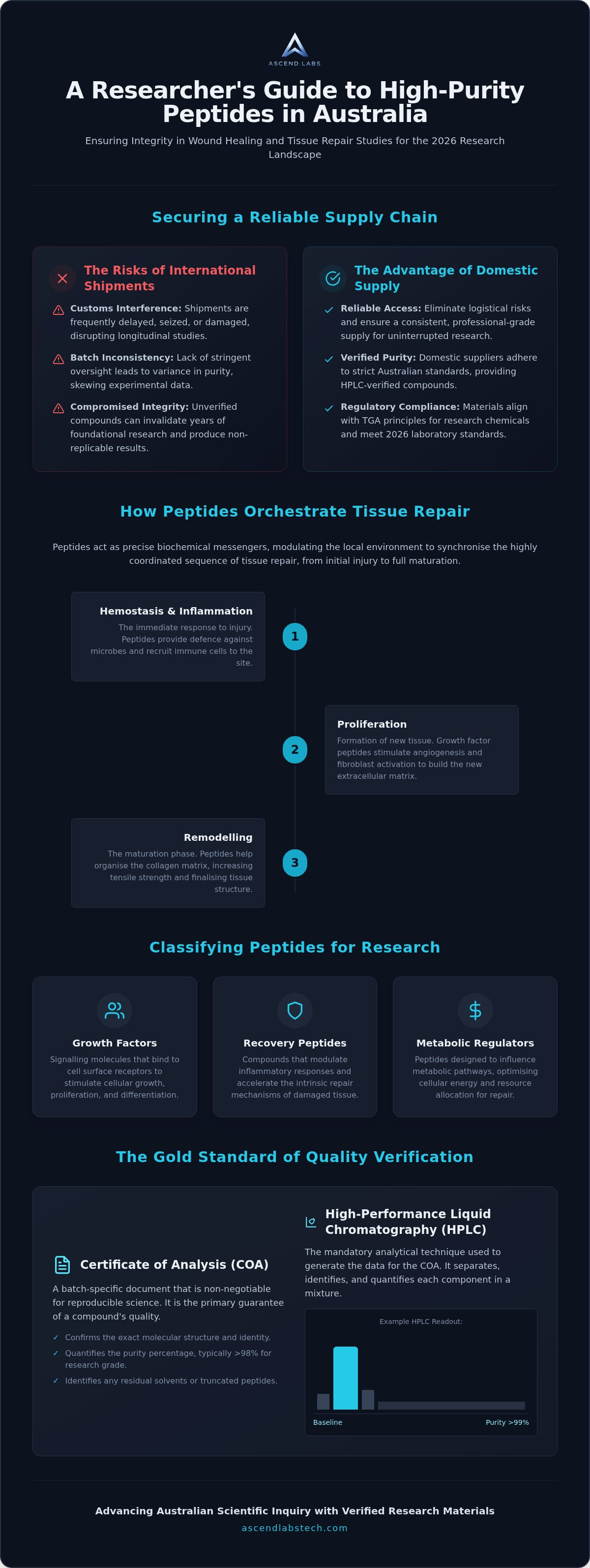
Research into tissue repair typically categorises peptide intervention into three distinct stages. Each stage requires a unique signalling profile to ensure successful maturation of the new tissue.
- Step 1: Hemostasis and Early Inflammatory Signalling. During the immediate response to injury, antimicrobial peptides (AMPs) are scrutinised for their dual role. They act as a primary defence against microbial colonisation while simultaneously recruiting neutrophils and macrophages to the wound site through chemotactic signalling.
- Step 2: Proliferation Phase. This stage focuses on fibroblast migration and angiogenesis. Peptides in this category are studied for their capacity to stimulate the formation of new blood vessels and the synthesis of granulation tissue. This is a critical window for researchers examining recovery peptides and their impact on cellular turnover.
- Step 3: Remodelling. The final phase involves the maturation of collagen and the refinement of tissue architecture. Researchers observe how specific sequences influence the ratio of Type III to Type I collagen, which ultimately dictates the tensile strength and aesthetic outcome of the repaired area.
Cellular Signalling and Gene Expression
The efficacy of wound healing research peptides australia is often measured by their ability to upregulate growth factor expression at the gene level. In-vitro studies frequently focus on the modulation of Transforming Growth Factor-beta (TGF-β) and Vascular Endothelial Growth Factor (VEGF). These pathways are essential for coordinating the complex interplay between different cell types. Meticulous observation of these pathways allows for a deeper understanding of how molecular signals translate into physical tissue changes.
A significant area of inquiry involves the modulation of matrix metalloproteinases (MMPs). These enzymes are responsible for degrading the extracellular matrix to allow for cellular migration. However, excessive MMP activity is a hallmark of non-healing wounds. Research peptides are utilised to study how to balance MMP-2 and MMP-9 levels, ensuring that the "cleaning" of the wound site does not prevent the formation of new tissue. Additionally, the impact of these compounds on keratinocyte proliferation is vital for understanding re-epithelialisation. By accelerating the closure of the wound surface in laboratory models, these peptides provide a framework for studying the restoration of the skin's barrier function.
Comparative Analysis of Recovery and Growth Factor Peptides
Within the discipline of wound healing research peptides australia, investigators must distinguish between distinct molecular classes to align their study objectives with the appropriate biochemical compound. These materials are generally categorised into growth factor analogues, recovery compounds, and metabolic regulators. While growth factors directly stimulate mitogenesis and cellular division, recovery compounds are often utilised to study broader systemic responses and structural organisation in damaged tissue. For a detailed look at structural applications, researchers should consult the Peptides for Connective Tissue: 2026 Technical Roundup.
Growth Factor Peptides in Proliferation Studies
Growth factor analogues are essential for investigating epithelial repair. These compounds mimic endogenous signals that trigger keratinocyte and fibroblast proliferation. Their primary strength lies in their direct action on cellular division, making them ideal for acute models of skin injury. However, in chronic wound models, their efficacy can be limited by the high proteolytic activity of the wound bed, which can degrade the peptide before it reaches its target receptor. Researchers often use these analogues to study the restoration of the epidermal barrier and the initiation of the proliferation phase. For comprehensive protocols, refer to the Growth Factor Peptides Australia: Scientific Research Guide.
Metabolic and Recovery Compounds
Emerging research in 2026 suggests that mitochondrial efficiency is a prerequisite for effective tissue regeneration. Metabolic research compounds, such as MOTS-C, are now being scrutinised for their role in cellular energy homeostasis during the repair process. By upregulating mitochondrial biogenesis, these peptides may provide the metabolic substrate required for energy-intensive proliferation phases. This represents a significant shift in wound healing research peptides australia, moving from traditional signalling research toward an energy-centric model of recovery. This approach addresses the gap in understanding how metabolic dysfunction contributes to stalled healing in diabetic or aged models.
In contrast, recovery peptides are studied for their impact on angiogenesis and the organisation of the extracellular matrix. Unlike growth factor analogues that primarily drive cell count, these compounds appear to influence the quality of the repair and the reduction of fibrotic tissue. Australian laboratories are increasingly conducting KLOW vs MOTS-C research to determine how different metabolic pathways affect cellular longevity and repair speed. This multi-class approach allows for a more nuanced understanding of tissue repair than single-compound studies can provide, facilitating the development of more complex and accurate laboratory models.
Laboratory Standards and Quality Verification for Australian Research
The integrity of scientific inquiry rests on the verifiable purity of its reagents. In the context of wound healing research peptides australia, the use of unverified materials introduces variables that can obscure cellular responses and invalidate longitudinal datasets. High-Performance Liquid Chromatography (HPLC) is the indispensable standard for determining chemical purity; mass spectrometry provides the necessary confirmation of the amino acid sequence identity. Without these dual layers of verification, researchers risk working with compounds that may contain residual solvents, truncated sequences, or incorrect counter-ions. These contaminants don't just compromise the current study; they introduce systemic errors that can trigger unintended inflammatory responses in-vitro, thereby masking the true mechanistic effect of the peptide being studied.
Interpreting Verification Documents
HPLC remains the gold standard for purity testing in 2026. A valid Certificate of Analysis (COA) must reflect the specific batch being utilised in the laboratory. Red flags in these documents include missing or mismatched batch numbers, outdated testing dates, or the absence of a clear chromatogram. If a supplier cannot provide a batch-specific report, the material's identity and purity remain speculative. For a detailed breakdown of the verification process, investigators should review the Peptide Purity Testing: A Professional Protocol for Australian Research Verification. Ensuring that every aliquot meets these standardised benchmarks is a prerequisite for any peer-reviewed submission, as journals increasingly require raw analytical data to support experimental claims.
Domestic Supply vs. International Procurement
Procuring wound healing research peptides australia through domestic channels offers significant technical advantages over international alternatives. Peptide stability is highly sensitive to temperature fluctuations. International transit often exposes compounds to extreme conditions that can lead to degradation or denaturation before they reach the bench. Maintaining cold-chain integrity is significantly more reliable within a domestic logistics network, where transit times are measured in hours rather than days. Domestic supply lines are also insulated from the unpredictability of international customs, which often results in delayed shipments and compromised samples. By sourcing within Australia, laboratories ensure a more secure and consistent supply of high-purity compounds, allowing for tighter control over experimental timelines and material quality. This domestic focus eliminates the risk of customs interference and ensures that the compounds arrive in the precise chemical state required for high-fidelity research.
Sourcing High-Purity Compounds for Australian Scientific Inquiry
Ascend Labs functions as a disciplined curator for the Australian scientific community. By prioritising technical verification over retail volume, we provide the precision required for valid inquiry into wound healing research peptides australia. Our operation is built on the principle that research integrity is non-negotiable; every compound in our inventory undergoes rigorous assessment before being cleared for domestic distribution. This ensures that investigators can focus on their data rather than questioning the molecular identity of their reagents. In the 2026 research climate, where regulatory scrutiny is heightened, working with a transparent domestic partner is the most effective way to maintain laboratory standards.
The Ascend Labs Research Catalogue
Our specialised inventory is designed to support diverse investigative needs, ranging from metabolic signalling to structural tissue remodelling. The catalogue includes high-purity Growth Factor Peptides and recovery compounds, alongside advanced metabolic research compounds such as Retatrutide, Tirzepatide, and KLOW. These materials are curated for their specific roles in modulating cellular pathways in-vitro. It's essential to reiterate that all products provided are strictly for laboratory research and are not intended for human consumption or clinical application. Detailed technical specifications for each sequence, including molecular weight and purity levels, are available through the Ascend Labs Products portal.
Commitment to Australian Research Integrity
The selection process for our research-grade compounds is meticulous. We act as an authoritative gatekeeper, ensuring that every batch meets the 2026 HPLC standards required for peer-reviewed research. By opting for domestic procurement, researchers directly support the Australian biotechnology sector while securing their supply chain against the volatility of international logistics. This commitment to domestic shipping ensures that cold-chain integrity is maintained, preserving the biochemical activity of sensitive growth factors that might otherwise denature during long-haul transit. We provide a transparent pathway for researchers to secure COA-verified materials, facilitating studies that are both replicable and robust. Elevating the standard of wound healing research peptides australia requires a partnership with a supplier that values scientific truth above all else. We invite serious investigators to integrate our high-purity compounds into their next phase of inquiry to ensure the highest possible fidelity in their results.
Advancing the Standards of Australian Tissue Repair Inquiry
The evolution of wound healing research peptides australia in 2026 demands a shift toward phase-specific modulation and verified chemical purity. Precise scientific discovery hinges on the ability to replicate results; this is only possible when the molecular integrity of the compounds is beyond reproach. By prioritising domestic procurement, investigators secure their datasets against the risks of international transit and ensure the cold-chain integrity required for sensitive recovery compounds. Every study deserves a foundation built on transparency and meticulous laboratory standards.
Securing HPLC and COA-verified materials is a prerequisite for any peer-reviewed submission. As the Australian biotechnology sector continues to expand, maintaining these high-purity benchmarks will define the quality of domestic research. We remain committed to providing the specialised metabolic and recovery compounds necessary for this critical work. Our focus on domestic shipping ensures your laboratory receives compounds in their optimal chemical state, free from the uncertainties of customs interference.
We look forward to supporting your next phase of scientific inquiry with the accuracy and discretion your research demands.
Frequently Asked Questions
What are the most common peptides used in wound healing research in Australia?
Common peptides include growth factor analogues and specialised recovery compounds. These materials allow researchers to study specific signalling pathways like TGF-β or VEGF. In the 2026 Australian landscape, investigators frequently utilise recovery peptides to examine fibroblast activation and extracellular matrix remodelling. By isolating these sequences, laboratories can observe the granular physiological changes required for tissue repair without the variables present in complex biological systems.
Are research peptides legal for laboratory use in Australia?
Research peptides are legal for legitimate laboratory and scientific inquiry within Australia. However, they are strictly prohibited for human consumption or clinical use. Under the 2026 TGA compliance framework, these compounds must be handled within controlled research environments. Sourcing from domestic suppliers like Ascend Labs ensures that the procurement process remains transparent and adheres to the professional standards expected of the Australian biotechnology sector.
How does peptide purity affect the results of a tissue repair study?
Purity levels directly dictate the reliability and reproducibility of your experimental data. Even a minor variance in purity can introduce residual solvents or truncated peptide sequences that trigger unintended inflammatory responses in-vitro. This "noise" can mask the actual mechanistic effects of the compound, leading to compromised datasets. High-purity wound healing research peptides australia are essential for ensuring that observed cellular changes are a direct result of the peptide sequence itself.
What is the difference between a research peptide and a therapeutic medication?
The primary distinction lies in the intended use and regulatory approval status. Therapeutic medications are TGA-approved products prescribed by doctors for human treatment. Research peptides are laboratory-grade chemicals intended solely for scientific study. They lack clinical approval for human administration and are curated for high-fidelity in-vitro and in-vivo models. This distinction is vital for maintaining ethical laboratory protocols and ensuring compliance with Australian regulations governing therapeutic goods.
Why is HPLC verification critical for Australian research peptides?
HPLC verification is the 2026 gold standard for confirming that a compound meets its stated purity benchmarks. It provides a quantitative analysis of the peptide's composition, identifying any potential contaminants that could skew research results. For Australian investigators, HPLC data serves as a critical verification layer that supports the integrity of peer-reviewed submissions. Without this raw analytical data, the validity of a study's foundational reagents remains speculative and scientifically vulnerable.
Can metabolic peptides like MOTS-C be used in recovery research?
Metabolic compounds like MOTS-C are increasingly used to study the energetic requirements of tissue regeneration. Researchers utilise these peptides to investigate mitochondrial biogenesis and its role in supporting the energy-intensive proliferation phase of repair. By upregulating cellular energy homeostasis, metabolic compounds provide a unique framework for studying how systemic health influences local wound resolution. This represents a significant shift toward an integrated, energy-centric model of recovery research in Australian laboratories.
How should research peptides be stored to maintain stability in Australian climates?
Stability in the Australian climate requires strict adherence to cold-chain protocols. Lyophilised peptides should be stored in a temperature-controlled environment, typically at -20°C for long-term stability or 4°C for immediate use. Heat exposure during transit or storage can lead to peptide degradation and loss of biological activity. Domestic shipping is preferred because it minimises the time compounds spend in uncontrolled environments, ensuring they arrive at the laboratory in their optimal chemical state.
What documentation should accompany a high-purity research peptide?
Every high-purity research compound must be accompanied by a batch-specific Certificate of Analysis (COA) and an HPLC chromatogram. These documents confirm the molecular identity, purity percentage, and mass spectrometry results of the specific aliquot. For professional investigators, this documentation is not optional; it's a mandatory requirement for verifying the integrity of the research materials. These records should be archived alongside experimental data to provide a complete audit trail for peer-reviewed publication.


