

In the Australian research landscape, peptide stability isn't a static attribute but a managed variable dictated by thermodynamic precision and rigorous environmental control. Researchers across the continent often face significant uncertainty regarding thermal degradation during domestic transit, particularly when navigating the vast distances between laboratory facilities. You've likely questioned whether your storage durations for specific sequences are sufficient or if the unique Australian humidity is silently compromising your research data. Maintaining lyophilized peptide stability australia wide requires a sophisticated approach to preservation that goes beyond basic refrigeration. We agree that the risk of compromised data is an unacceptable variable in serious scientific inquiry. This technical guide provides the expertise needed to master the science of lyophilised peptide preservation and ensure research integrity within our specific environmental landscape. We'll establish clear protocols for long-term storage, analyse the impact of local atmospheric conditions on compound integrity, and detail the verification methods, such as HPLC and Mass Spectrometry, required to confirm stability. With the TGA making unapproved peptide products a compliance priority in 2026, the necessity for meticulous quality verification and stable storage has never been higher.
Key Takeaways
- Master the thermodynamic principles of sublimation to protect the primary structure of research peptides from environmental degradation.
- Learn to mitigate the specific risks of thermal stress and moisture ingress to ensure optimal lyophilized peptide stability australia wide.
- Establish rigorous storage tiers, utilising -20°C environments for long-term preservation and understanding the limitations of standard refrigeration.
- Understand the exponential increase in degradation rates following reconstitution and the critical role of bacteriostatic water in microbial control.
- Utilise HPLC and Mass Spectrometry data as essential benchmarks for verifying purity and ensuring the integrity of your longitudinal research data.
The Science of Lyophilized Peptide Stability: A Thermodynamic Overview
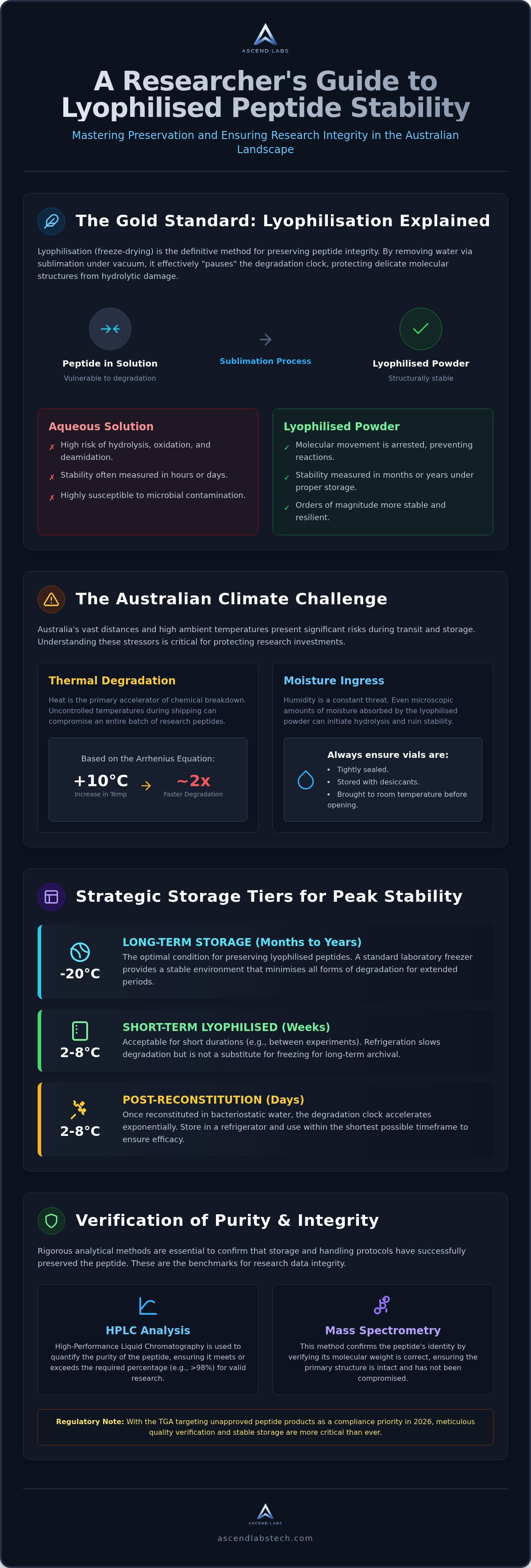
Lyophilisation represents the definitive methodology for maintaining the primary structure of research peptides within the laboratory environment. It is the gold standard because it effectively pauses the degradation clock, ensuring that the biochemical integrity of the compound remains intact from the point of manufacture to the moment of reconstitution. This process relies on the principle of sublimation, where water is removed from a frozen product under a vacuum without passing through the liquid phase. By bypassing the liquid state, the delicate peptide bonds are protected from the hydrolytic stresses that typically occur during standard evaporation or heat-drying methods. The Science of Lyophilization ensures that the physical structure of the peptide is preserved in a porous, solid-state matrix.
The thermodynamic benefit of this state is significant. In a lyophilised form, the energy required for chemical reactions is substantially higher than in a liquid state. Lyophilisation is a process that arrests molecular movement to prevent hydrolysis. By immobilising the molecules, the rate of both chemical and physical degradation is reduced to near-zero levels when stored under optimal conditions. For researchers, this means that lyophilized peptide stability australia wide can be managed with high predictability, even when accounting for the thermal challenges of domestic logistics.
Molecular Integrity and the Freeze-Drying Process
The removal of the aqueous environment is the most critical factor in preventing deamidation and oxidation. These two chemical pathways are responsible for the majority of peptide failures in the lab. Deamidation, specifically the conversion of asparagine or glutamine residues, requires water as a reactant. Oxidation, often affecting methionine or cysteine, is similarly accelerated in liquid environments. The creation of a stable peptide 'cake' often involves the use of specific excipients or bulking agents. These substances provide a structural scaffold that maintains the shape of the lyophilised powder and prevents it from collapsing into a dense, less soluble mass. When comparing stability, lyophilised powders are orders of magnitude more resilient than aqueous solutions, which can begin to degrade within hours of being prepared.
Sequence-Specific Stability Variables
The inherent stability of a research compound is heavily influenced by its specific amino acid sequence. Certain sequences are naturally more robust, while others contain 'hot spots' that are susceptible to environmental stressors. For example, compounds such as Retatrutide or MOTS-C exhibit different stability profiles based on their molecular weight and residue composition. Sequences with high percentages of hydrophobic residues may require different handling than those with highly reactive side chains. Understanding these variables is essential for maintaining lyophilized peptide stability australia, as it allows researchers to tailor their storage protocols to the specific vulnerabilities of the compound in question.
Environmental Stressors: Managing Peptide Integrity in the Australian Climate
The Australian climate presents a unique set of challenges for maintaining lyophilized peptide stability australia wide. Ambient temperatures in many regions frequently exceed 30°C, a threshold where the rate of chemical degradation begins to climb. During the summer months, unshaded transit vehicles or sorting facilities can reach internal temperatures far higher than the reported ambient peak. These thermal spikes are not merely inconveniences; they are kinetic drivers of molecular breakdown. Maintaining a stable environment is a technical necessity for preserving the efficacy of research compounds over their intended shelf life.
Thermal Degradation and the Arrhenius Equation
The Arrhenius equation provides the mathematical framework for understanding how temperature fluctuations accelerate peptide breakdown. For every 10°C increase in temperature, the rate of chemical reactions, such as hydrolysis or oxidation, typically doubles or triples. This exponential relationship makes the "Cold Chain" philosophy essential in a national context. By prioritising domestic shipping, Ascend Labs reduces the duration of environmental exposure. International transit often involves prolonged delays in customs warehouses where climate control is not guaranteed. Reducing the transit window is the most effective way to mitigate thermal risk and ensure the compound arrives in its optimal state.
Hygroscopy and Moisture Management
Humidity is a pervasive threat across much of the Australian landscape, particularly in coastal research hubs. Lyophilised peptides are highly hygroscopic. They actively attract and hold water molecules from the surrounding air. If a vial seal is compromised, even slightly, moisture ingress can occur. This leads to the physical collapse of the peptide 'cake', which is a visible indicator of potential degradation. To maintain integrity in the lab, researchers must implement strict handling protocols. For those managing sensitive projects, choosing metabolic research compounds that have been stored and dispatched under rigorous domestic standards is a critical first step.
To prevent moisture-related failures, consider these laboratory best practices:
- Thermal Equilibration: Never open a vial immediately after removing it from cold storage. Allow the vial to reach room temperature to prevent atmospheric moisture from condensing on the cold interior surfaces of the glass.
- Atmospheric Control: Conduct all reconstitution and sampling in a climate-controlled environment where relative humidity is kept below 50 percent.
- Seal Verification: Regularly inspect the integrity of the rubber stopper and crimp seal for any signs of displacement or atmospheric exposure.
By managing these variables, researchers can ensure that the lyophilized peptide stability australia requires for high-fidelity data is maintained throughout the duration of the study.
Strategic Storage Protocols for Long-Term Research Stability
Maintaining lyophilized peptide stability australia wide requires a tiered storage strategy that distinguishes between immediate use and long-term archiving. While the lyophilised state provides inherent resilience during transit, laboratory storage demands more rigorous control. It's a common misconception that lyophilised powders are invincible at room temperature. Short-term storage, defined as a period of up to four weeks, is generally sufficient at 4°C within a standard laboratory refrigerator. However, room temperature storage should be strictly avoided in Australian facilities, as ambient fluctuations can easily exceed the stability thresholds of sensitive sequences.
For medium-term requirements spanning one to twelve months, a consistent -20°C environment is necessary. This temperature range significantly slows molecular degradation, preserving the compound's primary structure for longitudinal studies. When research objectives require archiving samples for twelve months or longer, deep-freeze protocols at -80°C represent the only viable option for maintaining maximum integrity. At these ultra-low temperatures, biological and chemical activity is effectively suspended. This prevents the subtle, incremental changes that can occur at higher freezer temperatures.
Optimising the Laboratory Freezer Environment
The selection of storage hardware is as critical as the temperature setting itself. Researchers shouldn't use frost-free freezers for peptide storage. These units employ internal heating elements to prevent ice accumulation, creating frequent temperature fluctuations that can induce micro-thaw cycles. These cycles are detrimental to the peptide 'cake' and often lead to premature degradation. Samples should be organised logically within the unit to minimise the duration the door remains open. Using secondary containment, such as a sealed plastic container with desiccant packs, provides an additional layer of protection. This setup guards against moisture ingress and thermal shock during routine access.
Protection Against Photodegradation
Light sensitivity is a frequently overlooked variable in peptide preservation. UV and even intense ambient light can catalyse the cleavage of specific peptide bonds, particularly those involving aromatic amino acids. This process, known as photodegradation, can occur even if the temperature remains stable. It's particularly problematic for sequences containing tryptophan or tyrosine residues. Sensitive compounds, such as those discussed in our KLOW vs MOTS-C Research: A Comparative Analysis for Australian Laboratories (2026), should always be stored in the dark. Utilising amber vials or opaque secondary packaging ensures that the compound is shielded from light-induced breakdown. This maintains the baseline purity established at the time of synthesis and ensures lyophilized peptide stability australia for the duration of your project.
Post-Reconstitution Dynamics: Stability After Solvent Addition
Reconstitution represents the most vulnerable phase in the peptide lifecycle. While lyophilized peptide stability australia provides a secure baseline for transit and storage, the introduction of a solvent immediately activates the "stability clock." In an aqueous state, the molecules are no longer held in a rigid, protective matrix. They're free to interact with the solvent, atmospheric oxygen, and any trace impurities. This increased molecular mobility leads to an exponential rise in degradation rates compared to the powdered form. Maintaining the integrity of the solution requires a shift from long-term preservation to immediate, active management.
The choice of solvent is a critical determinant of longevity. Bacteriostatic water, containing 0.9 percent benzyl alcohol, is the preferred medium for multi-use research vials. The alcohol acts as a preservative, inhibiting microbial growth that could otherwise flourish in the nutrient-rich environment of a peptide solution. In contrast, sterile saline or plain sterile water lacks these antimicrobial properties, making them suitable only for immediate, single-use applications. Even with bacteriostatic water, the peptide's primary structure will inevitably begin to fragment over time, necessitating precise lyophilized peptide stability australia protocols to ensure research accuracy.
Mechanical stress is another often-overlooked factor in the laboratory. Peptides are delicate chains held together by specific bonds that can be disrupted by physical force. Researchers should never shake or vortex a vial after adding solvent. Instead, gentle rotation or swirling is required to facilitate dissolution without inducing denaturation. Excessive agitation can cause the peptide to aggregate or unfold, rendering the sample useless for serious inquiry.
Reconstitution Best Practices for Researchers
Successful reconstitution begins with thermal equilibration. Adding cold solvent to a cold vial can cause precipitation or incomplete dissolution. Allow both the vial and the solvent to reach room temperature before beginning the process. Use the "Side-Wall" technique: tilt the vial and allow the solvent to trickle slowly down the internal glass surface rather than squirting it directly onto the peptide cake. This prevents foaming and ensures a gentle transition into the liquid phase. A successful dissolution should result in a clear, particulate-free solution. Any cloudiness or persistent aggregation suggests that the peptide has either degraded or was improperly handled.
Shelf-Life Expectations in Liquid State
Once reconstituted, peptides must be stored in a consistent 2°C to 8°C environment. Most compounds will maintain acceptable purity levels for 7 to 14 days, though this window varies significantly by sequence. Unlike the powdered state, reconstituted peptides should never be frozen. The formation of ice crystals creates significant mechanical shear that can literally tear the peptide molecules apart, rendering the research data invalid. For projects requiring long-term liquid storage, aliquoting the solution into single-use vials immediately after reconstitution is the only way to avoid the damage caused by repeated handling. Verification of these liquid-state dynamics is essential for maintaining the high standards detailed in our guide on Peptide Purity Testing: A Professional Protocol for Australian Research Verification.
Verification of Purity and Stability Standards in Australia
Verification is the final, essential pillar of research integrity. Interpreting High-Performance Liquid Chromatography (HPLC) and Mass Spectrometry reports allows researchers to establish a baseline for lyophilized peptide stability australia. While a Certificate of Analysis (COA) is often viewed as a permanent guarantee of quality, it's more accurately described as a scientific snapshot in time. It documents the purity and molecular identity of a batch at the point of testing. If the compound is subsequently exposed to thermal stress or moisture during international transit, the data on that COA may no longer reflect the reality of the vial in your laboratory. This is why a secure chain of custody from the synthesis lab to the domestic researcher is paramount.
HPLC analysis identifies the percentage of the target peptide relative to impurities, while Mass Spectrometry confirms the exact molecular weight of the sequence. Together, these metrics provide the necessary assurance that the compound is both pure and correctly identified. Ascend Labs employs independent third-party testing for every research compound in our inventory. This commitment to transparency ensures that our data is unbiased and verified by external experts, providing a level of security that internal testing alone cannot match.
Quality Assurance at Ascend Labs
Our operational framework focuses on the meticulous selection of high-purity metabolic and growth factor compounds. By restricting our operations to a domestic-only supply model, we significantly reduce the environmental variables that threaten the integrity of lyophilised cakes. This strategy ensures that the stability verified in the lab is preserved during the short transit window to your facility. Researchers seeking verified materials can explore our full range of Ascend Labs Products, each backed by comprehensive verification data.
The Researcher's Responsibility in Quality Maintenance
The quest for stability doesn't end upon delivery. It's a disciplined partnership between the supplier's precision and the researcher's rigorous handling. Upon receiving a shipment, laboratories should implement internal verification protocols, such as inspecting the physical state of the lyophilised powder for signs of moisture ingress or cake collapse. Documentation is equally critical. Maintaining a detailed log of storage temperatures and duration creates an audit trail that can be vital when troubleshooting unexpected research results. Stability is not a passive state; it's an active commitment to scientific truth through meticulous documentation and environmental control.
Securing the Future of Australian Peptide Research
Maintaining lyophilized peptide stability australia wide is a continuous commitment to thermodynamic precision. We've established that the integrity of a research compound depends on the synergy between expert lyophilisation and disciplined laboratory management. From the initial sublimation process to the final verification of purity through HPLC and Mass Spectrometry, every step must be calculated. Reducing the transit window through specialised domestic shipping remains the most effective strategy for mitigating the thermal gradients inherent to our local climate.
As you move forward with your inquiry, remember that a Certificate of Analysis is only as reliable as the storage protocols that follow it. By implementing tiered freezing strategies and managing the stability clock post-reconstitution, you protect the validity of your data. Ascend Labs remains dedicated to providing premium clinical-grade standards for serious researchers who value transparency and scientific truth above all else.
We look forward to supporting your next breakthrough with the precision and professional discretion your research deserves.
Frequently Asked Questions
How long do lyophilised peptides last at room temperature in Australia?
Lyophilised peptides generally remain stable at room temperature, approximately 25°C, for four to six weeks. However, the Australian climate often presents ambient temperatures exceeding 30°C, which can accelerate molecular degradation. For maximum integrity, researchers should limit room temperature exposure to the shortest duration possible. If your laboratory environment fluctuates, immediate refrigeration at 4°C is the safer protocol to ensure consistent results across your longitudinal studies.
Can I freeze reconstituted peptides to extend their shelf life?
Freezing reconstituted peptides is generally discouraged because the formation of ice crystals causes significant mechanical shear. This physical stress can disrupt delicate peptide bonds and lead to denaturation. While some specific protocols allow for rapid freezing at -80°C to minimise crystal size, standard laboratory freezers are unsuitable. It's more effective to aliquot the solution into single-use vials immediately after reconstitution and store them at 2°C to 8°C for short-term use.
What are the visual signs that a lyophilised peptide has degraded?
Visual indicators of degradation include the physical collapse of the lyophilised "cake" or a change in the powder's colour. If the powder appears clumpy, shrunken, or yellowed, it often suggests moisture ingress or thermal damage. A healthy lyophilised product should appear as a uniform, porous solid or a fine white powder. Any visible aggregation or "melting" indicates that the compound's primary structure may have been compromised during storage or transit.
Does the Australian summer heat affect peptides during domestic shipping?
The extreme thermal gradients of the Australian summer can pose a risk to lyophilized peptide stability australia wide. High ambient temperatures in transit vehicles can exceed the stability thresholds of sensitive sequences. Ascend Labs mitigates this risk by utilising specialised domestic shipping, which reduces the duration of environmental exposure. This domestic-only focus ensures that compounds don't sit in uncooled customs warehouses, preserving the integrity of the lyophilised state before it reaches your facility.
Is it necessary to use a desiccant when storing peptides in a freezer?
Utilising a desiccant is a critical secondary containment measure for laboratory storage. When vials are moved in and out of cold storage, atmospheric moisture can condense on the glass and penetrate the seal. A desiccant pack within a sealed storage container actively absorbs this moisture, maintaining a dry environment. This simple precaution is essential for preventing hygroscopic collapse and ensuring that the peptide remains in its stable, solid-state matrix for the long term.
Why is bacteriostatic water preferred for peptide reconstitution?
Bacteriostatic water is the preferred solvent because it contains 0.9 percent benzyl alcohol, which acts as a potent antimicrobial preservative. This is particularly important for multi-use vials where repeated needle entries could introduce contaminants. In the nutrient-rich environment of a peptide solution, microbes can flourish rapidly, leading to enzymatic degradation of the compound. Using bacteriostatic water extends the liquid-state shelf life and protects the purity required for high-fidelity research data.
How does light exposure impact the stability of research compounds like MOTS-C?
Light exposure, particularly UV radiation, can catalyse the cleavage of peptide bonds through a process known as photodegradation. Compounds like MOTS-C or those containing aromatic residues are especially sensitive to these photon-induced reactions. Even standard laboratory lighting can cause incremental breakdown over time. To maintain lyophilized peptide stability australia, researchers must store vials in the dark, using amber vials or opaque secondary packaging to shield the delicate molecular structures from light-induced fragmentation.
What is the difference between physical and chemical peptide degradation?
Physical degradation involves changes to the peptide's higher-order structure, such as aggregation, precipitation, or unfolding without breaking covalent bonds. In contrast, chemical degradation involves the actual breaking or formation of new chemical bonds, typically through pathways like hydrolysis, oxidation, or deamidation. While physical changes might be reversible through careful handling, chemical degradation permanently alters the primary sequence of the molecule, rendering the compound ineffective and potentially introducing confounding variables into your research.


