

The integrity of a multi-year metabolic study often hinges on a single vial of unverified material. Securing high-quality biochemical research compounds australia is a primary concern for laboratories facing unpredictable customs seizures and the opaque quality of international shipments. You understand that even a minor variance in peptide purity can compromise months of data and lead to irreproducible results. It's a risk that modern research protocols simply cannot afford to ignore.
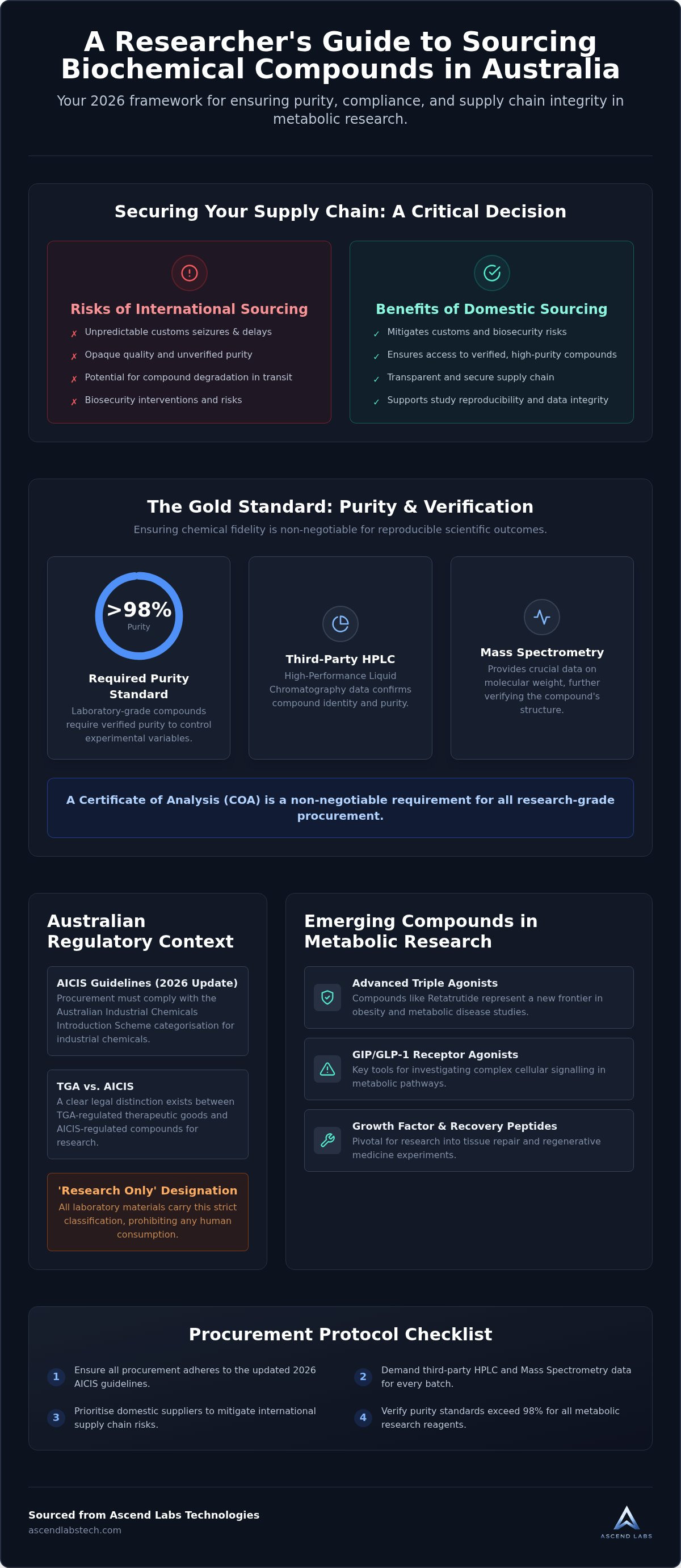
This 2026 procurement guide outlines the essential protocols for securing high-purity metabolic compounds while adhering to the latest AICIS categorisation guidelines implemented in September. We'll provide a framework to ensure your facility maintains a secure, transparent, and verified inventory without the biosecurity risks associated with unverified global vendors. Our analysis examines the necessity of third-party HPLC verification, the logistics of domestic supply chains, and the technical standards required to maintain research integrity within the Australian scientific landscape.
Key Takeaways
- Navigate the updated 2026 AICIS guidelines to ensure compliant procurement of industrial chemicals within the Australian scientific framework.
- Recognise the critical role of third-party HPLC and Mass Spectrometry data in maintaining research integrity and study reproducibility.
- Secure your supply chain by sourcing biochemical research compounds from local suppliers, effectively mitigating the risks of international customs delays and biosecurity interventions.
- Evaluate the research potential of emerging metabolic compounds, including advanced triple agonists and GIP/GLP-1 receptor agonists.
- Prioritise domestic, high-purity verification standards to ensure that all laboratory reagents meet the technical requirements of modern metabolic research protocols.
The Landscape of Biochemical Research Supplies in Australia
The Australian biotechnology sector has transitioned into a phase of heightened precision. Procuring biochemical research compounds australia now requires more than simple vendor selection; it demands a deep understanding of the intersection between Biochemistry and rigorous laboratory standards. These supplies encompass a broad spectrum of reagents, amino acid chains, and metabolic catalysts essential for modern in-vitro and in-vivo models. As research objectives become more complex, the distinction between high-purity standards and standard commercial-grade chemicals has never been more critical for data integrity.
To better understand the standards expected in this sector, watch this overview of professional verification protocols:
In 2026, the demand for specialised peptides has surged, driven by a domestic research community focused on metabolic health and regenerative medicine. Relying on international supply chains has become increasingly untenable due to revised biosecurity frameworks and the potential for significant data delays. Domestic availability ensures that high-purity standards are maintained without the risk of degradation during long-haul transit. High-purity research standards are distinct from commercial-grade chemicals. While commercial grades may suffice for industrial applications, laboratory-grade compounds require verified purity levels, often exceeding 98%, to ensure that experimental variables remain controlled and outcomes stay reproducible.
The Role of Peptides in Modern Scientific Inquiry
Peptides serve as high-resolution tools for investigating complex cellular signalling. The shift toward triple agonists, such as Retatrutide, represents a new frontier in obesity and metabolic studies. Beyond metabolic research, growth factor and recovery peptides are pivotal in tissue repair and regenerative experiments. These compounds allow researchers to isolate specific physiological responses with a degree of accuracy that traditional small molecules often lack. It's this specificity that makes them indispensable for mapping intricate metabolic pathways.
Regulatory Context for Research Compounds in Australia
Compliance is the foundation of legitimate scientific inquiry. In the Australian legal framework, a clear distinction exists between therapeutic goods regulated by the TGA and industrial chemicals used for research purposes. Under the latest AICIS categorisation guidelines implemented in September 2026, all materials provided for laboratory use carry a strict 'Research Only' designation. This classification is vital. Reputable suppliers of biochemical research compounds australia strictly prohibit human consumption. This boundary ensures that materials are used solely for their intended purpose: the advancement of scientific knowledge within controlled environments. You can view the full range of compliant materials at products.
Verification Standards: Ensuring Purity and Research Integrity
Scientific reproducibility relies entirely on the chemical fidelity of the materials used in a study. Within the framework of the Australian and New Zealand Standard Research Classification (ANZSRC), maintaining rigorous standards is a prerequisite for valid peer-reviewed outcomes. For those sourcing biochemical research compounds australia, the presence of even trace impurities can lead to catastrophic data skew. These contaminants often act as unintended variables. They can trigger off-target cellular responses that confound in-vitro results and lead to false conclusions. This makes unverified materials a significant liability for any serious investigation.
Professional peptide purity testing is the only method to mitigate these risks effectively. A Certificate of Analysis (COA) is a non-negotiable requirement for procurement. It isn't just a supplementary document. It is a batch-specific verification of the supplier's operational integrity. Without this data, the actual concentration of the compound remains speculative. This level of uncertainty is unacceptable in modern laboratory settings where precision is the primary objective.
Interpreting HPLC and Mass Spectrometry Data
Verification protocols rely on two distinct methodologies to confirm a compound's quality. High-Performance Liquid Chromatography (HPLC) measures quantitative purity by separating the target compound from residual synthesis by-products. This process yields a percentage value, typically targeting 98% or higher for research-grade materials. Mass Spectrometry complements this by confirming the qualitative identity of the peptide sequence through its molecular weight. Identifying red flags in supplier-provided documents, such as generic reports or HPLC chromatograms with missing baseline data, is a critical skill for procurement officers. If you require verified materials for your next protocol, you can review our current batch specifications here.
Standardising Quality Across Research Batches
Longitudinal studies require absolute batch-to-batch consistency to ensure data remains comparable over months or years. Any minor variance in the synthesis or purification process can introduce drift in experimental data. Beyond the synthesis phase, stability is maintained through meticulous handling and storage protocols. Lyophilisation is the standard for maintaining peptide stability during transit, as it involves removing water through sublimation to create a stable, freeze-dried powder. Proper storage, typically at -20°C or below, prevents the degradation of biochemical research compounds australia and ensures chemical properties remain intact until the point of reconstitution.
Procurement Strategies: Domestic vs. International Sourcing
Unit price is often a deceptive metric in laboratory procurement. While international vendors frequently offer lower initial costs, the biological and logistical risks associated with trans-border shipments can negate these savings. For those sourcing biochemical research compounds australia, the domestic supply chain provides a level of predictability that global vendors cannot match. Domestic procurement transforms an uncertain international transit into a controlled, internal logistics process, ensuring that research timelines remain intact and budgets are protected from the hidden costs of seized or degraded cargo.
Navigating Customs and Importation Risks
Border interventions represent the primary point of failure for international research shipments. Australian Border Force and biosecurity officers operate under strict mandates regarding the importation of industrial chemicals and biological analogues. Seizures often occur due to inaccurate chemical categorisation under the revised September 2026 AICIS guidelines or a lack of specific documentation regarding the 'Research Only' status of the cargo. Even if a shipment is eventually released, temperature excursions during extended customs holding periods can compromise peptide stability.
A single seizure doesn't just result in the loss of capital; it resets the research timeline by weeks or even months. Using a domestic provider eliminates these biosecurity hurdles. It ensures that materials arrive in a stable, lyophilised state without the risk of destruction at the port of entry. This domestic reliability allows laboratories to maintain a lean inventory, as they don't need to over-order to compensate for potential international shipping failures.
The Value of Domestic Technical Expertise
Working with an Australian-owned entity establishes a layer of accountability that's absent in cross-border transactions. Direct communication with suppliers who understand the local regulatory environment allows for more precise technical support. If a batch requires verification or if there's a discrepancy in the HPLC data, local accountability ensures a resolution that respects Australian professional standards and consumer protections. It's far simpler to resolve a technical query with a domestic partner than it is to navigate a dispute with a vendor in a different time zone and jurisdiction.
Domestic procurement also strengthens the local biotechnology ecosystem. By choosing local stockists, laboratories ensure that the technical expertise required to verify and handle sensitive biochemical research compounds australia remains within the country. This creates a more resilient supply chain, capable of supporting long-term longitudinal studies without the volatility of international shipping markets or shifting global trade policies. Supporting the domestic market ensures that high-purity materials remain accessible to the entire Australian scientific community.
Emerging Compounds in Australian Metabolic Research
The Australian research landscape is currently prioritising ligands that offer multi-pathway engagement. Identifying the most relevant biochemical research compounds australia requires an understanding of how these emerging peptides interact with complex biological systems. Current study designs have moved beyond simple hormonal mimetics, focusing instead on compounds that can modulate multiple metabolic checkpoints simultaneously. This shift is particularly evident in the growing domestic interest in triple agonists and mitochondrial-derived peptides.
Neuromodulator peptides are also gaining significant traction within Australian neuroscience and recovery studies. These compounds allow researchers to investigate neuroprotective mechanisms and synaptic plasticity in various injury models. Their precision makes them indispensable for laboratories focused on the intersection of metabolic health and cognitive function. Maintaining a reliable supply of these advanced materials is essential for sustaining the momentum of local scientific discovery.
Triple Agonist Research: Retatrutide and Beyond
Triple agonists like Retatrutide are redefining the parameters of metabolic inquiry. Unlike traditional single-receptor ligands, these compounds engage the GLP-1, GIP, and Glucagon receptors. This multi-pathway activation allows researchers to investigate weight-loss mechanisms and glycaemic control with a higher degree of complexity than previously possible. In-vitro models currently focus on how this simultaneous receptor engagement influences lipid metabolism and energy expenditure. Sourcing high-purity Retatrutide for Australian laboratory standards requires a commitment to the rigorous verification protocols established in previous sections of this guide.
Mitochondrial Peptides and Longevity Science
Mitochondrial-derived peptides represent a sophisticated category of biochemical research compounds australia. Mitochondrial peptide research has become central to longevity science, specifically regarding cellular energy and mitochondrial biogenesis. MOTS-C is a key regulator of metabolic homeostasis in recent studies. When evaluating the research applications of KLOW vs MOTS-C, researchers must consider the specific metabolic targets of each compound. While MOTS-C is often studied for its role as an exercise mimetic, KLOW is emerging as a critical tool for investigating systemic metabolic regulation and cellular ageing processes.
Sourcing High-Purity Biochemicals from Ascend Labs
Ascend Labs operates as a disciplined curator within the Australian scientific landscape. We don't merely distribute materials; we manage a high-end boutique of verified reagents specifically for advanced practitioners. Our focus remains exclusively on high-purity biochemical research compounds australia, ensuring that every laboratory we partner with has access to materials that meet the most stringent technical specifications. By maintaining an authoritative presence in the domestic market, we provide a secure alternative to the volatility of unverified international vendors.
The Ascend Labs Quality Assurance Framework
Our internal protocols are designed to eliminate the variables that compromise study integrity. Every batch in our inventory undergoes rigorous verification, adhering to the HPLC and Mass Spectrometry standards required for modern research. We prioritise transparency by ensuring that comprehensive COA data is accessible for every compound, from metabolic catalysts like MOTS-C to recovery peptides. This meticulous selection process ensures that only materials with a verified purity of 98% or higher enter our distribution chain. Our commitment to the Australian scientific community is built on this foundation of scientific truth and operational excellence.
Partnering for Research Success
Navigating the Ascend Labs peptide catalogue allows researchers to secure advanced ligands like Retatrutide, Tirzepatide, and KLOW with complete confidence. We understand that operational discretion and professional ethics are as important as the purity of the compounds themselves. By maintaining a domestic-only supply chain, we ensure that your research materials are delivered rapidly and securely. This approach bypasses the biosecurity risks and temperature excursions common with international transit, protecting the stability of your reagents from the point of synthesis to the laboratory bench.
Our technical team is available to assist with specialised enquiries regarding our range of neuromodulators and growth factor analogues. We act as a reliable partner for serious inquiry, positioning our institution as a principled gatekeeper of quality. Whether you're conducting a short-term in-vitro pilot or a long-term longitudinal study, our domestic infrastructure is designed to support your timelines without compromise. It's this combination of scientific rigor and logistical efficiency that makes Ascend Labs the authoritative choice for biochemical research compounds australia.
Securing the Future of Australian Scientific Inquiry
The landscape of 2026 demands a shift from opportunistic procurement to disciplined supply chain management. Ensuring the integrity of your study requires a commitment to domestic reliability and rigorous technical verification. By prioritising HPLC-verified materials and navigating the latest AICIS guidelines, laboratories can effectively eliminate the variables that lead to data drift. Sourcing biochemical research compounds australia from a domestic partner provides the security of mind necessary for long-term longitudinal studies.
We've examined how domestic logistics bypass biosecurity risks and how emerging compounds like Retatrutide and MOTS-C are currently shaping the metabolic research field. The path to reproducible results is paved with transparency and professional ethics. Ascend Labs remains dedicated to providing the high-purity reagents your research deserves.
We look forward to supporting your next breakthrough with the precision and discretion your work demands.
Frequently Asked Questions
What are the legal requirements for buying research peptides in Australia?
Buying biochemical research compounds australia requires adherence to the Australian Industrial Chemicals Introduction Scheme (AICIS). As of September 2026, importers and manufacturers must register and categorise chemicals according to updated hazard guidelines. These compounds are sold strictly for laboratory use and must carry a 'Research Use Only' designation. Buyers must ensure their intended use complies with institutional ethics and the Australian Code for the Responsible Conduct of Research to maintain compliance.
How do I verify the purity of biochemical research supplies?
Purity is verified through analytical laboratory techniques, specifically High-Performance Liquid Chromatography (HPLC) and Mass Spectrometry. A reputable supplier will provide a batch-specific Certificate of Analysis (COA) that displays these results. You should look for a purity level of 98% or higher to ensure experimental variables remain controlled. Verifying that the data is current and corresponds to the specific batch number is essential for maintaining the integrity of your research data.
Can research peptides be used for human consumption in Australia?
No, research peptides are strictly prohibited from human consumption or therapeutic use in Australia. These materials are classified as industrial chemicals for laboratory inquiry and don't meet the regulatory standards for medicinal products set by the Therapeutic Goods Administration (TGA). Reputable suppliers, such as Ascend Labs, enforce a strict policy against human use. Attempting to use research-grade compounds for non-laboratory purposes violates legal frameworks and carries significant safety risks.
Why is domestic shipping preferred for research chemicals over international options?
Domestic shipping is preferred because it eliminates the high risk of international customs seizures and biosecurity interventions at the Australian border. International transit often involves unpredictable delays and temperature fluctuations that can degrade sensitive peptides. Sourcing biochemical research compounds australia through a domestic supply chain ensures faster lead times and greater accountability. It also provides a more secure logistics path, protecting the chemical stability of the materials from synthesis to the lab.
What is the difference between HPLC and Mass Spectrometry in peptide testing?
HPLC and Mass Spectrometry serve two distinct but complementary roles in verification. HPLC measures the quantitative purity of a sample by separating the target compound from impurities, yielding a percentage of total content. Mass Spectrometry provides qualitative confirmation of the compound's identity by measuring its molecular weight. While HPLC tells you how much of the substance is pure, Mass Spectrometry confirms that the substance is exactly what the supplier claims it to be.
What are the most common metabolic peptides currently being researched?
Current research priorities in Australia focus heavily on metabolic agonists and mitochondrial-derived peptides. Retatrutide, a triple receptor agonist, is a primary focus for studies involving GLP-1, GIP, and glucagon receptor pathways. Other frequently researched compounds include Tirzepatide, MOTS-C, and KLOW. These peptides are used to investigate energy regulation, cellular homeostasis, and mitochondrial function in various in-vitro and in-vivo metabolic models across the domestic scientific community.
How should research peptides be stored to maintain their integrity?
Research peptides should be stored in their lyophilised state at temperatures of -20°C or below to ensure long-term stability. For extended storage, -80°C is often preferred to prevent any potential degradation of the amino acid chain. It's vital to keep the vials in a cool, dark environment away from moisture and direct light. Once reconstituted, peptides are far less stable and should generally be used within a short timeframe while being kept refrigerated.
What documents should I expect from a reputable Australian peptide supplier?
You should expect a comprehensive documentation package that includes a batch-specific Certificate of Analysis (COA). This document must contain the HPLC chromatogram, showing purity percentages, and a Mass Spectrometry report confirming the molecular weight. Reputable Australian suppliers will also provide clear information regarding the compound's 'Research Use Only' status. Transparency in these documents is a hallmark of professional ethics and is necessary for ensuring the reproducibility of your scientific data.


