
The efficacy of a growth factor in a laboratory setting isn't determined by its initial potency, but by its ability to remain active long enough to yield measurable data. You likely understand the technical hurdles of working with standard IGF-1, where rapid degradation often compromises the integrity of long-term cellular cultures before meaningful results can be recorded. This technical overview examines IGF-1 LR3 research applications Australia, focusing on how the Long R3 analogue overcomes the inherent limitations of its natural counterpart through engineered resistance to binding proteins.
Researchers across the country require high-purity compounds that arrive stable and ready for immediate protocol implementation. You'll gain a definitive understanding of the peptide's extended half-life mechanism, specific applications for cellular proliferation studies, and the critical standards for interpreting COA data with precision. We will also address the logistical necessity of securing a reliable domestic supply. By prioritising Australian-based procurement, you eliminate the common risks of customs seizures and the instability associated with prolonged international transit. This guide provides the scientific framework needed to ensure your laboratory's growth factor research remains both accurate and efficient.
Key Takeaways
- Examine the 83-amino acid structure of IGF-1 LR3 to understand how the Long R3 modification enhances metabolic stability in vitro.
- Explore the diverse IGF-1 LR3 research applications Australia facilitates for studies involving myogenesis and skeletal muscle hypertrophy.
- Detail the activation of the PI3K-Akt/mTOR signalling pathway and its critical role in laboratory protein synthesis protocols.
- Identify the logistical advantages of domestic procurement for maintaining cold chain integrity and avoiding international transit risks.
- Confirm the necessary compliance standards for growth factor research to ensure your laboratory adheres to Australian scientific regulations.
Understanding IGF-1 LR3 in a Research Context
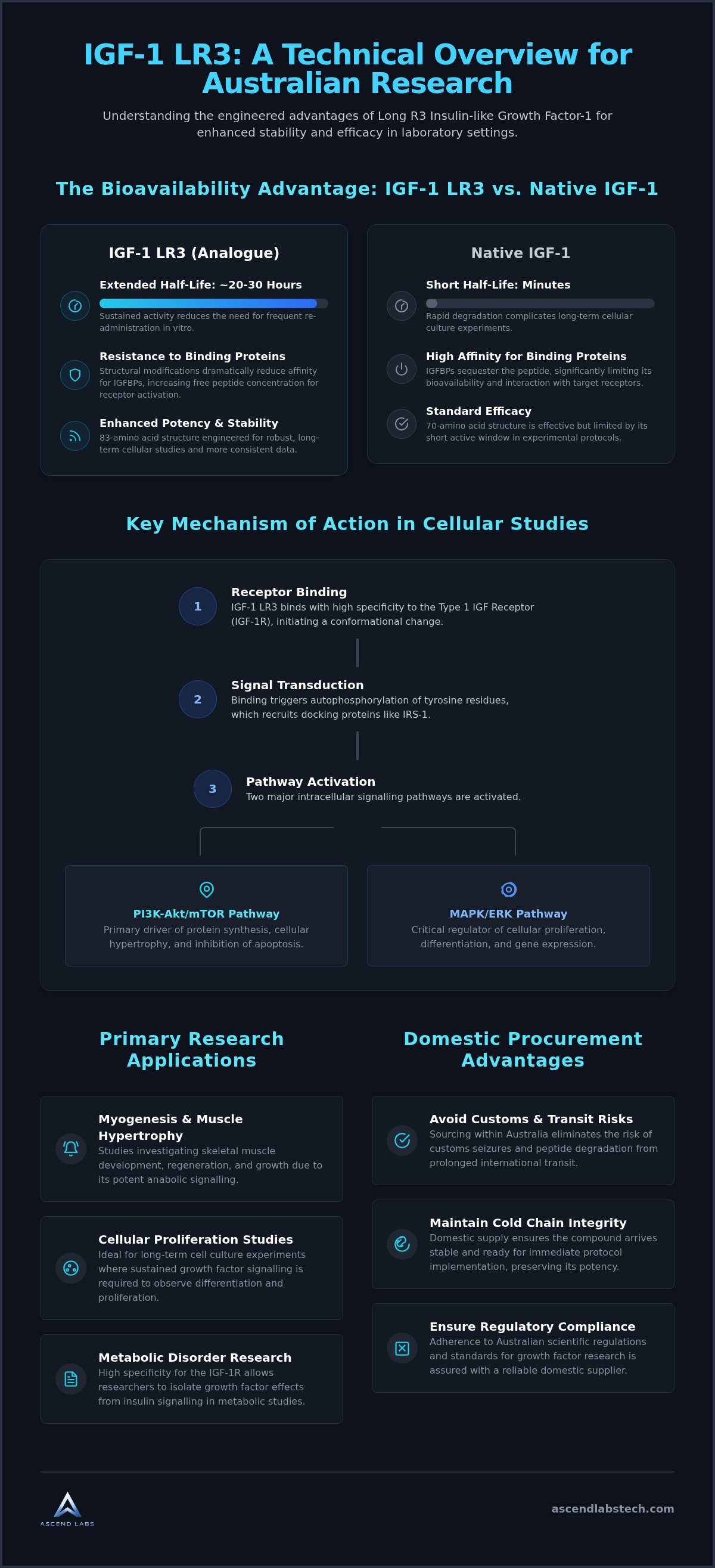
IGF-1 LR3 is a synthetic, 83-amino acid analogue of human Insulin-like Growth Factor-1. While native IGF-1 consists of 70 amino acids, this specific variant incorporates two critical structural alterations. First, a 13-amino acid extension is added to the N-terminus. Second, a precise substitution occurs at position 3, where Glutamic Acid replaces the naturally occurring Glutamine. These modifications aren't merely structural curiosities. They're engineered to address the inherent stability issues of the native hormone. In the scope of IGF-1 LR3 research applications Australia, these changes allow for more robust data collection in environments where native growth factors would otherwise fail.
LR3 vs. Native IGF-1: The Bioavailability Advantage
Native IGF-1 possesses a remarkably short half-life, often measured in minutes. This rapid clearance is largely due to its high affinity for IGF-binding proteins (IGFBPs). These proteins sequester the peptide and prevent it from interacting with the Type 1 IGF Receptor. The LR3 modification dramatically reduces this binding affinity. By effectively bypassing these regulatory proteins, a significantly higher concentration of the free peptide remains available for receptor activation. This increased bioavailability is a primary reason why researchers choose this analogue over the native form for complex laboratory protocols. It ensures that the peptide remains active and unbound, facilitating more direct interaction with target cells.
Significance for In-Vitro and In-Vivo Studies
The extended half-life of roughly 20 to 30 hours provides a distinct advantage for longitudinal research. In both in-vitro and animal model studies, the need for frequent re-administration is reduced. This reduces potential disturbances to the experimental environment. It's particularly relevant for cell culture studies where serum interference often limits the effectiveness of traditional growth factors. By maintaining sustained signalling, researchers can observe long-term cellular responses with greater consistency. For laboratories exploring IGF-1 LR3 research applications Australia, this stability ensures that the focus remains on the biological outcome rather than the logistics of peptide degradation. Consistency is key. It allows for reproducible results across multiple trial phases.
Key Mechanisms of Action in Cellular Studies
The biological utility of IGF-1 LR3 stems from its potent activation of the Type 1 IGF Receptor (IGF-1R). This transmembrane tyrosine kinase receptor is the primary mediator for growth factor effects in laboratory models. Upon binding, the receptor undergoes conformational changes that initiate complex intracellular cascades. These cascades are fundamental to IGF-1 LR3 research applications Australia, particularly when investigating tissue regeneration and metabolic disorders. The peptide acts as a powerful agonist, driving cellular responses that are often suppressed or regulated too tightly by native growth factors.
Receptor Binding and Signal Transduction
Binding triggers the autophosphorylation of tyrosine residues on the receptor's cytoplasmic domain. This event recruits docking proteins, such as Insulin Receptor Substrate 1 (IRS-1), which then activate two major pathways:
- PI3K-Akt/mTOR Pathway: The primary driver of protein synthesis, cellular hypertrophy, and the inhibition of apoptosis.
- MAPK/ERK Pathway: A critical regulator of cellular proliferation, differentiation, and gene expression related to cell survival.
While IGF-1 LR3 shares structural similarities with insulin, its binding kinetics are highly specific to IGF-1R. It exhibits approximately 1,000 times less affinity for the insulin receptor than for its primary target. This specificity allows researchers to isolate growth factor effects from purely metabolic insulin signalling, ensuring that nuclear gene expression changes are attributed correctly to the IGF-1R pathway.
The Role of IGFBP Evasion
In natural physiological states, Insulin-like Growth Factor Binding Proteins (IGFBPs) act as gatekeepers. They regulate the availability of native IGF-1 by sequestering it in the extracellular space. There are six high-affinity binding proteins, designated IGFBP-1 through IGFBP-6, that typically inhibit growth factor action. The LR3 modification, specifically the Glutamic Acid substitution at position 3, creates a structural hindrance that prevents these proteins from attaching. This evasion ensures that the peptide remains in its bioactive, unbound state. For those conducting IGF-1 LR3 research applications Australia, this provides a controlled environment where receptor activation is not suppressed by endogenous binding proteins.
Beyond protein synthesis, this analogue significantly influences glucose uptake in laboratory models. It stimulates glucose transport into cells by modulating GLUT4 translocation, providing a clearer picture of how growth factors intersect with metabolic regulation. When evaluating these mechanisms in a lab setting, utilising high-purity metabolic research compounds ensures that the observed signalling responses are accurate and reproducible. This precision is vital for establishing baseline data in longitudinal studies where peptide stability and receptor affinity are the primary variables.
Primary Research Applications for Australian Laboratories
Australian research institutions prioritise the use of this analogue due to its predictable pharmacokinetics in controlled environments. The scope of IGF-1 LR3 research applications Australia is diverse, encompassing both fundamental cell biology and applied pathological models. By providing a sustained signalling stimulus, researchers can isolate specific variables in cellular growth and survival pathways that would be obscured by the rapid degradation of native growth factors. This stability is particularly valued in longitudinal studies where consistent receptor saturation is required for accurate data collection.
Tissue Repair and Muscular Research
In studies of myogenesis, the analogue is a critical reagent for observing satellite cell activation. These muscle-specific stem cells respond to IGF-1R signalling by proliferating and eventually fusing into existing myofibres to facilitate repair. Laboratory protocols often focus on the peptide's ability to downregulate the Ubiquitin-Proteasome system, which is the primary pathway for intracellular protein degradation. This makes it an essential tool for investigating skeletal muscle hypertrophy and atrophy mechanisms in animal models. Such inquiries are frequently complemented by data from peptides for connective tissue research, allowing for a holistic view of musculoskeletal regeneration and the structural integrity of the extracellular matrix.
Metabolic and Endocrine Inquiries
The peptide's influence extends significantly into the regulation of glucose transport and lipid metabolism. Researchers utilise laboratory models to determine how sustained IGF-1R activation affects GLUT4 translocation independently of insulin signalling. In many Australian laboratories, this work is integrated with insulin sensitising peptide research to explore the synergistic effects of metabolic compounds in diabetes and obesity models. These studies provide insights into how growth factors modulate insulin sensitivity and adipocyte function under chronic stress conditions. By observing these metabolic shifts, scientists can better understand the endocrine crosstalk required to maintain systemic homeostasis.
Beyond metabolic and muscular studies, the analogue is employed in neural development research. In-vitro protocols use the peptide to investigate neuroprotection and the inhibition of apoptosis in neuronal cell lines. By stabilising the cell cycle and preventing programmed cell death, it allows for the observation of neural differentiation over extended periods. This versatility ensures its place as a foundational component in contemporary Australian laboratory inquiry, providing a reliable framework for studying complex cellular life cycles.
Procurement and Compliance for Australian Researchers
Securing high-purity analogues for IGF-1 LR3 research applications Australia requires a nuanced understanding of the domestic regulatory landscape. Australian researchers must operate within a strict 'Research Only' framework, ensuring that all compounds are utilised exclusively for laboratory and scientific inquiry. This classification distinguishes research chemicals from therapeutic goods, which are not intended for human or veterinary use. Procurement from international vendors often introduces unacceptable risks, including the potential for customs seizures and the significant degradation of heat-sensitive peptides during prolonged transit periods across borders.
Verification and Quality Assurance
Precision in laboratory results depends entirely on the chemical integrity of the starting material. A comprehensive Certificate of Analysis (COA) is the primary document for institutional verification. Industry standards for growth factor research generally dictate a minimum purity of ≥98%. This is determined through a combination of High-Performance Liquid Chromatography (HPLC) and Mass Spectrometry. These analytical techniques confirm the peptide's identity and ensure that residual solvents or synthesis byproducts don't interfere with cellular signalling pathways. For a detailed breakdown of these verification standards, refer to the peptide purity testing protocol established for high-end research verification.
Australian Domestic Logistics
Maintaining cold chain integrity is a primary concern during the procurement phase. While lyophilised peptides are inherently more stable than those in solution, prolonged exposure to fluctuating temperatures during international transit can compromise their secondary structure. Domestic supply chains effectively mitigate these risks. By utilising Australian-based providers, researchers benefit from climate-controlled, discreet shipping methods that bypass the delays and environmental stressors inherent in international logistics. This approach ensures that the peptide arrives at the laboratory in a state that matches its original HPLC profile, preserving the efficacy required for sensitive IGF-1 LR3 research applications Australia.
Adhering to Australian laboratory procurement standards is a commitment to both scientific integrity and operational security. Domestic sourcing provides a level of stability that international imports cannot guarantee. It ensures that the substances remain within the intended research framework while providing researchers with a reliable, transparent supply chain. This transparency is vital for longitudinal studies where the consistency of the growth factor is the most critical variable in the experimental design.
Access clinical-grade growth factor peptides for domestic laboratory research.
Sourcing High-Purity Growth Factor Peptides from Ascend Labs
Ascend Labs operates as a disciplined curator for the Australian scientific community, providing a bridge between advanced biotechnology and practical laboratory application. Our focus remains on the domestic supply of high-purity Growth Factor Peptides and Recovery Peptides, ensuring that IGF-1 LR3 research applications Australia are supported by a supply chain that prioritises stability and data integrity. We don't act as a mere vendor; we position ourselves as a reliable partner for researchers who value scientific truth and meticulous quality assurance over the convenience of mass-market retail.
The Ascend Labs Quality Framework
The Ascend Labs Quality Framework is built on the principle of transparency. Quality isn't a vague promise; it's a measurable standard verified through meticulous batch-to-batch testing. This rigorous approach allows researchers to rely on the specific chemical profile of their reagents, ensuring consistency across different trial phases. Our technical support provides authoritative guidance for practitioners who need to interpret complex data or navigate technical specifications. For a deeper understanding of these laboratory standards, researchers can consult our growth factor peptides Australia guide, which details the verification processes required for growth factor inquiry.
Integrated Research Solutions
Modern scientific inquiry often requires a multi-faceted approach to cellular signalling. By combining IGF-1 LR3 with mitochondrial peptide research, laboratories can conduct comprehensive studies into cellular metabolism and longevity science. Our streamlined procurement process is designed to meet the rigorous demands of Australian institutions and private laboratories alike. You can access the full Ascend Labs product range to identify the specific metabolic research compounds or neuromodulator peptides required for your current experimental protocols. This integrated approach ensures that every component of your research is supported by clinical-grade purity.
We operate with a strict adherence to 'Research Only' protocols and ethical supply standards. This commitment ensures that all compounds, from Tirzepatide to IGF-1 LR3, are supplied exclusively for legitimate scientific inquiry. By removing the logistical hurdles and degradation risks associated with international transit, we provide a secure foundation for IGF-1 LR3 research applications Australia. This domestic focus isn't just about logistical efficiency; it's about maintaining a principled institution that operates with the high degree of professional ethics expected by the Australian research community.
Advancing Laboratory Standards for Growth Factor Research
The technical superiority of the Long R3 analogue lies in its capacity for sustained receptor activation. This mechanism remains a fundamental pillar for IGF-1 LR3 research applications Australia, particularly when investigating complex cellular lifecycles and metabolic signalling. By prioritising domestic procurement, laboratories effectively eliminate the variables of international transit degradation and customs uncertainty. It's a decision that secures data integrity from the outset.
Ascend Labs serves as a disciplined curator for the scientific community, providing HPLC and COA verified compounds that meet the rigorous standards of 2026. We ensure every batch maintains the chemical integrity required for reproducible results. It's our priority to provide a secure foundation for your laboratory's operational goals through discreet nationwide domestic shipping as an Australian-owned research specialist.
We value the precision of your inquiry and look forward to supporting your next breakthrough with technical excellence and professional discretion.
Frequently Asked Questions
What is the primary difference between IGF-1 LR3 and native IGF-1?
The primary difference lies in the molecular structure and pharmacokinetic profile. IGF-1 LR3 is an 83-amino acid analogue, incorporating a 13-amino acid N-terminus extension and a substitution at position 3. These modifications prevent the peptide from binding to Insulin-like Growth Factor Binding Proteins (IGFBPs). While native IGF-1 is sequestered and cleared within minutes, the LR3 variant remains bioactive for 20 to 30 hours, ensuring sustained receptor interaction in laboratory models.
Is IGF-1 LR3 legal for research purposes in Australia?
Yes, IGF-1 LR3 is legal when utilised strictly within a laboratory or scientific research framework. In Australia, it's classified as a Schedule 4 substance under the Poisons Standard. This means possession and procurement are restricted to authorised research institutions, such as NATA-accredited laboratories or universities. It isn't approved for veterinary or human use. Researchers must ensure their procurement follows institutional compliance and state-based therapeutic goods legislation.
How should IGF-1 LR3 be stored in a laboratory setting?
For long-term stability, the lyophilised peptide should be stored in a freezer at -20°C, protected from light. Once reconstituted, the solution is more susceptible to degradation and should be kept refrigerated at 2°C to 8°C. It's critical to avoid repeated freeze-thaw cycles, which can shear the peptide's delicate structure. Most researchers recommend using reconstituted aliquots within 7 to 14 days to maintain maximum potency during experimental protocols.
What is the recommended reconstitution protocol for IGF-1 LR3?
Reconstitution requires a diluent such as 100mM acetic acid or sterile bacteriostatic water, depending on the specific IGF-1 LR3 research applications Australia aims to support. The solvent should be added slowly down the side of the vial. You shouldn't shake the vial; instead, gently swirl the liquid until the powder is completely dissolved. Precise concentration levels must be calculated based on the required molarity for your specific cellular assays.
Can IGF-1 LR3 be used for human therapeutic applications in Australia?
No, IGF-1 LR3 cannot be used for human therapeutic applications. It is not a TGA-approved medication and hasn't undergone clinical trials to establish safety or efficacy for any medical condition. Ascend Labs provides these compounds exclusively for laboratory research purposes. Using these substances for human consumption is a violation of the intended research-only framework and carries significant health risks, as the long-term effects on human physiology remain unverified.
Why is the LR3 analogue preferred for in-vitro cell culture studies?
The LR3 analogue is preferred because it bypasses the inhibitory effects of binding proteins found in cell culture media. In standard in-vitro environments, IGFBPs often sequester native IGF-1, making it difficult to measure pure receptor activation. Because the LR3 modification reduces binding affinity for these proteins, the peptide remains free to interact with the Type 1 IGF Receptor. This results in a more potent, predictable, and consistent signalling response for researchers.
How do I verify the purity of an IGF-1 LR3 batch?
Purity is verified through analytical techniques such as High-Performance Liquid Chromatography (HPLC) and Mass Spectrometry. A reputable supplier will provide a Certificate of Analysis (COA) for every batch. You should look for a purity level of at least 98%. The HPLC chromatogram should show a single, sharp peak, while the mass spec confirms the peptide's molecular weight matches the theoretical value for the 83-amino acid sequence.
What is the expected half-life of IGF-1 LR3 compared to the standard peptide?
The half-life of IGF-1 LR3 is significantly longer than that of the standard peptide. While native human IGF-1 has a systemic half-life of approximately 10 to 20 minutes, the LR3 modification extends this period to roughly 20 to 30 hours. This dramatic increase is due to the peptide's resistance to binding proteins, preventing it from being cleared or deactivated rapidly. This makes it an ideal tool for studies requiring sustained growth factor signalling.


