

In the precision-driven world of biotechnology, a single percentage point in chemical variance can be the difference between experimental success and a failed trial. When sourcing high-purity metabolic peptides Australia presents a complex landscape where the 99% purity benchmark is often claimed but rarely documented with sufficient transparency. You understand that the integrity of your data depends entirely on the stability and verification of your compounds.
It's frustrating to manage the risks of international customs seizures or the lack of verifiable HPLC and Mass Spec documentation that often accompanies imported materials. This guide provides a clinical analysis of the 2026 peptide landscape, offering the clarity needed to secure reliable, domestic sources for your laboratory. We'll examine the rigorous verification standards required for experimental accuracy, the current TGA compliance priorities for 2026, and the technical specifications of metabolic research compounds like Retatrutide and MOTS-C. By prioritising substance over style, you can ensure strict laboratory compliance and maintain the professional standards of scientific inquiry.
Key Takeaways
- Establish ≥99% purity as the non-negotiable scientific baseline and understand the role of HPLC in maintaining rigorous experimental accuracy.
- Compare the triple-agonist mechanisms of Retatrutide with other core signalling molecules to refine your specific metabolic research protocols.
- Secure your laboratory's supply chain by sourcing high-purity metabolic peptides australia, eliminating the risk of peptide degradation common in international transit.
- Align your procurement strategies with 2026 TGA compliance priorities to ensure uninterrupted and professional scientific inquiry within the domestic landscape.
- Recognise the critical value of domestic verification and transparent documentation in achieving reliable, reproducible data for advanced metabolic studies.
The Evolution of Metabolic Peptide Research in Australia
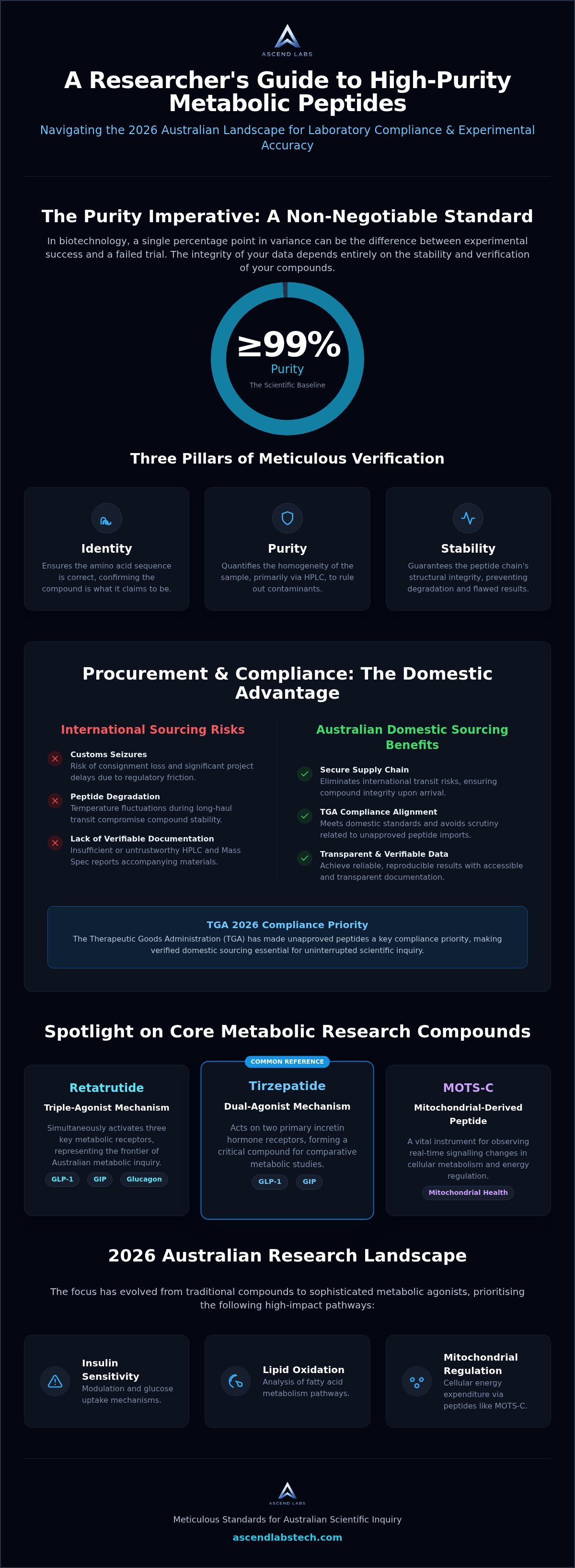
Metabolic peptides act as critical signalling molecules that modulate complex biological pathways, particularly those governing glucose metabolism and cellular energy expenditure. While early Australian laboratory focus often centred on traditional recovery peptides, the 2026 research climate has shifted toward sophisticated metabolic agonists. This evolution is driven by a requirement for high-purity metabolic peptides australia to ensure that experimental results remain repeatable across multiple cohorts. Researchers now look beyond simple hormonal mimetic effects, focusing instead on the nuance of multi-receptor activation.
To explore the broader scientific context and potential risks associated with these compounds, consider this expert overview:
Metabolic Signalling and Research Utility
Modern inquiry prioritises how specific amino acid sequences facilitate the study of insulin sensitivity and lipid oxidation within in-vitro models. Accurate data collection depends on the stability of the peptide chain; if a compound lacks structural integrity, the resulting observations of metabolic flux will be fundamentally flawed. Securing high-purity metabolic peptides australia is now the primary objective for laboratories aiming to eliminate variables in complex metabolic assays. Scientists don't settle for unverified reagents when investigating the following pathways:
- Insulin sensitivity modulation and glucose uptake.
- Lipid oxidation and fatty acid metabolism.
- Mitochondrial energy regulation via peptides like MOTS-C.
By using What are peptides as a foundational reference, researchers can better understand the secondary and tertiary structures that define these metabolic tools. Mitochondrial-derived peptides have emerged as vital instruments for observing real-time signalling changes in cellular metabolism without the noise of lower-grade reagents.
The Australian Research Landscape in 2026
The Australian biotechnology sector has matured into a series of specialised hubs dedicated to metabolic pathway discovery. A significant trend in 2026 is the preference for domestic procurement to avoid the regulatory friction and temperature fluctuations inherent in international shipping. The TGA has made unapproved peptides a compliance priority this year, making domestic sourcing even more critical for laboratory security and legal certainty. For serious practitioners, the distinction between 'Research Grade' and 'Commercial Grade' is absolute. Research-grade compounds require rigorous verification to meet the standards of the domestic scientific community. You can find the necessary metabolic research compounds within our curated catalogue. Triple-agonist research, involving the simultaneous activation of GLP-1, GIP, and glucagon receptors, represents the current frontier of Australian metabolic inquiry. This multi-pathway approach requires a level of purity that only meticulous domestic verification can provide.
Defining High-Purity: The Gold Standard for Laboratory Compounds
In metabolic inquiry, purity is not a subjective metric. It is a quantitative requirement. A purity level of ≥99% constitutes the absolute baseline for credible results in any Australian laboratory. When sourcing high-purity metabolic peptides australia, researchers must look beyond the label. Lower-grade compounds introduce exogenous variables that obscure signalling outcomes and invalidate complex data sets. Accuracy requires a commitment to three-part verification: identity, purity, and stability. Without these benchmarks, the reproducibility of your research is fundamentally compromised.
The Role of HPLC in Research Integrity
High-Performance Liquid Chromatography (HPLC) serves as the primary diagnostic tool for assessing chemical homogeneity. It operates by separating the components of a sample to identify residual solvents, trifluoroacetic acid (TFA) salts, or truncated peptide sequences. These impurities are common byproducts of the synthesis process that can interfere with cellular assays. Researchers shouldn't accept generic templates or representative data from previous years. Each batch requires its own specific report to ensure the integrity of in-vitro experimental data. If a supplier cannot provide batch-specific HPLC results, the compound's suitability for precision research remains unverified.
Mass Spectrometry and Sequence Verification
While HPLC measures the concentration of the target molecule, Mass Spectrometry (MS) confirms its identity. By measuring the mass-to-charge ratio, MS provides a definitive molecular weight verification. This step is crucial because the global market occasionally presents mislabelled peptides, where a compound's actual sequence doesn't match its description. Domestic testing within Australia provides a necessary layer of security against these discrepancies. You can examine our standardised Peptide Purity Testing protocol to understand the technical depth required for high-end research. This dual-testing approach ensures that the compound in the vial is exactly what is written on the label.
A Certificate of Analysis (COA) is a dynamic technical record, not a static marketing asset. It must be tied to a specific lot number and include both HPLC and MS data. For specialists who value precision, these documents are the only way to verify that high-purity metabolic peptides australia meet the rigorous demands of advanced metabolic studies. Our curated selection of metabolic research compounds is defined by this commitment to technical transparency and scientific truth. Maintaining these standards ensures that Australian labs remain at the forefront of global peptide science while ensuring absolute experimental accuracy.
Core Metabolic Compounds: Retatrutide, Tirzepatide, and MOTS-C
The hierarchy of metabolic research tools is defined by receptor affinity and signalling breadth. While early research focused on single-pathway activation, the 2026 landscape is dominated by multi-agonist compounds that target several metabolic receptors simultaneously. This evolution allows Australian scientists to observe more complex physiological interactions within in-vitro models. Securing high-purity metabolic peptides australia is the only way to ensure these multi-receptor interactions aren't obscured by chemical noise or structural degradation. Precision in synthesis correlates directly with the clarity of your experimental observations.
Retatrutide: The Triple Agonist Frontier
The most significant advancement in recent years is the transition from dual to triple-agonist mechanisms. While Tirzepatide focuses on the dual activation of the glucagon-like peptide-1 (GLP-1) and glucose-dependent insulinotropic polypeptide (GIP) receptors, Retatrutide introduces a third layer of complexity by targeting the glucagon receptor. This triple-agonist approach facilitates the study of enhanced energy expenditure alongside traditional glucose management pathways. Australian laboratories prioritise high-purity Retatrutide for receptor affinity studies because even minor impurities can alter the binding efficacy of the glucagon component, leading to inconsistent data. Accurate metabolic profiling requires a compound that maintains the precise ratio of activity across all three target sites.
Mitochondrial Peptides: MOTS-C and KLOW
Mitochondrial-derived peptides (MDPs) represent a distinct category of research tools that function as retrograde signalling molecules. Unlike receptor-based agonists, these compounds influence metabolic flexibility by regulating mitochondrial gene expression and cellular stress responses. MOTS-C is frequently utilised in studies involving lipid metabolism and insulin sensitivity at the intracellular level. When evaluating KLOW vs MOTS-C, researchers must consider the specific metabolic pathway under inquiry. KLOW is often selected for its role in cellular longevity and protein homeostasis, whereas MOTS-C remains the primary choice for observing acute metabolic shifts. Both compounds require meticulous domestic verification to ensure they remain biologically active during transit and storage.
The efficacy of these research tools depends on their structural integrity. In the Australian context, the shift toward triple-agonists and MDPs has increased the technical burden on quality assurance. Researchers don't just require a chemical; they require a verified signalling tool. By sourcing high-purity metabolic peptides australia, laboratories can focus on the nuances of cellular metabolism without questioning the baseline quality of their reagents. This commitment to data-first procurement is what separates advanced practitioners from those using commercial-grade alternatives. You can view our full technical catalogue of metabolic research compounds to see how these specifications are maintained for the domestic scientific community.
Procurement and Compliance: Sourcing Research Peptides Domestically
Domestic procurement is the only viable path for maintaining the integrity of high-purity metabolic peptides australia. International supply chains are fraught with variables that compromise chemical stability. Customs delays don't just stall research; they degrade the product. When a peptide sits in an uncontrolled warehouse environment for weeks, the risk of peptide bond hydrolysis increases significantly. Local sourcing eliminates these international regulatory frictions and ensures that the compounds arrive in a state that reflects their original synthesis reports.
The logistical advantages of an Australian-owned supply chain extend beyond simple speed. It allows for a chain of custody that prioritises the physical requirements of sensitive signalling molecules. High-end research demands a domestic partner that understands the specific environmental challenges of the Australian climate. This ensures that the 99% purity benchmark verified at the laboratory is the same purity that reaches your bench.
Understanding the Australian Regulatory Landscape
Australian regulation in 2026 is precise regarding the distinction between therapeutic goods and research chemicals. Reputable suppliers operate with a clinical focus on in-vitro inquiry and strictly prohibit any references to human consumption. This isn't merely a formality; it's a fundamental requirement for maintaining professional laboratory standards. Compliance ensures that your procurement remains within the legal framework established for scientific advancement. For a deeper understanding of these technical boundaries, you may review our GIP Receptor Agonist overview. This technical context is essential for laboratories that prioritise long-term operational security and ethical research practices.
Ensuring Compound Stability During Transit
Stability is the cornerstone of experimental accuracy. Most high-purity metabolic peptides australia are supplied in a lyophilised (freeze-dried) state to maximise their shelf life and resistance to temperature fluctuations. While lyophilisation provides a robust barrier against degradation, domestic express logistics further minimise the time compounds spend outside of climate-controlled environments. It's a structured approach to risk management. Once received, researchers must adhere to strict storage protocols, typically involving refrigeration for short-term use or freezing at -20°C for long-term preservation. This discipline ensures that the molecular structure remains intact for the duration of the study. Discreet domestic shipping provides an additional layer of professional service, ensuring that sensitive research materials are handled with the necessary level of operational discretion.
Ascend Labs: Meticulous Standards for Australian Scientific Inquiry
Ascend Labs operates as a disciplined curator for the domestic scientific community, prioritising technical transparency over commercial hyperbole. Our philosophy is defined by a "substance over style" approach, ensuring that every compound in our catalogue meets the non-negotiable requirements of advanced inquiry. We don't act as a mere vendor; we position ourselves as a principled institution that values scientific truth above all else. By focusing strictly on the Australian market, we maintain an exclusive and meticulous operation that serves as a reliable partner for serious research. This dedication to precision is why specialists rely on us for high-purity metabolic peptides australia when their data cannot afford the risk of chemical variance.
The Ascend Labs Verification Process
Our verification protocol involves a data-first approach to batch selection and quality assurance. We don't rely on outdated or representative certificates from third-party manufacturers. Instead, each lot of high-purity metabolic peptides australia undergoes internal scrutiny to confirm its chemical profile before it's released for procurement. This rigorous standard is particularly vital for advanced metabolic agonists like Retatrutide and Tirzepatide, where structural homogeneity is essential for accurate receptor affinity studies. Our internal standards for batch selection include:
- Stringent assessment of chemical homogeneity and molecular mass.
- Verification of lyophilisation quality to ensure long-term stability.
- Clinical and professional support tailored to the specific needs of the research community.
By maintaining these elevated benchmarks, we provide the technical transparency required for reproducible laboratory results. We understand that your research is only as valid as the reagents you use, which is why we provide the quiet confidence of an expert who prioritises integrity over marketing jargon.
Partnering with Australian Laboratories
Partnering with Ascend Labs means engaging with a supplier that understands the nuances of metabolic science and the logistical challenges of the Australian landscape. We provide the speed and reliability that international vendors cannot match, effectively removing the variables of customs friction and long-haul transit degradation. Our commitment to data integrity allows lead researchers and procurement officers to focus on their primary objectives without the burden of verifying reagent quality. We invite you to engage with a supplier that acts as an authoritative scientific gatekeeper, ensuring that your laboratory remains at the forefront of metabolic discovery. You can access our comprehensive products list to review current availability and technical specifications for your upcoming research projects. Securing your supply chain with a domestic, high-purity partner is the most effective way to maintain the professional standards of your scientific inquiry.
Advancing the Precision of Australian Metabolic Inquiry
The 2026 research landscape demands a level of chemical integrity that exceeds traditional industry standards. By prioritising ≥99% purity and comprehensive HPLC and Mass Spectrometry verification, laboratories can eliminate the exogenous variables that compromise complex metabolic data. The transition toward advanced triple-agonist compounds like Retatrutide represents the new frontier of scientific discovery; however, these findings are only as reliable as the reagents used. Securing high-purity metabolic peptides australia through a domestic supply chain ensures that your compounds arrive without the degradation risks inherent in international transit.
Ascend Labs remains committed to the principles of technical transparency and scientific truth. We specialise in advanced triple-agonist research tools and provide domestic Australian dispatch for all orders to maintain a secure chain of custody. Our role is to act as a disciplined curator for the scientific community, ensuring that your bench work is supported by meticulous quality control and rigorous verification protocols. This data-first approach provides the stability required for accurate in-vitro observations.
We look forward to supporting your next breakthrough with the precision and reliability your research deserves.
Frequently Asked Questions
What defines 'high-purity' in the context of metabolic research peptides?
Purity refers to the percentage of the target peptide relative to other organic impurities. In metabolic research, a threshold of ≥99% is the clinical gold standard. This ensures that experimental variables are minimised and that receptor signalling is accurately observed. High-purity metabolic peptides australia are characterised by the absence of truncated sequences, residual solvents, or salts that could interfere with in-vitro assays.
How do I verify the purity of a metabolic peptide batch in Australia?
Verification requires a combination of High-Performance Liquid Chromatography (HPLC) and Mass Spectrometry (MS). HPLC identifies the purity percentage by separating chemical components, while MS confirms the compound's identity by measuring its mass-to-charge ratio. You should always request a batch-specific Certificate of Analysis (COA) rather than a generic template. This documentation provides the technical transparency necessary for maintaining professional laboratory standards during your inquiry.
Why is domestic Australian shipping preferred for sensitive compounds like Retatrutide?
Domestic shipping eliminates the risks associated with international customs delays and uncontrolled temperature fluctuations during long-haul transit. Peptides are sensitive signalling molecules that can undergo hydrolysis if exposed to heat or moisture for extended periods. By using a domestic supplier, you ensure a faster chain of custody and a more stable environment. This speed is essential for preserving the structural integrity of advanced triple-agonists like Retatrutide.
What is the difference between Retatrutide and Tirzepatide in a research setting?
The primary difference lies in their receptor activation profiles. Tirzepatide functions as a dual agonist, targeting the GLP-1 and GIP receptors. In contrast, Retatrutide is a triple agonist that also activates the glucagon receptor. This additional pathway allows researchers to observe more complex interactions regarding energy expenditure and lipid metabolism. Choosing between them depends on whether your study requires a dual or triple-receptor signalling model for its specific metabolic assays.
Are metabolic peptides from Ascend Labs suitable for in-vitro studies?
Yes, our entire catalogue is specifically curated for in-vitro research and laboratory applications. Ascend Labs prioritises the needs of the Australian scientific community by providing high-purity metabolic peptides australia that meet rigorous domestic standards. Every compound is selected for its chemical stability and structural accuracy. This focus on research-grade quality ensures that your laboratory can produce reliable and reproducible data without the noise introduced by commercial-grade alternatives.
How should research-grade metabolic peptides be stored to maintain integrity?
Lyophilised peptides should be stored in a cool, dry environment away from light. For short-term use, refrigeration at 4°C is typically sufficient. For long-term preservation, compounds should be kept in a freezer at -20°C or -80°C to prevent degradation. It's vital to avoid frequent freeze-thaw cycles, as this can damage the peptide bonds. Always allow the vial to reach room temperature before reconstitution to prevent condensation from forming inside the vial.
Does Ascend Labs provide Certificates of Analysis for every compound?
We maintain a strict policy of technical transparency and provide batch-specific documentation for our research compounds. This includes HPLC and Mass Spectrometry reports that verify both the purity and the identity of the peptide. We don't rely on static marketing documents; instead, we provide dynamic technical records that correlate directly with the lot number you receive. This commitment to data integrity helps researchers maintain strict laboratory compliance and experimental accuracy.
Can these peptides be used for clinical trials or human consumption?
No, these compounds are strictly for laboratory research and in-vitro purposes only. Ascend Labs don't provide prescription medications or products intended for human consumption. It's illegal to possess or use these research-grade chemicals for therapeutic purposes without a valid prescription from a registered medical practitioner. Our operation is dedicated solely to the advancement of peptide science within a controlled laboratory environment, and we strictly prohibit any references to human use.


