

In the precise world of metabolic research, a Certificate of Analysis is often the only barrier between a significant breakthrough and a contaminated dataset. It's a reality that many Australian researchers face, where the domestic market is often saturated with inconsistent syntheses and obscure documentation. When sourcing hplc tested peptides australia, the distinction between a commercial-grade product and a true laboratory standard becomes the defining factor for your project's success. You've likely encountered vendors who prioritise marketing over molecular accuracy, leaving the integrity of your scientific inquiry at risk.
Securing verified compounds is the fundamental baseline for any credible laboratory work. This article provides the technical framework you need to master the requirements for verifying peptide purity and identifying genuine laboratory-grade standards. We'll examine the critical role of High-Performance Liquid Chromatography and Mass Spectrometry in establishing a reliable domestic supply chain. By the end of this briefing, you'll have the expertise to verify molecular integrity with absolute confidence, ensuring your research is built on a foundation of scientific truth and meticulous quality control.
Key Takeaways
- Understand how chemical contaminants in research compounds can skew metabolic data and compromise the reproducibility of your scientific findings.
- Learn the technical distinction between High-Performance Liquid Chromatography for purity verification and Mass Spectrometry for molecular identity.
- Discover the methodology for accurately decoding a Certificate of Analysis (COA) to verify the authenticity of hplc tested peptides australia.
- Identify why a domestic Australian supply chain is critical for maintaining the cold chain and protecting the molecular integrity of research compounds.
- Apply a 5-point audit to evaluate peptide suppliers based on laboratory accreditation, batch transparency, and specialised research range.
The Critical Necessity of Purity Standards in Australian Research
Scientific inquiry relies on the absolute stability of its variables. In metabolic and neuromodulator research, the presence of even minor contaminants can invalidate months of observation and resource allocation. For those sourcing hplc tested peptides australia, the demand for transparency isn't merely a preference; it's a safeguard against synthesis errors that often occur during industrial-grade production. While industrial synthesis focuses on volume, research-grade synthesis prioritises the elimination of truncated sequences and residual solvents. These impurities act as uncontrolled variables, potentially altering the binding affinity or metabolic pathways being studied. Without rigorous verification, a researcher cannot distinguish between the biological effect of the peptide and the interference caused by a synthesis byproduct.
Reproducibility and the Scientific Method
Experimental reproducibility is the cornerstone of the scientific method. Trace impurities, often undetected by basic testing, can lead to false-positive results in in-vitro studies by triggering unintended cellular responses. Consistent molecular weight across batches ensures that results from one phase of research can be reliably compared to the next. This is particularly vital in mitochondrial and longevity research, where precise dosing is contingent on the absolute purity of the compound. Utilising High-Performance Liquid Chromatography (HPLC) allows researchers to identify the exact purity profile of a batch. It ensures that the observed effects are attributed to the peptide itself rather than chemical byproducts. When purity levels fluctuate, the data becomes skewed, leading to conclusions that cannot be replicated by other laboratories.
The Australian Regulatory Landscape for Research Chemicals
The Australian scientific community operates under rigorous expectations for domestic laboratory supply. Relying on manufacturer data from overseas often presents a significant risk. These reports may lack the specificity required by local standards or fail to reflect the degradation that occurs during international transit. Domestic verification provides a layer of security that international documentation cannot match. There is a clear ethical obligation for suppliers to provide accurate molecular verification for all metabolic research compounds. This transparency maintains the integrity of the domestic supply chain.
Key advantages of domestic standards include:
- Elimination of data discrepancies between synthesis and delivery.
- Verification of the cold chain integrity during local transit.
- Adherence to Australian laboratory accreditation benchmarks.
- Batch-specific accountability that international vendors often avoid.
In 2026, the Australian market has shifted toward a substance over style approach. Batch-specific data is now the only acceptable proof of quality for serious scientific inquiry. By insisting on these standards, researchers protect their work from the contamination risks inherent in inferior synthesis processes.
Defining Third-Party Testing: HPLC and Mass Spectrometry
Verification of chemical integrity requires more than a manufacturer's assurance. In high-stakes scientific inquiry, internal in-house testing is insufficient because it lacks the objective distance necessary for rigorous quality control. Independent, accredited laboratories serve as the final gatekeepers, providing unbiased data that confirms a compound's molecular profile. For those sourcing hplc tested peptides australia, third-party verification is the only method to ensure that the material received matches the theoretical design of the synthesis.
HPLC: Quantifying Peptide Purity
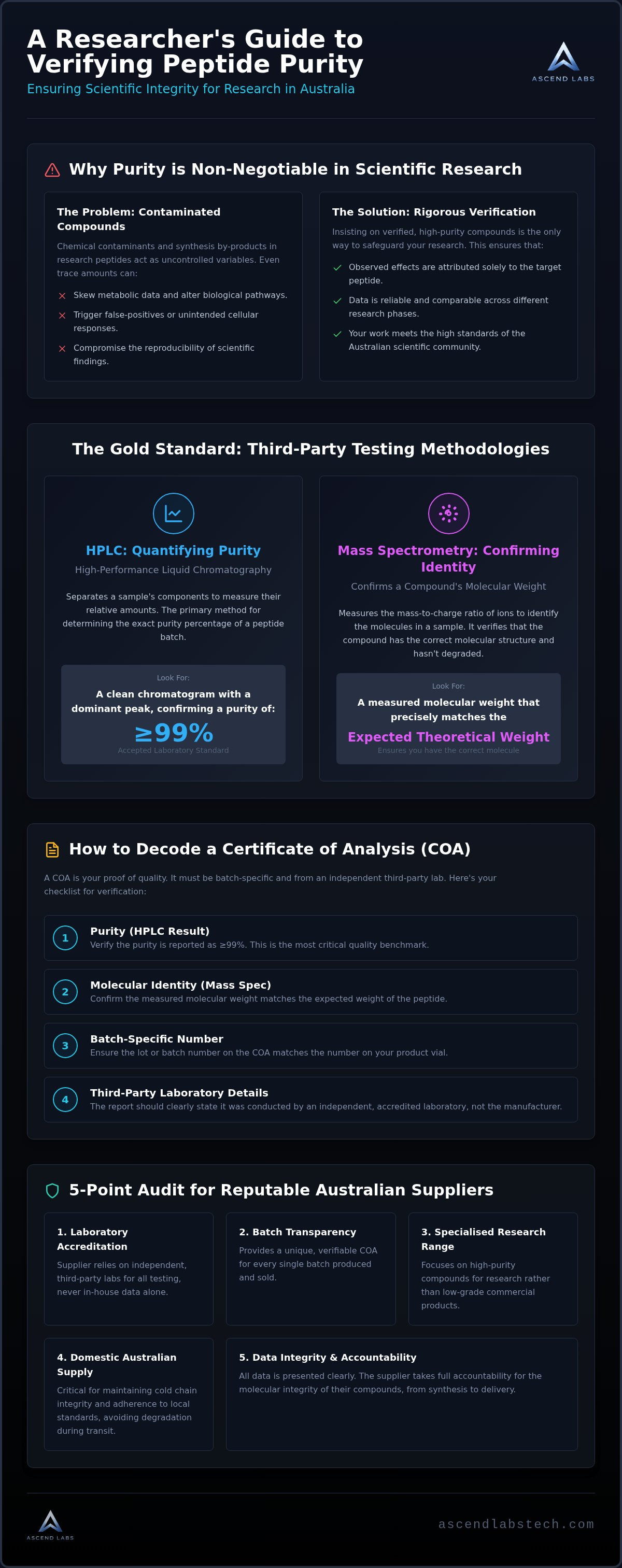
High-Performance Liquid Chromatography (HPLC) is the primary analytical tool used to determine the purity of a sample. The process involves passing the peptide through a column filled with a stationary phase under high pressure. Different chemical components move through the column at varying speeds, allowing them to be separated and measured individually. Purity is calculated using the "Area Under the Curve" (AUC) method on the resulting chromatogram.
For laboratory-grade research, a purity threshold of ≥99% is the accepted industry standard. When reviewing a standard HPLC report, a clean peak indicates a highly pure compound. Conversely, "noise" or smaller secondary peaks suggest the presence of residual solvents, salts, or truncated peptide sequences. These contaminants can interfere with cellular assays, making the identification of clear results nearly impossible. When evaluating hplc tested peptides australia, the presence of a sharp, singular peak on the chromatogram is the first indicator of a successful synthesis.
Mass Spectrometry: Confirming Molecular Identity
While HPLC measures how much of the substance is the target compound, it cannot confirm that the substance is actually the intended peptide. Mass Spectrometry (MS) addresses this by measuring the mass-to-charge ratio of the molecules. By ionising the sample, MS provides a precise molecular weight that must align with the theoretical mass of the specific peptide sequence.
An HPLC purity test is scientifically incomplete without a corresponding MS identity test. This is particularly critical for complex, long-chain peptides such as Retatrutide or Tirzepatide, where the risk of amino acid deletions during synthesis is significantly higher. Without MS data, a researcher might receive a 99% pure substance that is actually the wrong molecule entirely. To ensure your project begins with the correct chemical foundations, you may wish to explore our verified research catalogue, where identity and purity are established through independent laboratory standards. This dual-layered verification provides the certainty required for advanced metabolic and neuromodulator research.
Decoding the Certificate of Analysis (COA) for Peptides
A Certificate of Analysis (COA) serves as the primary instrument of verification for any research compound. For professionals seeking hplc tested peptides australia, the ability to scrutinise these documents separates valid scientific inquiry from compromised experimentation. A valid COA must include specific, non-negotiable elements: a unique batch number, a clear testing date, and the credentials of an accredited third-party laboratory. Without these identifiers, the document lacks the necessary chain of custody to ensure that the data reflects the physical compound in your laboratory. Documentation that is generic or lacks batch-specific details is a significant indicator of synthesis inconsistency.
The Anatomy of a Professional HPLC Report
Reading a professional HPLC report requires a focused analysis of the chromatogram and the corresponding summary table. The retention time indicates exactly when the peptide eluted from the column, while the area percentage quantifies the relative concentration of the target molecule. A clean peak, characterized by a sharp ascent and a smooth baseline, confirms high purity. It's essential to ensure the batch number on the report matches the physical vial's label to maintain experimental integrity. For a deeper technical breakdown of these standards, researchers should consult our guide on peptide purity testing, which outlines the specific protocols used for Australian research verification.
Verifying Laboratory Authenticity
In the fast-moving research chemical market, timestamped data is critical. A report from several years ago does not accurately represent the integrity of a current synthesis. Authentic third-party audits are performed by independent facilities that have no financial stake in the sale of the compound. This is a vital distinction from manufacturer-provided COAs, which often lack the impartiality required for high-stakes research. Disciplined researchers often contact the testing facilities directly to verify report authenticity, ensuring the data hasn't been recycled or altered.
When evaluating documentation, look for these specific red flags:
- Generic templates that lack specific laboratory branding or verifiable contact details.
- Inconsistencies between the theoretical mass and the observed mass in the MS reports.
- Recycled reports where the date or batch number appears to have been digitally manipulated.
- Missing chromatograms, where only a summary table is provided without visual proof of the peak.
If a supplier is reluctant to provide batch-specific documentation or if the laboratory details are obscured, the integrity of the compound is fundamentally unverified. This level of meticulousness ensures that your domestic supply chain remains untainted by the synthesis errors common in international grey markets. Precision in documentation is the only path to scientific truth.
Selecting a Reputable Australian Peptide Supplier
Procuring research compounds in the domestic market requires a disciplined approach that prioritises empirical data over community sentiment. While retail-heavy websites often rely on marketing hyperbole and community "votes," a professional researcher understands that these are not substitutes for technical auditing. When evaluating sources for hplc tested peptides australia, you should apply a 5-point audit to ensure the integrity of your supply chain. This audit focuses on purity verification, batch transparency, domestic logistics, technical support, and the depth of the specialised research range. A supplier's commitment to these standards is the only reliable indicator of their suitability for serious scientific inquiry.
The presence of advanced metabolic compounds like KLOW or MOTS-C serves as a litmus test for a supplier's technical relevance. Stocking these specialised sequences indicates a sophisticated understanding of current biotechnology trends. A reputable supplier acts as a scientific gatekeeper, ensuring that every vial in their catalogue meets the rigorous requirements of modern laboratory standards.
Domestic Supply Chain Advantages
Maintaining the cold chain is a critical logistical challenge that international vendors often fail to address. Peptides are delicate molecular structures; exposure to fluctuating temperatures during lengthy international transit can lead to significant degradation. By choosing a domestic supplier, you avoid the risks of international customs delays and the degradative effects of long-haul shipping. A domestic supply chain allows for temperature-controlled handling and discreet, rapid delivery, ensuring the compound's molecular stability remains intact upon arrival. These factors are central to the criteria for a reputable Australian peptide supplier, where the focus is on maintaining the integrity of the compound from the laboratory to your facility.
Technical Support and Research Resources
The procurement of hplc tested peptides australia should be supported by comprehensive technical documentation. A professional supplier doesn't just provide a product; they provide the data sheets and stability information necessary for complex procurement. This expert guidance is particularly valuable when sourcing compounds for mitochondrial peptide research, where precise molecular weights and sequence accuracy are non-negotiable. You should evaluate a supplier's professionalism through their digital lexicon and their willingness to provide batch-specific verification. If a vendor's communication lacks clinical depth, it's unlikely their quality control protocols meet the standards required for advanced research.
Ascend Labs: Meticulous Standards for Australian Science
Ascend Labs acts as an authoritative scientific gatekeeper within the Australian research community. Our philosophy is built on the premise that scientific truth and integrity are the only acceptable foundations for compound supply. In an environment where synthesis quality can be inconsistent, we position ourselves as a disciplined curator of high-purity laboratory standards. We don't present ourselves as a conventional vendor; rather, we function as a principled institution that values operational discretion and professional ethics. Precision is our baseline. By ensuring access to hplc tested peptides australia, we remove the risks associated with inferior synthesis and provide a reliable domestic supply chain for advanced metabolic research.
Specialised Metabolic and Recovery Compounds
The current trajectory of biotechnology has highlighted the necessity for more sophisticated molecular sequences. Our catalogue is focused on the frontier of triple agonist research, particularly Retatrutide, which provides unique opportunities for studying multi-pathway metabolic regulation. Beyond metabolic inquiry, the role of growth factor and recovery peptides has become increasingly critical in modern tissue repair and cellular regeneration studies. These compounds require exacting synthesis protocols to ensure the amino acid sequences are truncated-free and biologically active. You can explore our meticulously selected range through the research peptide catalogue, which serves as a benchmark for domestic quality and scientific relevance.
Uncompromising Quality Control Protocols
Our operational standards are defined by a laboratory-first approach to logistics and verification. Ascend Labs maintains a sophisticated supply chain that prioritises the maintenance of the cold chain; this ensures that molecular integrity is preserved from synthesis to delivery. We believe in exclusivity and meticulousness, focusing on a curated selection of compounds that meet the expectations of advanced practitioners. Every batch is subjected to rigorous third-party verification, including both HPLC and Mass Spectrometry, to confirm purity and identity. This commitment to domestic excellence ensures that researchers can procure Ascend Labs products with the quiet confidence that their data is built on a foundation of absolute precision. When you source hplc tested peptides australia through our facility, you're engaging with a partner that values substance over style and data over marketing.
Establishing Scientific Certainty in Australian Research
The integrity of metabolic research hinges on the absolute verification of molecular purity. By mastering the interpretation of HPLC and Mass Spectrometry data, researchers can effectively mitigate the risks of synthesis contamination and experimental variance. Selecting a domestic supplier that prioritises batch-specific transparency and rigorous cold chain logistics ensures that your chemical foundations remain uncompromised. Sourcing hplc tested peptides australia represents a commitment to these meticulous laboratory-grade standards. Ascend Labs remains a dedicated, Australian-owned and operated partner, providing specialised domestic logistics for the most advanced scientific inquiries.
Secure the future of your research with compounds that reflect the highest echelon of molecular accuracy.
Frequently Asked Questions
Why is third-party testing more reliable than manufacturer testing?
Third-party testing provides an objective layer of verification that manufacturer-provided data cannot match. Manufacturers possess an inherent conflict of interest; their primary goal is synthesis volume rather than critical self-audit. Independent laboratories act as impartial gatekeepers, ensuring every vial of hplc tested peptides australia meets the theoretical design. This separation of production and verification is essential for maintaining the scientific integrity of your research datasets and avoiding synthesis bias.
What is the minimum purity percentage required for valid scientific research?
The accepted industry standard for high-stakes scientific research is a purity level of ≥99%. While some industrial-grade suppliers offer compounds at 95% or 98% purity, these lower thresholds often contain synthesis byproducts like truncated sequences or residual salts. These contaminants act as uncontrolled variables in metabolic studies, potentially skewing results. Maintaining a 99% baseline ensures that observed biological effects are attributed solely to the specific peptide being studied.
How do I verify a Certificate of Analysis (COA) is genuine?
Verifying a Certificate of Analysis (COA) requires a meticulous audit of the document's metadata and visual data. You should confirm the batch number on the report aligns perfectly with the physical vial's label. A genuine COA must include the laboratory's accreditation details and a clear, sharp chromatogram peak. If you're uncertain, you can contact the testing facility directly to verify the report's authenticity and ensure the data hasn't been digitally manipulated.
Does third-party testing cover every single batch of peptides?
A disciplined supplier ensures that every unique synthesis batch undergoes separate verification. You shouldn't rely on a representative report from a previous production year. Each production run carries its own risk of synthesis errors or amino acid deletions, particularly with complex sequences. Professional domestic suppliers provide batch-specific reports for their hplc tested peptides australia, ensuring the specific material in your laboratory matches the provided documentation with absolute precision.
What are the most common impurities found in unverified research peptides?
Unverified research peptides often contain residual solvents like acetonitrile or trifluoroacetic acid (TFA), which are used during the synthesis and purification phases. Other common impurities include truncated sequences, where the amino acid chain hasn't formed completely, and residual salts. These substances can trigger unintended cellular responses in in-vitro studies. Using verified compounds eliminates these variables, protecting the molecular accuracy of your metabolic or neuromodulator research projects.
How does domestic Australian shipping impact peptide stability?
Domestic Australian shipping is critical for maintaining the cold chain and protecting delicate molecular structures. Peptides are sensitive to thermal degradation; lengthy international transit times increase the risk of exposure to extreme temperatures. Australian-owned suppliers utilise specialised domestic logistics to ensure rapid delivery. This controlled handling minimises the time a compound spends in transit, preserving its stability and ensuring it arrives with its molecular integrity fully intact for laboratory use.
Can I request specific HPLC data before purchasing a research compound?
You can, and should, request batch-specific HPLC data before procurement. A transparent supplier will provide these technical data sheets as a standard part of their professional service. Reviewing this information allows you to verify the purity threshold and identify any noise in the chromatogram baseline before committing your research budget. If a vendor is reluctant to share this data, it's a clear indicator that their quality control protocols may be insufficient for scientific standards.
What is the difference between HPLC and Mass Spectrometry in peptide verification?
HPLC and Mass Spectrometry (MS) serve distinct but complementary roles in the verification process. HPLC quantifies the purity of the sample, measuring the percentage of the target compound relative to impurities. Mass Spectrometry confirms the identity of the molecule by measuring its precise molecular mass against the theoretical sequence. A compound can be 99% pure according to HPLC but be the entirely wrong molecule without MS verification. Both are required for absolute certainty.


