

The evolution from dual to triple agonism represents the most significant shift in metabolic science since the initial synthesis of GLP-1. While Tirzepatide has long served as the benchmark for multi-receptor activity, the emergence of triple-agonist models is forcing a re-evaluation of established laboratory protocols. When conducting Tirzepatide vs Retatrutide research Australia based scientists must look beyond simple weight loss metrics to understand the intricate interplay of GIP, GLP-1, and glucagon pathways.
You likely recognise that moving from dual-receptor targeting to the more complex triple-agonist mechanism introduces significant variables into your data sets. It's difficult to maintain research integrity when receptor agonism ratios remain ambiguous or when domestic sourcing feels like a logistical hurdle. This technical comparison provides a clear framework for selecting the most appropriate metabolic model for your specific inquiry. We'll examine the biochemical distinctions between these compounds, provide data to justify your model selection, and outline the pathways for securing high-purity, laboratory-grade materials within the Australian domestic market.
Key Takeaways
- Understand the biochemical shift from dual GIP/GLP-1 agonism to the triple-target mechanism of Retatrutide and its impact on metabolic pathway analysis.
- Establish a precise framework for Tirzepatide vs Retatrutide research Australia to ensure your model selection aligns with specific glucose-centric or energy-focused study parameters.
- Master the interpretation of HPLC and COA verification data to maintain the rigorous purity standards required for credible laboratory inquiry.
- Optimise research continuity by prioritising domestic supply chains that mitigate the regulatory complexities and risks of international peptide procurement.
- Refine laboratory protocols by understanding how multi-pathway compounds are redefining metabolic research standards in the 2026 landscape.
The Evolution of Metabolic Agonist Research in Australia
The landscape of metabolic research has undergone a profound transformation. Initial inquiries focused almost exclusively on the Glucagon-like peptide-1 (GLP-1) receptor. While this single-pathway approach provided foundational data, it eventually reached a ceiling regarding metabolic efficacy. By 2026, the focus has shifted toward compounds that engage multiple hormonal pathways simultaneously to better mirror biological complexity.
This progression reflects a deeper understanding of how incretin hormones interact within biological systems. Researchers now prioritise agents that mimic the natural synergy of endogenous hormones. For those engaged in Tirzepatide vs Retatrutide research Australia provides a unique environment where high-purity compounds are essential for mapping these intricate interactions. To better understand the technical differences between these multi-pathway models, watch this helpful video:
The Paradigm Shift to Multi-Receptor Target Models
Single-target metabolic research often fails to account for the compensatory mechanisms inherent in biological systems. The shift toward synergistic receptor activation represents a move toward more holistic metabolic inquiry. Dual-agonism, specifically the GIP and GLP-1 synergy, established a new standard for research protocols. However, the introduction of Retatrutide's triple agonist mechanism has expanded the scope of current studies. By integrating glucagon receptor activation, researchers can now investigate energy expenditure alongside insulin sensitivity. Australian scientists are prioritising these multifaceted pathways to uncover data that single-receptor models simply cannot provide.
Current Trajectory of Incretin Research in Australia
The Australian scientific community has shown a disciplined interest in the evolution of metabolic peptides. In 2026, research standards have become increasingly stringent, requiring meticulous verification of compound purity. Laboratories are moving away from surface-level observations toward deep-tissue and cellular analysis. Establishing a baseline for comparative studies requires access to reliable metabolic research compounds that meet domestic quality benchmarks. This trajectory suggests that the future of Tirzepatide vs Retatrutide research Australia lies in the precise manipulation of triple-agonist models to understand complex metabolic dysfunction.
Analysing Dual vs Triple Agonist Mechanisms: Tirzepatide and Retatrutide
Deconstructing the molecular architecture of these peptides is essential for precise laboratory inquiry. In the context of Tirzepatide vs Retatrutide research Australia based scientists must look beyond simple weight metrics to evaluate how specific receptor affinities influence cellular metabolism. The primary distinction lies in the transition from a dual-pathway model to a triple-agonist framework. This shift fundamentally alters the metabolic levers available for investigation in in-vitro and in-vivo environments.
Molecular stability remains a critical factor for laboratory protocols. Both compounds utilise advanced peptide engineering, such as fatty acid diacid chains, to extend their half-lives and ensure sustained receptor engagement. This stability allows for longitudinal data collection without the volatility often associated with shorter-acting analogues. Researchers looking to implement these protocols can access verified metabolic research compounds through domestic channels to ensure molecular integrity and research continuity.
Tirzepatide: The Dual Agonist Research Benchmark
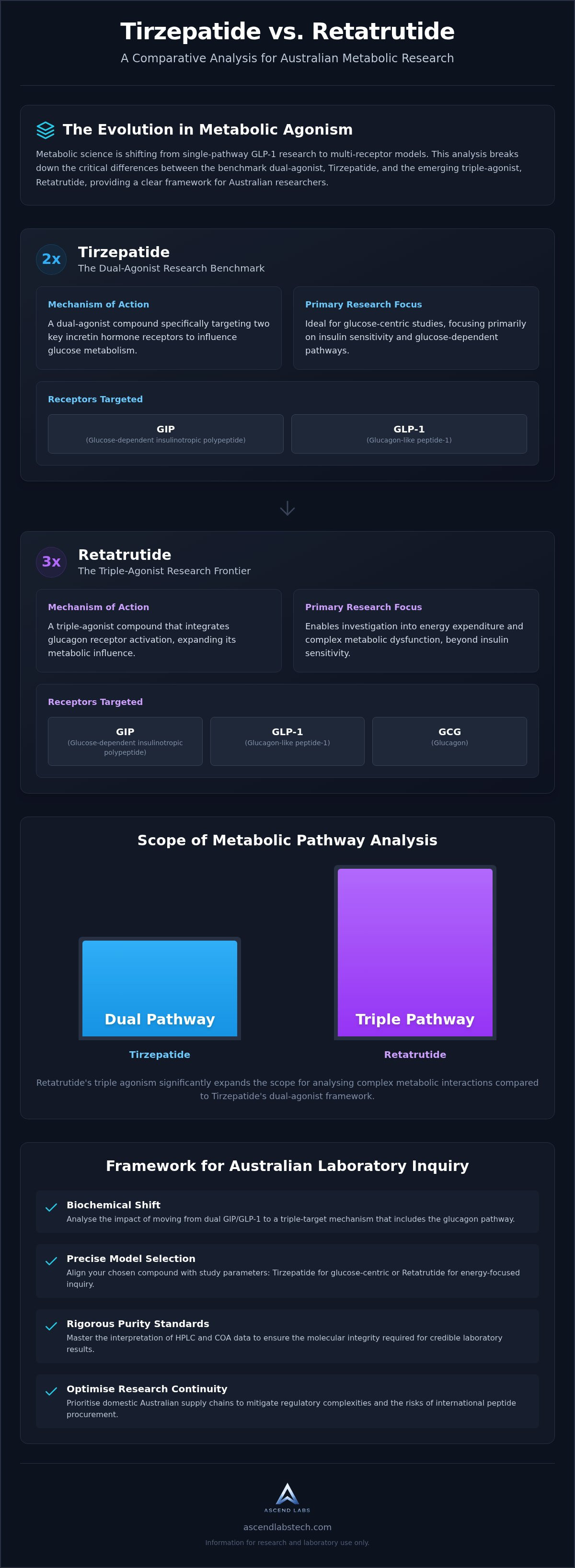
Tirzepatide is a dual-agonist research compound that specifically targets the glucose-dependent insulinotropic polypeptide (GIP) and glucagon-like peptide-1 (GLP-1) receptors. Its mechanism is notably GIP-dominant, with an affinity for the GIP receptor that significantly exceeds its GLP-1 potency. This ratio is intentional. It allows researchers to study how GIP-mediated insulin secretion and lipid metabolism work in tandem with GLP-1's traditional glucose-modulating effects. It's the standard for investigating insulin sensitivity and the synergistic potential of dual incretin activation.
Retatrutide: Triple Agonist Mechanism and Glucagon Integration
Retatrutide represents a new tier of scientific inquiry by integrating a third pathway: the glucagon (GCG) receptor. This triple-action profile (GLP-1, GIP, and GCG) introduces a dimension of energy expenditure that dual agonists lack. While Tirzepatide focuses on insulin and glucose modulation, Retatrutide allows for the study of glucagon-mediated thermogenesis and increased lipid oxidation.
The significance of this triple-target approach includes:
- Enhanced Thermogenesis: Investigating how glucagon receptor activation increases metabolic rate.
- Balanced Agonism: Analysing the precise potency ratios between the three receptors to avoid metabolic overstimulation.
- Lipid Management: Exploring glucagon's role in hepatic fat reduction and systemic energy balance.
By pulling three metabolic levers simultaneously, Retatrutide offers a more comprehensive model for studying complex metabolic dysfunction. It allows for a deeper exploration of how energy expenditure can be modulated alongside traditional incretin-based insulin regulation.
Current Landscape of Retatrutide and Tirzepatide Studies in Australian Labs
The Australian scientific landscape has adapted rapidly to the complexities of multi-receptor agonists. Current laboratory protocols are characterised by a move toward national standardisation, ensuring that data generated in private facilities remains comparable with university-led studies. This collaborative trend is vital for Tirzepatide vs Retatrutide research Australia, as it allows for a more robust pooling of metabolic data across different institutional frameworks. By aligning methodologies, researchers can better understand how these compounds influence complex biological systems.
Regulatory oversight in domestic facilities remains stringent. Researchers must navigate specific requirements for handling research-grade compounds, focusing on biosafety and meticulous documentation. This environment has fostered a culture of precision, where the provenance of a compound is as critical as the study design itself. Domestic facilities are now prioritising supply chains that offer transparency and rigorous quality control to meet these evolving national standards.
Standardising Research Protocols for 2026
Maintaining research integrity requires a disciplined approach to peptide handling. Best practices for reconstituting metabolic peptides now involve specific temperature-controlled environments and the use of bacteriostatic water to prevent degradation. Precise dosage models are essential for replicating the synergistic effects of GIP and GLP-1 pathways without introducing confounding variables. Labs must also implement strict administration schedules to maintain steady-state concentrations in their research models.
Australian labs are increasingly relying on High-Performance Liquid Chromatography (HPLC) verification to confirm the identity and purity of their samples. A Certificate of Analysis (COA) is no longer a luxury but a baseline requirement for any credible metabolic study. By sourcing metabolic research compounds from domestic suppliers that provide this level of verification, researchers can eliminate the ambiguity often associated with international procurement. This focus on purity ensures that experimental outcomes are the result of the compound's mechanism rather than contaminants.
Emerging Research Areas for Triple Agonists
The introduction of Retatrutide has opened new avenues for investigating energy expenditure. While previous studies focused heavily on insulin secretion, current Australian inquiry is shifting toward glucagon-mediated thermogenesis. This allows labs to observe how triple-agonist models influence metabolic rate in ways that dual-agonists cannot. It's a significant expansion of the traditional incretin-based research model.
Comparative studies on lipid metabolism are also gaining traction. Researchers are using these compounds to map how different receptor affinity ratios affect hepatic fat accumulation and systemic lipid profiles. Future directions for Australian inquiry involve the long-term observation of these multi-receptor agonists in complex metabolic models, providing a foundation for the next generation of biochemical research. This evolution ensures that Tirzepatide vs Retatrutide research Australia remains at the forefront of global metabolic science.
Comparative Framework: Selecting the Optimal Research Model
Selecting the correct biochemical model is the most critical decision in modern study design. For Tirzepatide vs Retatrutide research Australia based laboratories must weigh the precision of dual-pathway data against the broader metabolic insights offered by triple-agonism. This choice isn't merely about potency. It's about aligning the compound's specific receptor affinity with the primary research hypothesis to ensure the resulting data is both relevant and reproducible.
Research procurement in Australia requires a disciplined approach to cost-benefit analysis. While triple-agonists may represent a more complex investment in protocol design, the depth of data regarding thermogenesis often justifies the resource allocation. Dual-agonists offer a more streamlined path for focused glucose research. Both models require a commitment to verified purity to maintain the standards expected in the 2026 scientific landscape.
Research Model Selection Criteria
Hypothesis-driven selection is paramount for maintaining laboratory efficiency. When a study focuses on glucose-dependent insulinotropic polypeptide action and insulin sensitivity, Tirzepatide remains the benchmark. Its GIP-dominant profile provides a controlled environment for observing incretin synergy without the interference of glucagon pathways. Conversely, researchers should prioritise Retatrutide when the objective involves comprehensive energy studies. The inclusion of glucagon agonism introduces variables like increased metabolic rate and lipid oxidation. This adds complexity but offers a more complete picture of systemic metabolic modulation.
Technical Challenges in Multi-Agonist Research
Managing the increased variables of a triple-agonist mechanism requires meticulous data tracking. Every additional receptor target increases the potential for confounding interactions within the research model. Ensuring consistency across longitudinal studies depends entirely on the molecular stability of the compound. Australian researchers must account for the logistical realities of procurement. Domestic sourcing reduces lead times and potential environmental exposure during transit. Utilising high purity research peptides is the only way to ensure that metabolic observations aren't skewed by impurities or degradation during the study period.
Sourcing High-Purity Research Compounds for Australian Inquiry
The continuity of Tirzepatide vs Retatrutide research Australia based scientists conduct depends entirely on the stability of their supply chain. International procurement often introduces unacceptable variables, including lengthy transit delays and the increased risk of thermal degradation during global shipping. Domestic supply chains eliminate these hurdles, allowing laboratories to maintain strict experimental timelines without the threat of customs intervention. By prioritising Australian-based procurement, facilities can ensure their metabolic studies remain uncompromised by logistical instability or external environmental factors.
Maintaining the cold chain during Australian domestic transit is a non-negotiable requirement for peptide integrity. Sensitive metabolic compounds require temperature-controlled environments from the moment of synthesis to the point of laboratory delivery. Professional suppliers implement discreet and secure shipping protocols to protect the scientific value of the shipment. This disciplined approach to logistics ensures that the compound's biochemical properties are preserved, allowing for precise and reproducible analysis in a controlled setting.
Verifying Peptide Purity for Laboratory Use
In the Australian scientific community, 99% purity is the established standard for research-grade peptides. Achieving this level of refinement requires advanced purification techniques, primarily High-Performance Liquid Chromatography (HPLC). Mass spectrometry provides an additional layer of verification, confirming the molecular mass and identity of the compound with absolute certainty. A Certificate of Analysis (COA) must be provided for every research batch to verify its purity and chemical composition against established laboratory benchmarks. Without this documentation, the integrity of the metabolic data produced is fundamentally undermined.
Reliable Procurement through Ascend Labs
Professional standards in laboratory procurement require a partner that understands the rigorous demands of Australian researchers. Ascend Labs operates as a premier domestic supplier, offering a specialised metabolic research compound catalogue that adheres to international quality standards. The advantage of an Australian-owned and operated supplier lies in the transparency of the supply chain and the immediacy of technical support. It's about securing a partner that values scientific truth as much as operational efficiency.
The Retatrutide and Tirzepatide catalogue at Ascend Labs is curated with scientific rigor to meet the needs of advanced practitioners. Every compound undergoes strict verification to ensure it meets the requirements of complex metabolic inquiry. By choosing a domestic source, researchers can focus on data collection rather than procurement logistics. This commitment to domestic excellence ensures that Tirzepatide vs Retatrutide research Australia remains grounded in verified data and professional integrity.
Securing the Next Generation of Australian Metabolic Data
The transition toward triple-agonist models represents the next frontier in biochemical inquiry. By understanding the distinct mechanisms of dual and triple-target peptides, laboratories can design studies with greater precision and predictive power. Success in Tirzepatide vs Retatrutide research Australia requires a commitment to rigorous verification and domestic supply continuity. It's no longer enough to observe outcomes; researchers must account for the specific receptor affinity ratios that drive complex metabolic shifts.
Maintaining these standards ensures that every data point is a reflection of the compound's purity rather than environmental contamination. Ascend Labs supports this mission through HPLC and Mass Spectrometry verified compounds, secure domestic Australian shipping, and specialised metabolic research standards. These foundations allow researchers to focus entirely on the nuances of metabolic modulation without the logistical variables of international procurement. We're dedicated to providing the high-purity materials necessary for credible, high-impact scientific discovery.
We look forward to supporting your next breakthrough in metabolic science.
Frequently Asked Questions
What is the primary difference between Tirzepatide and Retatrutide in a research context?
Tirzepatide acts as a dual agonist on GIP and GLP-1 receptors, while Retatrutide functions as a triple agonist by adding glucagon receptor activation. This additional pathway is the central distinction in a laboratory setting. Researchers use the triple-agonist model to study energy expenditure and thermogenesis, whereas the dual-agonist model remains the standard for investigating insulin sensitivity and glucose-dependent pathways. Selecting the correct compound depends entirely on whether the hypothesis requires the inclusion of glucagon-mediated effects.
Is Retatrutide available for research purposes in Australia in 2026?
Retatrutide is available for legitimate laboratory and scientific inquiry through specialised domestic suppliers in 2026. While it remains an unapproved therapeutic good in the Australian Register of Therapeutic Goods (ARTG), researchers can procure it for in-vitro or in-vivo studies. It's essential to source these compounds from reputable Australian providers that adhere to national biosafety and handling standards. This ensures that the material is strictly for research and not for human consumption.
How does the Glucagon receptor agonism in Retatrutide affect metabolic research variables?
Glucagon receptor agonism introduces a dimension of energy expenditure and lipid management that is absent in dual-agonist models. In a research environment, this activation is used to observe increases in metabolic rate and the reduction of hepatic fat. These variables allow for more comprehensive studies into metabolic dysfunction. Scientists must adjust their protocols to account for the thermogenic effects triggered by glucagon, which can significantly alter the baseline data in a longitudinal study.
What purity standards should Australian labs require for Tirzepatide research compounds?
Australian laboratories should mandate a minimum purity standard of 99% for all Tirzepatide research compounds to ensure data reproducibility. High-Performance Liquid Chromatography (HPLC) remains the gold standard for verifying these levels. When conducting Tirzepatide vs Retatrutide research Australia based facilities must eliminate contaminants that could act as confounding variables. Purity levels below this threshold introduce unacceptable risks to the scientific integrity of the trial and the resulting metabolic observations.
Can Retatrutide be used in the same research models as Tirzepatide?
While both compounds are used in metabolic studies, Retatrutide requires a more complex research model to account for its triple-action mechanism. Tirzepatide is ideal for models focused on incretin-based glucose regulation and insulinotropic effects. Retatrutide is better suited for studies investigating energy balance and systemic thermogenesis. Researchers shouldn't simply swap one for the other without re-evaluating the experimental design, as the addition of the glucagon pathway fundamentally changes the biological response.
Why is domestic shipping preferred for Australian peptide research procurement?
Domestic shipping is preferred because it maintains the critical cold chain and avoids the regulatory risks associated with international peptide importation. Australian Border Force actively screens for peptide imports, which can lead to seizures or significant delays. By using a domestic supplier, labs ensure that compounds arrive quickly and in a stable condition. This proximity reduces the likelihood of thermal degradation, which is essential for preserving the molecular integrity of sensitive research peptides.
What verification documents should accompany metabolic research peptides?
Every batch of metabolic research peptides must be accompanied by a Certificate of Analysis (COA) and an HPLC verification report. These documents provide a transparent record of the compound's purity and molecular mass. Mass spectrometry data is also highly valued for confirming the exact identity of the peptide. Without these verification documents, researchers cannot guarantee the quality of their materials. These standards are foundational for maintaining professional integrity within the Australian scientific community.
How does Retatrutide compare to Tirzepatide in terms of receptor affinity ratios?
Tirzepatide exhibits a GIP-dominant affinity ratio, meaning its potency at the GIP receptor is significantly higher than at the GLP-1 receptor. In contrast, Retatrutide is engineered for a more balanced affinity across the GLP-1, GIP, and glucagon receptors. This balance is designed to maximise metabolic impact without overstimulating a single pathway. Understanding these ratios is vital for Tirzepatide vs Retatrutide research Australia as it determines the specific hormonal triggers being investigated in each model.


