

In the precise environment of Australian biotechnology, a 'research-grade' label is often little more than a marketing placeholder without the raw data to substantiate it. You understand that the validity of your entire study rests on the molecular integrity of your compounds. Yet, analysing the complex peptide lab results australia researchers typically receive can feel like an exercise in frustration when batch-to-batch consistency fluctuates. Uncertainty regarding legitimacy shouldn't compromise your data.
This guide will empower you to master the technical nuances of peptide verification, ensuring your laboratory maintains the highest standards of scientific rigour. We'll examine the critical markers of HPLC chromatograms, the necessity of mass spectrometry for identity confirmation, and how to verify that your domestic supply chain adheres to a minimum purity threshold of 98%. By the end of this briefing, you'll possess the expertise to cross-reference batch numbers with Certificates of Analysis with absolute confidence.
Key Takeaways
- Understand how HPLC (High-Performance Liquid Chromatography) quantifies purity levels and why a 98% threshold is the minimum benchmark for reproducible research.
- Learn to interpret Mass Spectrometry data to confirm exact molecular weight, ensuring the identity of your compound aligns with the intended research target.
- Identify the critical differences between self-reported data and the independent peptide lab results australia researchers utilise to establish an unbiased audit trail.
- Master the protocol for cross-referencing vial batch numbers with Certificate of Analysis databases to ensure the integrity of your current study.
- Recognise the importance of a domestic supply chain in maintaining cold-chain stability and providing rapid access to verified metabolic research compounds.
The Critical Role of Laboratory Verification in Australian Research
Reliable scientific data requires more than a sound methodology; it demands absolute certainty in the chemical composition of the reagents used. In the Australian research sector, the verification of compound purity serves as the fundamental baseline for any reproducible study. Without rigorous peptide lab results australia, researchers risk introducing uncontrolled variables that can invalidate months of longitudinal observation. The integrity of the scientific record depends on the ability to prove that the observed biological effects are caused by the peptide itself, rather than residual contaminants.
During the complex process of Peptide synthesis, several common contamination points can compromise the final product. These include truncated sequences, where the amino acid chain is incomplete, and residual trifluoroacetic acid (TFA) salts used during the cleavage process. While these impurities might seem negligible, they can significantly alter the pH of a solution or trigger unintended cellular responses. Accessing domestic-specific verification ensures that the compounds haven't been degraded by the extreme temperature fluctuations often encountered during international transit.
To better understand the visual markers of compound quality, watch this helpful video:
Integrity, Transparency, Precision: The Research Trio
High-end research procurement rests on three non-negotiable pillars. Integrity ensures the compound matches its label; transparency provides the raw data to prove it; and precision defines the exact concentration of the active molecule. When sourcing metabolic research compounds, even a 2% variance in purity can skew metabolic study outcomes, leading to false positives in toxicity assays. Maintaining a rigorous audit trail is both a scientific necessity and an ethical obligation for modern Australian laboratories.
The Risks of Unverified Research Compounds
The distinction between 'technical grade' and 'research grade' is significant. Technical grade substances are often mass-produced with purity levels that fluctuate between 90% and 95%, which is insufficient for advanced neuromodulator or growth factor studies. Research-grade compounds must maintain a purity threshold exceeding 98%. Furthermore, unsealed or poorly handled laboratory samples are susceptible to atmospheric exposure, which can lead to rapid oxidation. For sensitive neuromodulator peptides, this degradation happens at a molecular level, rendering standard, non-batch-specific results entirely irrelevant to the current state of the compound.
Decoding the Certificate of Analysis: HPLC and Mass Spectrometry
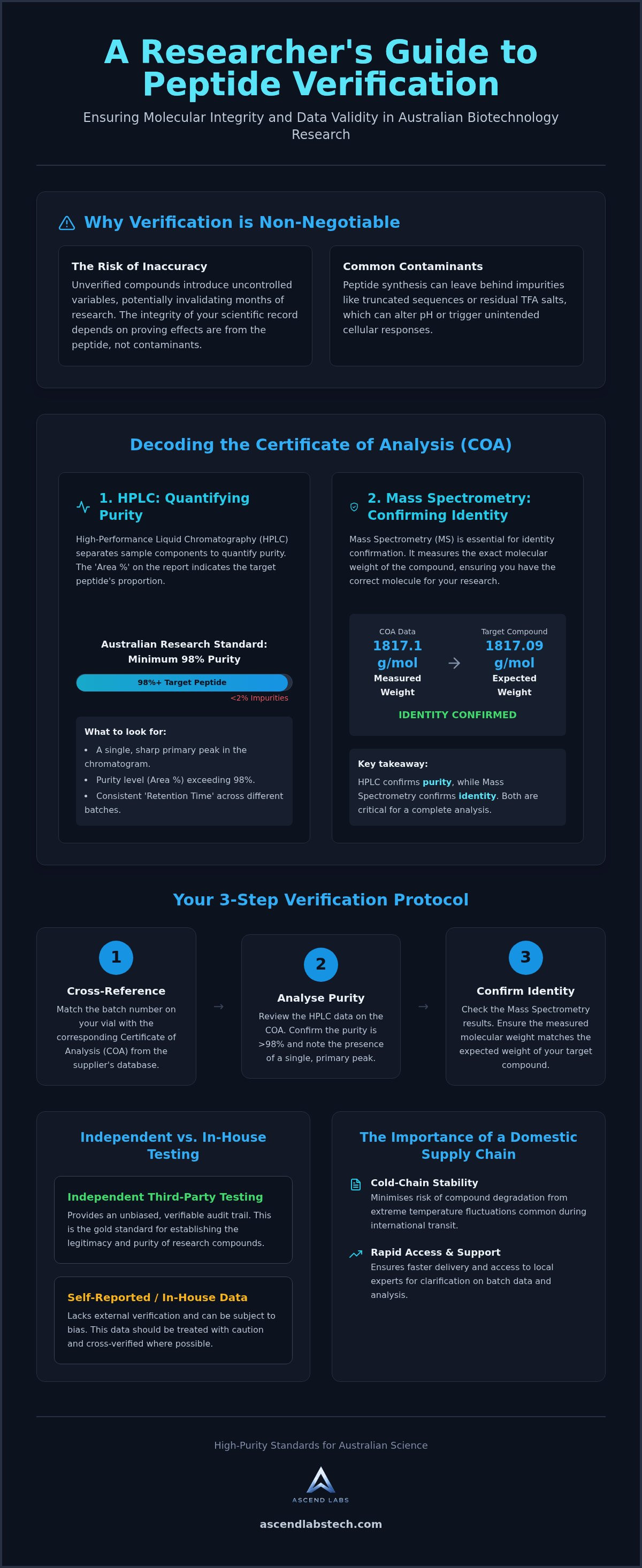
A Certificate of Analysis (COA) serves as the definitive diagnostic tool for the modern investigator. It provides the empirical evidence required to validate a study’s findings and ensure the integrity of the laboratory environment. When reviewing peptide lab results australia, researchers must focus on the synergy between High-Performance Liquid Chromatography (HPLC) and Mass Spectrometry (MS). Relying on a single metric creates a significant blind spot in your quality assurance protocol; true verification requires a multi-dimensional approach to data interpretation.
HPLC: Analysing the Purity Profile
HPLC is the gold standard for peptide purity quantification. This process separates the components of a sample based on their chemical properties, producing a chromatogram where individual substances appear as distinct peaks. The 'Area %' listed on the report indicates the proportion of the total sample that the target peptide occupies. For metabolic research in 2026, an industry-standard purity of >98% is the non-negotiable benchmark for high-end procurement.
A single, sharp peak is the desired outcome, yet researchers must remain vigilant regarding 'Retention Time'. This value indicates how long the molecule stays within the chromatography column. Consistency in retention time across different batches ensures that the synthesis process remains stable. Any secondary peaks, no matter how minute, represent baseline noise or synthesis by-products that could potentially interfere with sensitive biological assays.
Mass Spectrometry: Verifying Molecular Identity
While HPLC measures the quantity of the primary substance, Mass Spectrometry confirms its molecular identity. This is the second, crucial step of the COA. MS measures the mass-to-charge ratio of ions to determine the exact molecular weight of the compound. For advanced compounds like MOTS-C and KLOW, the observed mass must align with the theoretical mass within an extremely narrow margin. This level of scrutiny is essential for detecting truncated sequences or incorrect amino acid pairings that HPLC might overlook.
Identity verification acts as the final safeguard against mislabelled or structurally compromised reagents. It is possible for different molecules to co-elute in an HPLC column, appearing as a single peak despite being different substances. Mass Spectrometry differentiates these molecules by weight, providing the absolute certainty required for precision metabolic research. Without this data, a purity percentage is merely a number without a confirmed subject.
Independent Third-Party Testing vs In-House Analysis
In the pursuit of empirical truth, the source of verification is as critical as the data itself. Relying solely on self-reported peptide lab results australia vendors provide introduces an inherent conflict of interest. While internal checks are a necessary part of the manufacturing lifecycle, they cannot replace the objective scrutiny of an external, independent body. Scientific rigour requires a separation between the production of a compound and its final quality certification to ensure that results aren't biased by commercial incentives. This distinction is what separates a reliable domestic partner from a mere reseller.
The Gold Standard: Third-Party Verification
Independent analytical chemists within the Australian market act as the final gatekeepers of research integrity. These third-party facilities receive samples from a specific batch and perform an exhaustive audit of the manufacturer's claims; they specifically cross-verify the mass spectrometry and HPLC data discussed in previous sections. The most robust protocols involve 'blind testing'. This is where samples are submitted without identifying brand labels to ensure the chemist's analysis remains entirely impartial. This process creates an immutable audit trail that researchers can rely on when documenting their own methodologies. You can browse our verified research products to see how this level of scrutiny is applied to every compound in our catalogue.
In-House Analysis: The First Line of Defence
Internal quality assurance serves as the primary filter during the initial stages of synthesis. It allows technicians to monitor the reaction in real-time and make necessary adjustments before the final purification phase. However, in-house testing has significant limitations. It often lacks the high-resolution equipment or the external oversight required to detect subtle batch-to-batch inconsistencies that might only appear under independent review. Relying on internal data alone is a risk that serious practitioners can't afford to take. To understand the specific steps involved in a professional verification workflow, refer to our guide on Peptide Purity Testing: A Professional Protocol.
Ascend Labs operates on a philosophy of clinical transparency. We don't view third-party testing as a luxury; it's the baseline of our operational ethics. By subjecting our compounds to independent domestic analysis, we provide the Australian scientific community with the certainty needed for high-stakes inquiry. This approach ensures that every vial delivered meets the stringent requirements of a sophisticated laboratory environment.
Validating Batch Results for Precise Research Outcomes
The possession of a Certificate of Analysis is only the first stage of a rigorous quality assurance protocol. For the discerning investigator, verification is an active process that involves scrutinising the provenance and technical accuracy of the data provided. In the Australian scientific landscape, where precision is paramount, interpreting peptide lab results australia requires a disciplined approach to identifying potential discrepancies. A static document is meaningless if it cannot be mapped directly to the physical sample in your laboratory.
The 5-Point Verification Checklist
To maintain the integrity of your research, every new batch should be subjected to a formal validation checklist before the commencement of any study. This systematic review ensures that the reagents meet the expected high-purity standards and that the documentation is authentic. Practitioners should prioritise the following five criteria:
- Batch ID Alignment: The identification number printed on the physical vial must match the digital COA record exactly; any variation suggests a breakdown in the chain of custody.
- Analyst Authenticity: Verify the presence of a professional signature and an official laboratory stamp from a recognised analytical facility.
- Date of Analysis: Peptides are susceptible to degradation over time. Ensure the testing occurred recently enough to reflect the current molecular state of the compound.
- Instrumentation Standards: High-resolution data is typically generated using industry-standard Agilent or Shimadzu chromatography systems. Reports from generic or unbranded equipment should be viewed with caution.
- Spectrum Resolution: Examine the chromatogram for a clean baseline and sharp peaks. Blurred charts or missing baseline data are common indicators of 'dry-labbing', where results are fabricated rather than measured.
Ensuring Consistency Across Longitudinal Studies
Longitudinal research into metabolic pathways requires absolute batch-to-batch stability. If the purity or concentration of a compound fluctuates between orders, the resulting data will be inconsistent, making it impossible to draw valid conclusions. This is particularly critical in complex areas such as Retatrutide: The Frontier of Triple Agonist Research, where the interplay of multiple receptors demands a highly stable reagent profile. Researchers have the right to request detailed raw chromatography data to ensure that the synthesis protocols remain identical across different production runs. Maintaining this level of documentation is the only way to safeguard the reproducibility of your scientific findings.
Ascend Labs: Defining High-Purity Standards for Australian Science
Ascend Labs operates as a disciplined curator for the Australian scientific community. In a landscape where 'research-grade' is frequently used as a vague descriptor, we provide the empirical data required to establish true molecular integrity. Our commitment to clinical-grade transparency ensures that every researcher has access to the comprehensive peptide lab results australia demands for high-stakes metabolic and mitochondrial inquiry. We don't merely supply compounds; we provide the foundational certainty upon which reliable data is built.
A Curated Catalogue for Advanced Research
Our inventory is not a broad retail list but a meticulously selected collection of advanced compounds. We specialise in metabolic research compounds, recovery peptides, and neuromodulators, including high-purity Retatrutide and Tirzepatide. Every batch undergoes a rigorous multi-stage verification process before it is admitted into our inventory. This involves not only the initial synthesis verification but also secondary identity confirmation via mass spectrometry to ensure zero amino acid sequence errors. This ensures that the primary peak on an HPLC chromatogram consistently exceeds the 98% purity threshold required for sensitive biological assays. You may view our full research peptide catalogue to examine the specific categories we support.
Integrity at Every Stage of the Supply Chain
The journey from synthesis to the laboratory bench is critical for maintaining peptide stability. Ascend Labs prioritises a domestic Australian supply chain to mitigate the risks associated with international transit, such as atmospheric exposure and extreme temperature fluctuations. By maintaining a local inventory, we ensure that the cold-chain integrity remains uncompromised and verification speed is maximised. This domestic focus allows us to act as a reliable partner for serious scientific inquiry, providing reagents that haven't been degraded by the logistical failures of global shipping.
Key benefits of our domestic operation include:
- Rapid dispatch across Australia, reducing the time compounds spend in transit.
- Direct oversight of storage conditions, preventing the oxidation of sensitive neuromodulator peptides.
- Immediate access to batch-specific documentation and technical support for Australian researchers.
We prioritise data over marketing jargon in all our communications. Our role is to act as an authoritative gatekeeper, ensuring that the substances used in your laboratory are of the highest possible calibre. We understand that your reputation rests on the reproducibility of your findings. By providing consistent, lab-verified compounds and maintaining a principled approach to professional ethics, we support the Australian research community in its pursuit of scientific truth and long-term data integrity.
Securing the Integrity of Your Laboratory Research
Precision in the laboratory isn't a goal; it's a prerequisite. Mastering the interpretation of peptide lab results australia ensures that your research remains untainted by synthesis by-products or atmospheric degradation. By prioritising the synergy between HPLC purity and Mass Spectrometry identity, you establish a baseline of evidence that withstands the most rigorous peer review. Reliable data begins with reagents that meet a non-negotiable 98% purity threshold.
Domestic supply remains the most effective safeguard for maintaining the cold-chain stability of advanced metabolic research compounds. Ascend Labs supports this mission through sophisticated clinical-grade verification standards and a commitment to absolute data transparency. We ensure that every vial in your facility matches its digital audit trail with clinical fidelity.
Advance your scientific inquiry with the quiet confidence of verified molecular integrity.
Frequently Asked Questions
What is the minimum acceptable purity for research peptides in Australia?
The industry standard for high-purity research peptides in 2026 is generally established at a threshold of 98% or higher. For sensitive laboratory environments, particularly those involved in metabolic or mitochondrial studies, a purity level of 99% is often required to ensure reproducible data. Anything below these benchmarks introduces an unacceptable risk of contamination from synthesis by-products, which can negatively impact the validity of your scientific findings.
Can I trust a COA provided directly by the peptide manufacturer?
Relying solely on a manufacturer's Certificate of Analysis introduces an inherent conflict of interest. While internal checks are a necessary part of the production lifecycle, independent third-party verification provides the objective audit trail required for professional research. Ascend Labs ensures that the peptide lab results australia researchers receive are unbiased by subjecting every batch to external analysis, providing an essential layer of transparency and clinical-grade security.
How do I read an HPLC chromatogram to find impurities?
To identify impurities, you must examine the HPLC chromatogram for any secondary peaks or baseline noise surrounding the primary signal. The primary peak represents the target compound, while smaller spikes indicate the presence of residual solvents, truncated sequences, or synthesis salts. A sharp, narrow peak with a flat baseline signifies high purity. Broad or multiple peaks suggest significant molecular degradation or poor synthesis quality that could compromise your study outcomes.
What is the difference between HPLC and Mass Spectrometry in lab results?
High-Performance Liquid Chromatography (HPLC) quantifies the purity level of a sample by separating its individual components, whereas Mass Spectrometry (MS) confirms the molecular identity. HPLC determines the proportion of the target peptide within the total sample, while MS verifies the exact amino acid sequence by measuring the mass-to-charge ratio. Both tests are non-negotiable for professional verification; one measures quantity, while the other confirms the subject's identity.
Why do some peptide lab results show multiple peaks?
Multiple peaks on an HPLC chart typically signify the presence of chemical impurities or degradation products within the reagent. These secondary signals may represent TFA salts, uncoupled amino acids, or molecules that have oxidised during the synthesis or transit process. In some instances, multiple peaks indicate that the synthesis was incomplete, resulting in a mixture of the target peptide and truncated versions that will introduce uncontrolled variables into your research.
Is third-party testing mandatory for research peptides in Australia?
Third-party testing is not a legal mandate for research-only compounds, yet it remains a scientific necessity for maintaining laboratory standards. Without independent verification, a researcher cannot definitively prove the provenance or molecular integrity of their reagents. Most high-calibre Australian institutions require an external audit trail to satisfy internal quality assurance protocols and to ensure that longitudinal data remains consistent across different phases of a study.
How often should a peptide supplier update their lab results?
A reputable supplier should provide updated, batch-specific peptide lab results australia for every unique synthesis run. Because peptide stability is affected by batch-to-batch variation and environmental factors, a single 'representative' COA is insufficient for professional inquiry. At Ascend Labs, we ensure that every Certificate of Analysis is current and directly mapped to the batch ID on the physical vial, maintaining the transparency required for advanced scientific research.
What happens if my research compound doesn't match its COA?
If a research compound's experimental performance or physical properties don't align with its documentation, you should immediately isolate the batch and halt your study. Using unverified or suspicious reagents can lead to false positives and irreparable damage to your data sets. You should contact your supplier to request the raw chromatography data and verify the analyst's credentials. Maintaining a domestic supply chain often simplifies this resolution process through direct communication.


