

In the high-stakes environment of tissue modelling, a marginal variance in chemical purity isn't just a minor technicality; it's the difference between a reproducible breakthrough and an invalidated study. For researchers focused on cellular growth, the search for high-grade peptides for cell proliferation studies australia often leads to a frustrating crossroads of lengthy international lead times and inconsistent batch data. You've likely experienced the anxiety of waiting for sensitive compounds to clear customs, only to find the Certificate of Analysis lacks the granular detail required for rigorous verification.
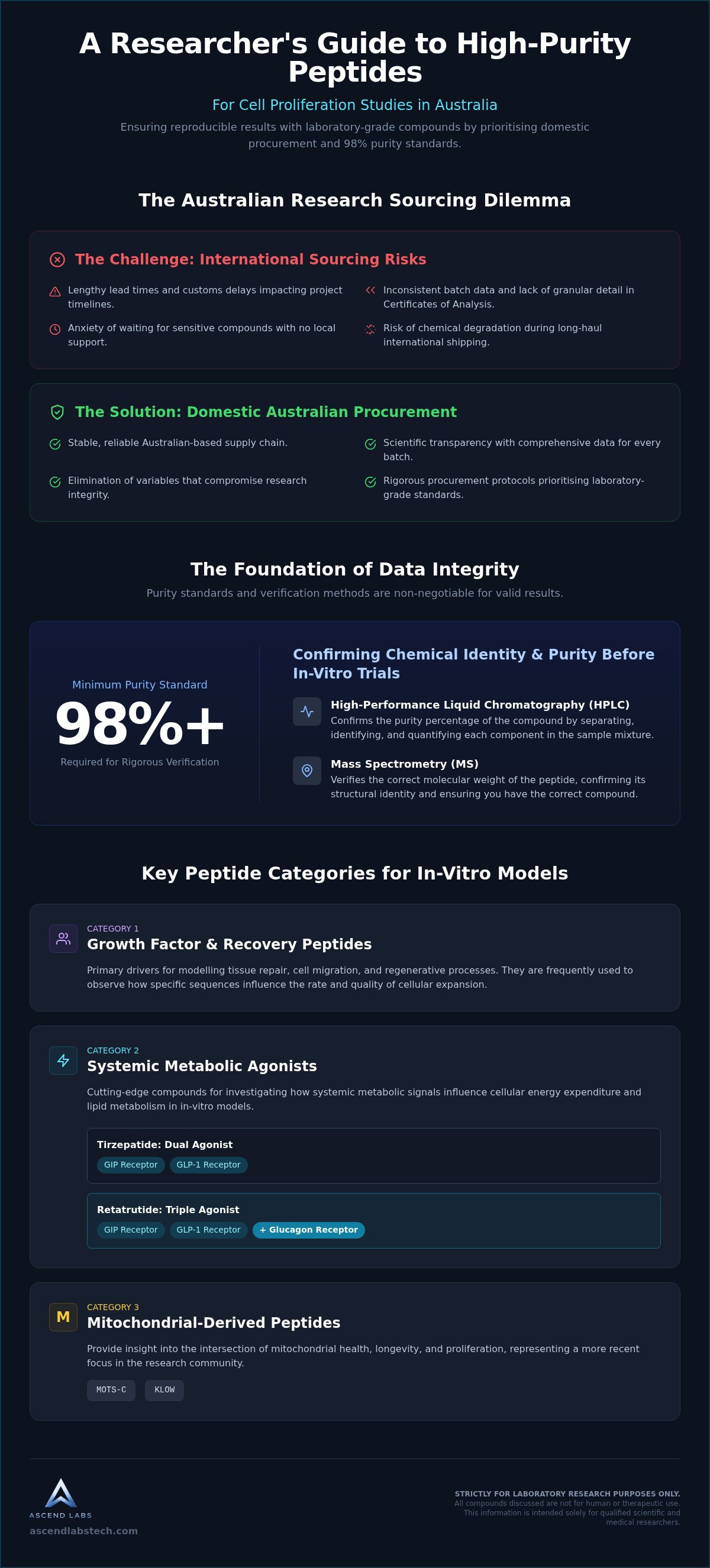
This guide serves as a definitive protocol for identifying and securing laboratory-grade research peptides within the domestic market. We'll outline the specific mechanisms of growth factor and metabolic peptides, explain how to interpret HPLC and mass spectrometry data, and establish a framework for maintaining a stable, Australian-based supply chain. By prioritising domestic procurement and 98% purity standards, you can eliminate the variables that compromise your research. Note that all compounds discussed are strictly for laboratory research purposes and are not for human consumption.
Key Takeaways
- Identify the primary mechanisms of growth factor and metabolic compounds to select the most suitable peptides for cell proliferation studies australia.
- Master the interpretation of HPLC and Mass Spectrometry reports to confirm chemical purity and molecular weight before commencing in-vitro trials.
- Evaluate the distinct mitochondrial-driven proliferation roles of KLOW and MOTS-C compared to systemic metabolic agonists like Retatrutide and Tirzepatide.
- Secure the stability of sensitive compounds by utilising domestic Australian supply chains to avoid the degradation risks of international shipping.
- Establish a rigorous procurement protocol that prioritises laboratory-grade standards and scientific transparency for advanced research verification.
The Role of Peptides in Cell Proliferation Studies within Australia
Peptides are precise signalling molecules that orchestrate the complex choreography of cellular biology. In the context of 2026 laboratory standards, these amino acid sequences function as high-affinity ligands, binding to specific cell-surface receptors to initiate proliferation, differentiation, or metabolic shifts. The Australian research landscape has seen a pivot towards in-vitro models that utilise these compounds to simulate physiological environments with extreme accuracy. While endogenous peptides regulate natural homeostasis, synthetic research analogues allow for the isolated study of specific pathways without the interference of rapid enzymatic degradation. Establishing reliable baseline data in these experiments requires laboratory-grade compounds that maintain structural integrity throughout the duration of the study. High-purity peptides for cell proliferation studies australia are the foundation of this rigorous scientific inquiry.
Mechanisms of Peptide-Induced Cellular Signalling
Peptide-induced proliferation typically begins when a molecule interacts with its cognate cell-surface receptor, such as a G protein-coupled receptor (GPCR) or a receptor tyrosine kinase (RTK). This interaction triggers a cascade of mitogenic pathways, including the MAPK/ERK and PI3K/Akt sequences, which ultimately regulate gene expression and the cell cycle. Secondary messengers, such as cyclic AMP or intracellular calcium, act as the translators that convert these external signals into a cellular response. Some advanced studies also utilise Cell-penetrating peptides (CPPs) to bypass the plasma membrane and deliver cargo directly to the nucleus or mitochondria. Peptide-receptor agonism in 2026 laboratory standards is defined as the high-affinity binding of a synthetic ligand to a specific cellular receptor to elicit a predictable, quantifiable biological response within a controlled environment.
Applications in Modern Australian Bio-Research
Australian bio-researchers use growth factor and recovery peptides to model tissue repair and regenerative processes. By manipulating signalling pathways, labs can observe how specific sequences influence the rate and quality of cellular expansion. There's also a growing focus on metabolic pathways through the study of GIP and GLP-1 receptor agonists, such as Tirzepatide and Retatrutide. These compounds provide a framework for investigating how systemic metabolic signals influence cellular energy expenditure and growth. More recently, the research community has shifted focus towards mitochondrial-derived peptides like MOTS-C and KLOW, which provide insight into the intersection of mitochondrial health, longevity, and proliferation.
Analysis of Growth Factor and Metabolic Peptides for In-Vitro Models
Proliferation research requires a nuanced understanding of specific chemical categories. Growth factor peptides serve as the primary drivers for connective tissue research, specifically in models investigating fibroblast expansion and collagen synthesis. These compounds are frequently utilised in three-dimensional tissue modelling to evaluate the structural integrity of synthetic matrices. Recovery peptides are equally critical for studying cellular migration. These molecules facilitate the movement of cells across a substrate, a process essential for understanding wound healing and tissue integration. Selecting the correct peptides for cell proliferation studies australia requires a focus on specific metabolic or mitochondrial targets.
Metabolic Agonists: Retatrutide and Tirzepatide
Metabolic agonists represent the cutting edge of metabolic research. While Tirzepatide acts as a dual agonist of GIP and GLP-1 receptors, Retatrutide introduces a third layer of complexity by targeting the glucagon receptor. This triple agonist mechanism allows researchers to observe heightened cellular energy expenditure and lipid metabolism in in-vitro models. For a deeper technical breakdown, researchers should consult the analysis of Retatrutide: The Frontier of Triple Agonist Research in Australia.
Research protocols for evaluating metabolic expenditure often involve measuring oxygen consumption rates and ATP production in response to varying concentrations of these compounds. Evaluating the efficacy of these agonists requires precise titration to avoid cytotoxic effects while maintaining the desired signalling intensity. These studies provide a framework for investigating how systemic metabolic signals influence cellular energy expenditure and growth patterns in isolated environments.
Mitochondrial and Longevity Peptides
Mitochondrial-derived peptides (MDPs) offer a different perspective on proliferation. KLOW and MOTS-C are instrumental in exploring the mitochondrial-to-nuclear signalling axis. These peptides communicate metabolic stress and energy status directly to the nucleus, influencing the expression of genes related to cell survival and longevity. Our guide on KLOW vs MOTS-C Research: A Comparative Analysis for Australian Laboratories (2026) provides detailed insights into their divergent applications.
MOTS-C specifically regulates glucose metabolism and has shown promise in studies involving metabolic flexibility. KLOW focuses on the klotho-related pathways associated with anti-ageing and senescence. Researchers investigating longevity markers often monitor these peptides to understand how mitochondrial dysfunction affects the regenerative capacity of senescent cells. This line of inquiry is essential for developing models that simulate the aging process at a cellular level.
Ensuring Data Integrity: Purity Standards and HPLC Verification
Data integrity is the cornerstone of any scientific inquiry. In the context of cell proliferation, where minute signalling changes lead to vastly different outcomes, the chemical composition of your compounds must be beyond reproach. High-Performance Liquid Chromatography (HPLC) is the industry standard for this verification. It provides a visual and quantitative representation of a peptide's purity by separating the target molecule from synthetic byproducts. When sourcing peptides for cell proliferation studies australia, the presence of a comprehensive Certificate of Analysis (CoA) is the only way to ensure that your baseline data remains untainted by manufacturing variables.
Protocol for Verifying Peptide Purity
Reading an HPLC chromatogram requires a disciplined eye. You're looking for a single, symmetrical peak that represents the target sequence. Any secondary peaks, or "shoulders," indicate the presence of truncated sequences or isomers that could interfere with your receptor-binding assays. For a detailed breakdown of this process, refer to our guide on Peptide Purity Testing: A Professional Protocol for Australian Research Verification. For sensitive in-vitro proliferation assays, the purity benchmark should never drop below the threshold of analytical excellence, as even minor contaminants can trigger off-target effects.
The Impact of Impurities on Cellular Assays
Impurities aren't just inert filler; they're active disruptors. Residual trifluoroacetic acid (TFA), a common byproduct of peptide synthesis, is known to be cytotoxic and can significantly decrease cell viability in culture. Similarly, excess salts can alter the osmotic balance of your growth medium, leading to unintended cellular stress responses that mask the peptide's true mitogenic potential. These variables compromise the reproducibility of scientific results, making it impossible to determine if an observed effect is due to the peptide or its contaminants.
Achieving 99% purity is the essential minimum standard for Australian proliferation studies to ensure that experimental observations are a direct result of the peptide's primary sequence. Mass Spectrometry (MS) complements this by confirming the molecular weight of the compound. While HPLC confirms how much of the substance is there, MS confirms exactly what that substance is. Together, these data points establish a document of integrity that protects the validity of your research. Without this transparency, the risk of batch-to-batch variability becomes a significant hurdle to long-term study viability.
Procurement Logistics: Sourcing Research-Grade Compounds Domestically
Procurement is a critical variable in the experimental lifecycle. For investigators sourcing peptides for cell proliferation studies australia, the geographic location of the supplier directly impacts the biological viability of the compounds. Peptides are inherently fragile molecules. Their secondary and tertiary structures are susceptible to thermal degradation and mechanical stress during transit. Relying on international supply chains introduces uncontrolled variables, such as customs impounds and extended exposure to ambient temperatures in transit hubs. Domestic sourcing eliminates these risks by providing a streamlined, temperature-controlled logistics path from the laboratory to the bench.
Advantages of Domestic Australian Shipping
Domestic logistics allow for precise control over the cold chain. Minimising thermal exposure is essential for ensuring that growth factors and metabolic agonists arrive with their bioactivity intact. International shipments often face delays of seven to fourteen days; domestic dispatch typically reduces this window to forty-eight hours. This efficiency is vital for time-sensitive laboratory protocols where research schedules depend on the immediate availability of stable reagents. Discreet and secure logistics tailored for the Australian scientific community ensure that sensitive materials are handled with the necessary operational discretion.
Evaluating Supplier Credibility
Selecting a domestic partner requires a rigorous vetting process. A reputable supplier acts as a scientific gatekeeper, prioritising data transparency over retail marketing. High-purity standards must be backed by batch-specific documentation that is accessible prior to purchase. Researchers should utilise a structured checklist when evaluating potential sources:
- Verification of HPLC and Mass Spectrometry reports for every batch.
- Clear labelling of "For Research Use Only" to align with Australian regulatory standards.
- Proven domestic warehouse presence to ensure compound stability.
- Transparent access to a Certificate of Analysis (CoA) for molecular weight confirmation.
Navigating these requirements is a prerequisite for maintaining the integrity of longitudinal studies. For specific insights into procuring mitochondrial-derived compounds, researchers can review our technical resource on Purchase MOTS-C Australia: A Technical Resource for Research Procurement (2026). Adhering to these criteria ensures that the focus remains on the data rather than the variability of the reagents. This disciplined approach to procurement is what separates successful in-vitro modelling from experiments compromised by degraded substrates.
The Ascend Labs Standard: High-Purity Peptides for Advanced Inquiry
Ascend Labs functions as an authoritative scientific gatekeeper, providing a bridge between advanced biotechnology and the Australian laboratory. Our operational model prioritises integrity and transparency, ensuring that every compound in our inventory meets the rigorous demands of modern inquiry. When sourcing peptides for cell proliferation studies australia, researchers require more than a vendor; they need a partner that understands the nuances of molecular signalling and the necessity of structural stability. We provide the documentation and domestic logistics required to maintain the validity of complex in-vitro models.
Curated Research Catalogue
Our inventory is a disciplined selection of the most relevant compounds for metabolic and cellular growth research. This includes advanced triple agonists like Retatrutide and dual agonists like Tirzepatide, which are essential for investigating systemic metabolic pathways. For studies focused on the mitochondrial-to-nuclear axis, we provide high-purity KLOW and MOTS-C. Beyond metabolic research, our catalogue includes specialised neuromodulator and recovery peptides designed to support inquiry into tissue repair and cellular migration. You can explore our full range of research products to find the specific ligands required for your experimental design.
Commitment to Professional Ethics
The Ascend Labs philosophy is built on a "substance over style" approach. We avoid the hyperbolic claims and loud aesthetics of the retail market, opting instead for a clinical approach to quality assurance. This commitment extends to our domestic supply chain, which we've organised to ensure that sensitive compounds never face the degradation risks associated with international transit. Integrity in research is non-negotiable; therefore, our operational discretion and meticulous verification processes are designed to instil a sense of security for advanced practitioners.
Integrating these compounds into your proliferation studies involves a straightforward protocol of verification and titration. Each batch is accompanied by the HPLC and Mass Spectrometry data discussed in previous sections, allowing you to establish a precise baseline. By choosing a domestic source that values scientific truth above all else, you eliminate the variables that often compromise longitudinal data. Secure high-purity standards for your next proliferation study to ensure your results are both reproducible and definitive.
Advancing the Precision of Cellular Inquiry
The integrity of modern biological research is tethered to the quality of the primary reagents. Achieving reproducible results in tissue modelling requires a move away from the uncertainties of international cold chains and unverified batch data. Prioritising domestic procurement ensures that sensitive compounds maintain their structural bioactivity from dispatch to delivery. By demanding HPLC and Mass Spectrometry verification for all peptides for cell proliferation studies australia, researchers can eliminate the contaminants that mask true mitogenic responses.
Ascend Labs remains committed to the role of a disciplined curator, offering specialised metabolic and growth factor compounds that meet the highest laboratory-grade benchmarks. Our focus on scientific transparency and domestic stability provides the foundation for advanced inquiry into cellular growth and metabolic pathways. It's time to refine your procurement protocols to align with the sophisticated standards your research demands.
We look forward to supporting your next scientific breakthrough with compounds that prioritise substance over style.
Frequently Asked Questions
Which peptides are best for studying cell proliferation in connective tissue?
Growth factor peptides are the primary choice for investigating connective tissue proliferation. These compounds are utilised to model fibroblast expansion and collagen matrix synthesis in synthetic environments. Recovery peptides also play a role in studying the regenerative capacity of these tissues. Researchers often select these specific sequences to observe how signalling pathways influence the density and structural integrity of connective models during longitudinal in-vitro trials.
How does HPLC verification impact the reliability of my research results?
HPLC verification is the definitive method for ensuring that experimental observations are a direct result of the peptide's primary sequence. By separating the target molecule from synthetic byproducts, HPLC provides a quantitative purity percentage. High purity levels are essential for the reproducibility of scientific results. Without this data, researchers risk off-target effects caused by residual salts or truncated sequences, which can invalidate the baseline data of sensitive cellular assays.
Are research peptides in Australia strictly for in-vitro use?
Yes, research peptides in Australia are strictly for laboratory research purposes and are not for human consumption. These compounds are explicitly labelled for in-vitro or animal-based laboratory inquiry to distinguish them from therapeutic goods. This classification allows investigators to procure high-purity peptides for cell proliferation studies australia without a prescription, provided they are used within a legitimate scientific or institutional framework to advance biological understanding.
What is the difference between Retatrutide and Tirzepatide in a research context?
The primary difference lies in their receptor agonism profiles. Tirzepatide functions as a dual agonist of the GIP and GLP-1 receptors. Retatrutide introduces a third layer of complexity by also targeting the glucagon receptor. In a research context, this triple agonist mechanism allows for the investigation of more intensive metabolic shifts and energy expenditure patterns. This makes Retatrutide a more advanced model for studying complex metabolic signalling pathways.
How do I interpret a Certificate of Analysis (CoA) for research peptides?
Interpreting a CoA involves two primary data points: the HPLC chromatogram and the Mass Spectrometry (MS) report. The HPLC section should show a single, symmetrical peak indicating high purity, typically 98% or above. The MS report confirms the molecular weight, ensuring the compound matches its theoretical chemical identity. Verifying these documents prior to procurement is a prerequisite for maintaining data integrity and ensuring that the substance is free from significant contaminants.
Why is domestic Australian shipping preferred for sensitive compounds like MOTS-C?
Domestic Australian shipping is preferred to minimise the risk of thermal degradation and mechanical stress. Sensitive mitochondrial-derived peptides like MOTS-C are fragile and can lose bioactivity if exposed to ambient temperatures during extended international transit. Domestic logistics typically reduce delivery times to under forty-eight hours, ensuring the compound arrives in a stable state. This reliability is essential for time-sensitive laboratory protocols that require consistent reagent structural integrity.
Can growth factor peptides be used for cellular migration studies?
Yes, growth factor peptides are frequently employed in cellular migration studies. These ligands trigger the signalling cascades necessary for cells to move across a substrate, a process central to wound healing and tissue integration research. By observing the rate and direction of migration in response to specific peptide concentrations, researchers can model how regenerative processes occur at a cellular level. This provides critical insights into the mechanics of tissue repair.
What purity standards should I look for when purchasing research chemicals in Australia?
Researchers should look for a minimum purity standard of 98%, though 99% is the benchmark for advanced peptides for cell proliferation studies australia. This purity must be verified through batch-specific HPLC and Mass Spectrometry documentation. Selecting compounds with lower purity levels increases the risk of residual trifluoroacetic acid (TFA) or other synthetic byproducts interfering with cellular viability. Always prioritise suppliers who provide transparent, pre-purchase access to a Certificate of Analysis.


