

A Certificate of Analysis is only as reliable as the laboratory that issued it, yet many researchers still rely on static documents as their sole guarantee of quality. You likely recognise that in the current 2026 regulatory climate, sourcing the best research peptides Australia has to offer requires more than just finding a domestic vendor; it demands a rigorous commitment to analytical transparency. The risks of batch inconsistency and opaque data are too high to ignore when the integrity of your longitudinal study is at stake.
This technical guide will empower you to identify 99%+ purity compounds by mastering HPLC verification standards and navigating the complexities of domestic supply logistics. We'll provide a disciplined framework for evaluating metabolic and recovery compounds, such as Retatrutide and MOTS-C, while ensuring your procurement process remains efficient. By the end of this briefing, you'll understand how to secure a reliable supply of high-calibre materials that meet the most exacting laboratory requirements, all while minimising the logistical friction often associated with international transit.
Key Takeaways
- Master the distinction between superficial marketing and analytical truth by prioritising HPLC and Mass Spectrometry data for every batch.
- Secure the best research peptides australia provides by opting for domestic supply chains that eliminate the risks of international customs seizures and thermal degradation.
- Evaluate the technical specifications of 2026's most advanced metabolic research compounds, including Retatrutide and Tirzepatide, through a clinical lens.
- Optimise your longitudinal studies by establishing a partnership with a disciplined curator committed to 99%+ purity and rigorous verification standards.
Navigating the Australian Research Peptide Landscape in 2026
The Australian biotechnology landscape has undergone a significant transformation. As we move through 2026, the demand for high-purity compounds has shifted from niche academic interests to a broader scientific focus on complex metabolic pathways. To understand the foundation of these studies, one must first ask: What are peptides? Fundamentally, they are short chains of amino acids that serve as precise biological messengers. In Australia, the pursuit of the best research peptides australia can provide is now defined by a substance over style philosophy, where technical verification outweighs marketing aesthetics.
This evolution hasn't been without friction. The global surge in metabolic research has strained supply chains, leading to a proliferation of vendors who often prioritise turnover over analytical integrity. With regulatory bodies increasing scrutiny on imports throughout 2026, domestic sourcing has moved from a convenience to a necessity for maintaining research timelines. For researchers, this means that the distinction between genuine research-grade materials and inferior consumer-facing products is more critical than ever.
To better understand the complexities of the current market and the risks involved with unverified sources, watch this informative report:
The Rise of Metabolic and Longevity Inquiry
The surge in GIP and GLP-1 receptor agonist inquiry has redefined domestic research priorities. Australian laboratories are increasingly focused on the triple-agonism mechanisms found in compounds like Retatrutide. Simultaneously, the study of mitochondrial health through peptides such as KLOW and MOTS-C has gained momentum. These delicate compounds are highly susceptible to global supply fluctuations and transit degradation. Consistent domestic access is now a primary requirement for longitudinal study success, as it ensures that the biochemical integrity of the peptides is preserved from the point of manufacture to the laboratory bench.
Identifying Tiers of Australian Peptide Suppliers
Identifying reliable partners in 2026 requires a discerning eye for operational transparency. Suppliers are generally categorised into two tiers: disciplined curators who provide batch-specific HPLC and Mass Spectrometry data, and resellers who rely on outdated or falsified documentation. Australian-owned entities offer a level of accountability that international vendors cannot match, particularly regarding ethical standards and shipping reliability. Independent audits have become the benchmark for those seeking the best research peptides australia has available. When sourcing specialised compounds, researchers must verify that the materials received align perfectly with the theoretical data provided.
Analytical Verification: The Gold Standard for Research Purity
Analytical integrity serves as the primary barrier between rigorous scientific inquiry and compromised data. For those seeking the best research peptides australia offers, understanding the mechanics of laboratory verification is essential. HPLC is the primary method for separating and quantifying peptide components to ensure 99%+ purity. This process involves passing a liquid solvent containing the peptide through a column filled with adsorbent material, allowing each component to interact differently and emerge at distinct intervals. Without this level of scrutiny, a researcher cannot realistically guarantee the chemical composition of their materials.
A legitimate Certificate of Analysis (COA) must be more than a static PDF; it should be a detailed record of a specific batch's journey through verification. A professional COA includes the batch number, the date of analysis, and clear laboratory stamps. It provides the empirical evidence required to validate that the substance in the vial matches the theoretical profile. Researchers should prioritise suppliers who provide transparent access to these documents, as they form the foundation of experimental reproducibility.
How to Interpret HPLC Chromatograms
Interpreting a chromatogram requires a focus on peak integration and baseline stability. The primary peak represents the target peptide, and its area relative to any secondary peaks determines the purity percentage. A stable, flat baseline indicates a lack of systemic noise or residual solvents. Retention time is equally critical; it acts as a chemical signature, showing the exact moment the compound exits the column. If the retention time deviates from established standards, it suggests a potential change in the peptide's structural integrity or the presence of contaminants.
The Necessity of Mass Spectrometry
While HPLC measures purity, Mass Spectrometry (MS) confirms identity. This process measures the mass-to-charge ratio of ions to determine the precise molecular weight of the compound. It's an essential safeguard to prevent the mislabelling of similar sequences, particularly when studying High-Interest Research Compounds that possess complex triple-agonist structures. HPLC alone might show a single peak, but only MS can verify that the peak actually represents the intended sequence. You can learn more about our purity testing protocols to see how these dual standards are applied in a professional setting.
Rigorous verification ensures that your research isn't undermined by poor material quality. By demanding both HPLC and MS data, you align your procurement with the highest international standards. If you're ready to secure verified materials for your next study, you can view our curated range of research compounds today.
Domestic vs International Procurement: Why Sourcing in Australia Matters
Procuring research materials from international sources often feels like participating in a "customs lottery." In 2026, the Australian Border Force and TGA have intensified scrutiny on peptide imports, making international seizures a significant risk to research timelines. When a shipment is intercepted, it doesn't just represent a financial loss; it creates a critical gap in longitudinal data. Sourcing the best research peptides australia offers domestically eliminates this variable, ensuring that your study remains on schedule without the threat of legal or logistical interference. Domestic dispatch provides a level of certainty that international shipping simply can't guarantee.
Peptides are inherently unstable molecules. Australia's extreme climate poses a unique challenge to molecular integrity during transit. During long-haul international shipping, vials are often exposed to uncontrolled temperatures in cargo holds and tarmac sorting zones. This exposure triggers thermal degradation, which can subtly alter the peptide's secondary structure without changing its appearance. Domestic procurement allows for rapid, short-duration transit that preserves the original biochemical profile. This ensures that the compound you test is exactly what was verified at the laboratory bench.
The Hidden Risks of Overseas Bulk Buying
Overseas bulk buying often introduces 'under-dosed' vials into the supply chain. In these instances, the stated milligram count on the label doesn't reflect the actual peptide content. When an international batch fails purity verification, the researcher is left with no recourse and lost capital. Domestic supply operates under the jurisdiction of the Australian Consumer Law (ACL), which mandates that goods must be of acceptable quality and fit for purpose. This legal framework provides a level of security that international grey-market vendors can't match. Choosing domestic sources also reduces the environmental impact of your research by minimising global logistics and carbon emissions.
Ensuring Chain of Custody for Delicate Compounds
A reliable chain of custody is non-negotiable for high-end inquiry. Our operations utilise climate-controlled warehousing specifically engineered to mitigate the impact of the Australian heat. This ensures that compounds remain at optimal temperatures from production to dispatch. Every order is housed in discreet, secure packaging designed to shield the vials from UV radiation and physical impact. Rapid 24-48 hour domestic dispatch facilitates an agile research environment, allowing for quick adjustments to study parameters. You can review Our domestic shipping and logistics standards to see how we maintain these rigorous protocols during the final mile of delivery.
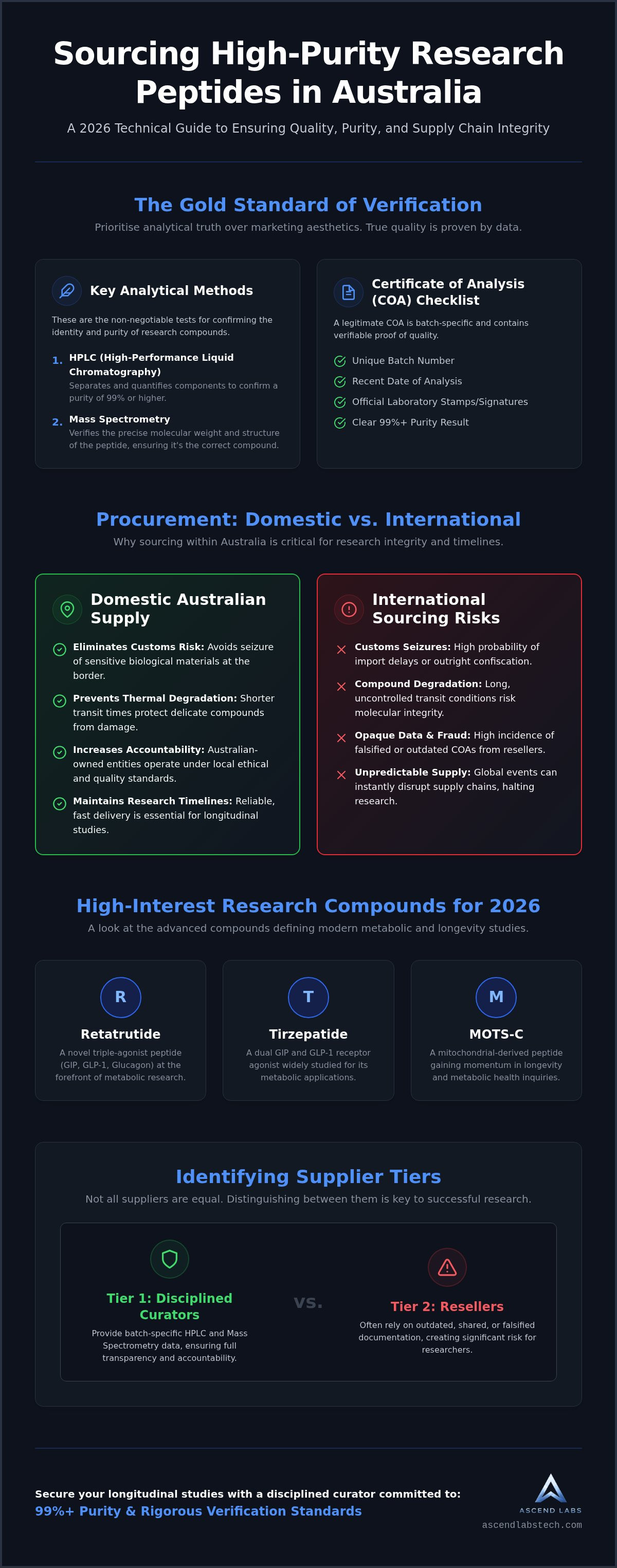
High-Interest Research Compounds for 2026 Australian Studies
The 2026 scientific vanguard is increasingly focused on multi-receptor agonism and mitochondrial modulation. Identifying the best research peptides australia provides requires a technical understanding of these advanced chemical structures. While previous years focused on single-pathway interventions, current inquiry prioritises the synergistic effects of compounds that target multiple metabolic and neurological centres simultaneously. This evolution has moved Tirzepatide from a novel compound to a dual-agonist benchmark, while Growth Factor and Neuromodulator peptides are significantly expanding the scope of domestic neuroscience research.
The Triple Agonist Frontier: Retatrutide Research
Retatrutide represents the pinnacle of metabolic research in 2026. Its mechanism involves triple agonism across the GIP, GLP-1, and Glucagon receptors, offering a complex profile for laboratory study. Synthesising this compound at a 99%+ purity level presents significant technical challenges due to its intricate sequence and the potential for truncated impurities. High-calibre verification is essential to ensure that the triple-agonist action isn't compromised by batch inconsistency. You can review a more detailed Retatrutide technical overview to understand its specific synthesis requirements and receptor affinity profiles.
Mitochondrial Peptides and Longevity Science
Mitochondrial-derived peptides (MDPs) have emerged as a critical frontier of longevity science. MOTS-C is currently being analysed for its role in metabolic homeostasis, specifically how it regulates nuclear gene expression in response to cellular stress. Simultaneously, the KLOW peptide has gained traction for its potential role in cellular senescence research. These delicate compounds require meticulous handling and climate-controlled storage to maintain their biochemical efficacy. For a deeper technical comparison of these mitochondrial agents, see our KLOW vs MOTS-C Research Analysis.
The pursuit of high-interest compounds demands a supplier that acts as a disciplined curator. As research parameters become more exacting, the need for verified, domestic supply becomes paramount for maintaining experimental integrity. Securing the best research peptides australia has available ensures that your laboratory data remains untainted by inferior chemical synthesis or transit-related degradation. This commitment to quality is the only way to ensure reproducibility in advanced longitudinal studies.
Establishing a Secure Research Partnership with Ascend Labs
Ascend Labs operates as a principled institution and a disciplined curator within the Australian biotechnology sector. We recognise that the integrity of your longitudinal study depends entirely on the chemical consistency of your materials. Our philosophy of "Substance Over Style" prioritises transparent analytical data over marketing aesthetics. By acting as a scientific gatekeeper, we ensure that every compound in our catalogue meets the exacting standards required for advanced inquiry. This commitment to professional ethics allows us to build long-term relationships with researchers who value data precision and operational discretion above all else.
Our catalogue is meticulously curated to reflect the current vanguard of biotechnology. We focus on high-interest compounds that define the 2026 research landscape, including triple agonists like Retatrutide and mitochondrial-derived peptides such as KLOW and MOTS-C. By specialising in these advanced chemical categories, we provide Australian laboratories with access to the best research peptides australia can offer. This focus ensures that your procurement process is aligned with the most recent developments in metabolic and longevity science, facilitating innovation without the risk of batch-to-batch variability.
Meticulous Quality Assurance
Analytical verification is the cornerstone of our operational framework. Every batch we distribute is cross-referenced with both High-Performance Liquid Chromatography (HPLC) and Mass Spectrometry (MS) data to confirm 99%+ purity and correct sequence identity. We provide our research partners with transparent access to batch-specific Certificates of Analysis (COAs), ensuring that the empirical evidence matches the substance in the vial. This rigorous verification process begins at the point of synthesis and continues until the material is ready for dispatch to your laboratory bench, exceeding standard industry averages for quality control.
Procurement and Professional Support
Efficiency in procurement is essential for maintaining agile research timelines. We've developed a streamlined online ordering system specifically for Australian-based scientific institutions and independent researchers. By operating exclusively within the domestic market, we eliminate the complexities of international customs and the associated risks of seizure or thermal degradation. Our logistics network provides rapid, discreet, and secure domestic freight across the continent, ensuring that your materials arrive in optimal condition. This domestic focus allows us to offer a level of accountability and professional support that international grey-market vendors cannot replicate.
Elevating Laboratory Standards for Future Inquiry
Achieving experimental reproducibility in the current landscape requires a shift from superficial procurement to rigorous analytical scrutiny. By prioritising domestic supply chains, you eliminate the variables of international customs interference and environmental degradation that often compromise delicate peptide bonds. The transition toward complex triple agonists and mitochondrial agents necessitates a partner who functions as a disciplined curator of high-purity materials.
Securing the best research peptides australia provides is fundamentally a matter of verifying HPLC and Mass Spectrometry data for every batch. As a specialist in advanced compounds like Retatrutide and KLOW, we maintain a 100% Australian owned and operated facility dedicated to scientific truth. This clinical focus ensures that your data remains untainted by the inconsistencies of the grey market.
We remain committed to providing the technical foundation required for your most exacting longitudinal studies. Your pursuit of scientific excellence deserves a supply partner that values integrity as much as you do.
Frequently Asked Questions
Are research peptides legal to purchase in Australia in 2026?
Research peptides are strictly regulated by the Therapeutic Goods Administration (TGA). In 2026, most of these compounds are classified under Schedule 4 (Prescription Only Medicine) or Schedule 10 (Prohibited) of the Poisons Standard. Possession or supply without appropriate authorisation is subject to significant legal penalties. It's essential for researchers to ensure their procurement aligns with current legislative frameworks and that materials are intended solely for scientific inquiry rather than personal use.
How can I verify if a peptide supplier's HPLC report is authentic?
Authentic HPLC reports must include batch-specific identifiers that match the product vial. You should verify that the report contains a clear chromatogram with a stable baseline and a distinct primary peak representing the target compound. Legitimate documents will also feature laboratory stamps, the date of analysis, and the signature of the verifying chemist. If a supplier provides a generic or outdated document, it's often a sign of compromised analytical integrity.
What is the typical shelf life of lyophilised research peptides in an Australian climate?
Lyophilised peptides generally remain stable for 24 months when stored in a temperature-controlled environment of -20 degrees Celsius. In the Australian climate, exposure to ambient heat during transit or storage can accelerate degradation. Once reconstituted, the shelf life reduces significantly, often requiring use within 7 to 14 days if kept refrigerated. It's vital to maintain the cold chain to ensure the biochemical integrity of the compound remains intact for your studies.
Why is domestic Australian shipping preferred over international options for peptides?
Domestic shipping is preferred because it eliminates the high risk of customs seizures and thermal degradation during long-haul transit. In 2026, the Australian Border Force has intensified scrutiny of international peptide imports, which frequently leads to seized shipments and halted research timelines. Sourcing the best research peptides australia offers via domestic dispatch ensures rapid 24-48 hour delivery, preserving the delicate molecular structure of the compounds within a controlled local environment.
What is the difference between Tirzepatide and Retatrutide in a research context?
Retatrutide is a triple agonist targeting the GIP, GLP-1, and glucagon receptors, whereas Tirzepatide is a dual agonist targeting only GIP and GLP-1. In a research context, Retatrutide offers a more complex mechanism for studying metabolic pathways due to the additional glucagon receptor activity. This makes it a high-interest compound for 2026 studies investigating multi-receptor synergy. Both compounds are currently benchmarks for metabolic inquiry but require different synthesis and verification protocols.
Can I request a batch-specific COA before finalising my procurement?
You can and should request a batch-specific Certificate of Analysis before finalising any procurement. A disciplined curator will provide transparent access to these documents, as they contain the HPLC and Mass Spectrometry data required to verify purity and identity. This practice is essential for maintaining the reproducibility of your laboratory data. Any supplier that refuses to provide batch-specific verification should be viewed with extreme caution as a potential risk to your study.
How should research peptides be stored upon arrival at the laboratory?
Peptides should be transferred to a freezer maintained at -20 degrees Celsius immediately upon arrival at the laboratory. For long-term preservation, some researchers prefer storage at -80 degrees Celsius to further minimise the risk of degradation. It's important to keep the vials in a dark, dry environment shielded from UV light. Avoid frequent freeze-thaw cycles, as the resulting moisture and temperature fluctuations can damage the delicate peptide bonds and compromise your research results.
Does Ascend Labs provide compounds for human therapeutic use?
Ascend Labs does not provide any compounds for human therapeutic use or personal consumption. Our operations are focused exclusively on the supply of high-purity materials for scientific research and laboratory inquiry. We don't sell prescription medications, nor do we provide medical advice or contract research services. All products, including metabolic and recovery peptides, are intended solely for in-vitro or laboratory-based studies conducted by qualified professionals in controlled environments.


