

In the rigorous environment of Australian biotechnology, the margin for error is non-existent; analytical precision is the only currency that matters when the validity of your data depends on chemical integrity. Sourcing the peptide research essentials australia requires for high-fidelity laboratory work has become a complex exercise in risk management. You likely recognise that inconsistent batch purity and the lack of verifiable HPLC or MS data from unregulated international suppliers pose a significant threat to research outcomes.
This technical guide outlines the protocols for securing 99%+ pure research compounds within the 2026 Australian regulatory framework. We prioritise the transition from retail-grade procurement to professional-grade laboratory supply. You'll gain a comprehensive understanding of how to access advanced metabolic peptides such as Retatrutide and Tirzepatide through a reliable domestic supply chain. By focusing on analytical verification and domestic logistics, you can ensure your research remains compliant and strictly limited to laboratory use, as these compounds are not for human consumption.
Key Takeaways
- Understand why domestic procurement is a critical component of peptide research essentials australia to bypass the risks of international customs seizures and logistical delays.
- Master the technical standards for purity, establishing a 99%+ baseline verified through High-Performance Liquid Chromatography (HPLC) to ensure data fidelity.
- Identify the frontier metabolic compounds currently driving Australian studies, including advanced triple-agonist research chemicals like Retatrutide.
- Learn the necessity of sourcing compounds in lyophilised form to maintain molecular stability and ensure long-term viability for laboratory applications.
- Implement a standardised procurement checklist to verify supplier transparency, focusing on the provision of comprehensive Certificates of Analysis (COA).
Navigating the Australian Peptide Research Landscape
The landscape of Australian peptide science has undergone a significant transformation. Historically, research focused on basic tissue recovery and growth hormone secretagogues. However, the current scientific frontier has shifted toward complex metabolic signalling and mitochondrial optimisation. Peptides are short chains of amino acids linked by peptide bonds, and in a laboratory context, they serve as precision tools for investigating cellular pathways. Understanding this evolution is one of the primary peptide research essentials australia demands for modern inquiry.
Under the Therapeutic Goods (Poisons Standard-June 2026) Instrument 2026, the distinction between research chemicals and therapeutic goods is strictly enforced. Compounds intended for in-vitro study must be treated as research-grade materials, distinct from prescription medications for human consumption. The TGA has designated unapproved peptides as a compliance priority for 2026. This makes the verification of research intent and sourcing more critical than ever for maintaining institutional integrity.
The Shift Toward Metabolic and Longevity Compounds
Researchers are increasingly pivoting toward mitochondrial-derived peptides like MOTS-C and advanced triple agonists like Retatrutide. These compounds allow for the exploration of GIP, GLP-1, and glucagon receptor agonism within controlled studies. Such sophisticated molecules require meticulous handling. They are far more sensitive to environmental degradation than traditional recovery peptides, necessitating stringent laboratory protocols and high-purity synthesis to ensure reliable data.
Domestic Supply vs. International Procurement Risks
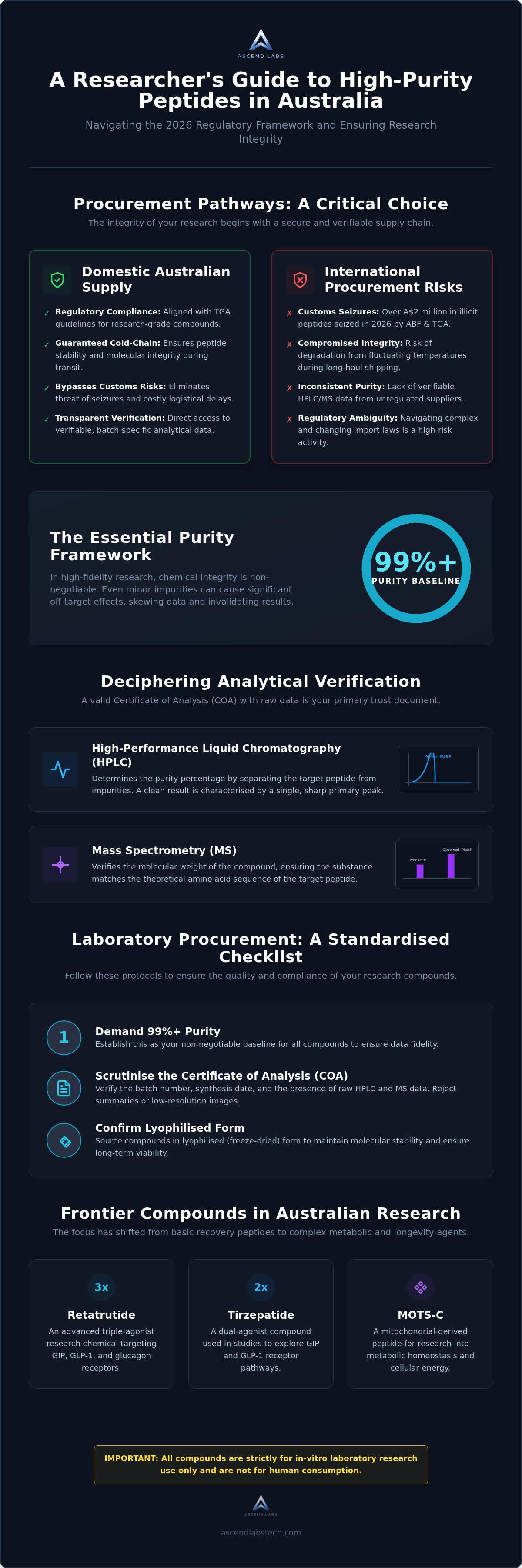
Relying on international vendors has become a high-risk strategy. In 2026, joint operations between the Australian Border Force and the TGA resulted in the seizure of over A$2 million in illicitly imported peptide products. Beyond legal risks, international shipping often compromises product integrity. Sensitive research chemicals face prolonged exposure to fluctuating temperatures during transit. Domestic procurement through Australian entities ensures a resilient supply chain and maintains the cold-chain requirements essential for peptide stability. You can view our specialised catalogue of metabolic research compounds to see how domestic supply maintains these technical standards.
The Essential Peptide Purity Framework
Precision is the primary metric of value in laboratory settings. For any study to yield reproducible results, the chemical integrity of the compounds must be beyond reproach. A purity level of 99%+ is the established baseline for high-fidelity research, as even minor impurities can lead to significant off-target effects or skewed data. This level of accuracy aligns with the rigorous standards maintained within Australian peptide and protein science, where analytical verification is non-negotiable. Achieving these benchmarks is one of the most critical peptide research essentials australia requires for advanced metabolic and longevity studies. A Certificate of Analysis (COA) is the primary trust document in peptide procurement, serving as a formal declaration of a batch's specific chemical profile and verified purity.
Deciphering HPLC and Mass Spectrometry Data
Analytical transparency relies on two core technologies: High-Performance Liquid Chromatography (HPLC) and Mass Spectrometry (MS). HPLC determines the purity percentage by separating the target peptide from residual solvents, truncated sequences, or by-products. When reviewing a chromatogram, look for a single, sharp peak; secondary peaks indicate the presence of impurities that could compromise your research. Mass Spectrometry complements this by verifying the molecular weight. It ensures that the substance in the vial matches the theoretical sequence of the target peptide. Successful verification occurs when the observed mass aligns precisely with the predicted molecular weight, confirming the identity of the compound. Batch-specific testing is superior to representative testing, as it accounts for the subtle variations inherent in different synthesis cycles.
The Critical Role of a Certificate of Analysis (COA)
A valid COA must provide raw data rather than mere summaries. For Australian researchers, essential elements include the batch number, synthesis date, and the actual HPLC and MS graphs. Red flags often include blurred or low-resolution images, generic dates, or the absence of a specific purity percentage. These discrepancies suggest a lack of meticulous quality control. You can learn more about peptide purity testing to refine your verification protocols. Ensuring your supplier provides batch-specific documentation is a fundamental step in maintaining laboratory standards. If you are sourcing high-purity research compounds, the availability of these reports is your first line of defence against analytical error. Reliable data begins with verified chemistry; without it, the research lacks a foundation of truth.
Essential Compounds for Contemporary Australian Studies
The selection of research compounds defines the scope and validity of modern laboratory inquiries. As focus shifts from simple tissue repair to complex endocrine and mitochondrial signalling, the requirement for high-purity molecules becomes absolute. These advanced compounds are the peptide research essentials australia based scientists utilise to map the future of metabolic and longevity science. Mastery of these compounds requires an understanding of their specific receptor affinities and the technical precision involved in their synthesis.
Beyond metabolic regulators, the scope of neuroscience studies is expanding through the use of neuromodulator and growth factor peptides. These tools allow for the investigation of neuroprotective pathways and synaptic plasticity within controlled in-vitro environments. Every compound in a contemporary laboratory must meet the 99%+ purity threshold established in previous sections to ensure that observations are the result of the peptide itself, rather than synthesis by-products.
Triple Agonist Research: Retatrutide and Tirzepatide
Retatrutide and Tirzepatide represent the vanguard of metabolic research. While Tirzepatide acts as a dual agonist of the glucose-dependent insulinotropic polypeptide (GIP) and glucagon-like peptide-1 (GLP-1) receptors, Retatrutide introduces a third layer of complexity. It functions as a triple agonist, incorporating glucagon receptor agonism into the framework. This triple-action mechanism is a primary focus for studies investigating synergistic effects on energy homeostasis and lipid metabolism. You can explore more detailed data on Retatrutide research in Australia to understand these interactions. Because these compounds interact with multiple sensitive receptor sites, even minute impurities can significantly distort agonism data, making batch-specific HPLC verification a critical requirement for any study.
Mitochondrial and Longevity Frontiers: MOTS-C and KLOW
Mitochondrial-derived peptides like MOTS-C have redefined the essentials of longevity research. MOTS-C is unique because it is encoded within the mitochondrial genome, acting as a systemic signalling molecule that regulates metabolic flexibility. KLOW, another primary compound in anti-ageing protocols, is frequently studied for its role in cellular senescence and protein expression. For a deeper technical comparison, refer to our KLOW vs MOTS-C research analysis. These compounds require specialised handling protocols. They are highly susceptible to thermal degradation and must be maintained in a lyophilised state until the moment of use. Evaluating these compounds for in-vitro longevity protocols requires a domestic supply chain that can guarantee temperature stability from the point of synthesis to the laboratory bench. This domestic reliability is one of the peptide research essentials australia demands for high-fidelity longevity studies.
Laboratory Procurement: A Standardised Checklist
Establishing a standardised procurement checklist is a foundational component of peptide research essentials australia. This protocol ensures that every compound entering the laboratory is verified for both chemical integrity and logistical security. Labs must prioritise suppliers who demonstrate a transparent commitment to analytical data, specifically the provision of batch-specific Certificates of Analysis as established in the purity framework. Confirming that a supplier focuses exclusively on research-only compounds is a critical step in ensuring that the materials meet laboratory-grade standards rather than retail expectations.
Stability is non-negotiable for high-fidelity data. All research chemicals should be supplied in a lyophilised state. This freeze-drying process removes moisture through sublimation, which significantly enhances molecular stability and extends shelf life. Unlike liquid formulations, which degrade rapidly and are prone to bacterial growth, lyophilised peptides remain stable during domestic transit and long-term storage. Discretion and security in domestic shipping are also paramount. Reliable suppliers utilise secure, trackable logistics to ensure that sensitive compounds are not compromised by environmental exposure or administrative delays.
Criteria for Selecting a Reputable Australian Supplier
Specialised boutiques typically offer a higher level of quality control than broad-spectrum chemical vendors. These curators focus on a meticulous catalogue, ensuring that every batch meets the 99%+ purity threshold through rigorous internal vetting. Technical support should be responsive and capable of addressing complex inquiries regarding peptide sequences or analytical reports. For those investigating specific recovery or growth pathways, our growth factor peptides research guide provides a deeper look into selecting compounds for neuroscience and cellular studies.
Handling, Storage, and Preparation Essentials
Proper storage is critical for maintaining the high-purity standards of peptide research essentials australia. Lyophilised vials should be stored in a laboratory freezer at -20°C for short-term use or -80°C for extended periods to prevent degradation. When preparing for in-vitro application, reconstitution must be performed with precision. Use bacteriostatic water or sterile saline, allowing the diluent to run down the side of the vial to avoid mechanical stress on the peptide structure. You should never shake the vial; a gentle swirling motion is sufficient to achieve a clear solution without damaging the delicate peptide bonds.
- Utilise low-dead-space syringes for accurate measurement of reconstructed solutions.
- Ensure all preparation is conducted in a sterile environment using alcohol swabs and sterile vials.
- Store reconstituted peptides in a laboratory refrigerator at 2°C to 8°C and use within the validated stability window.
Ascend Labs: High-Purity Standards for Australian Science
Ascend Labs operates as a disciplined curator in the biotechnology sector. We prioritise substance over style, ensuring every compound in our specialised catalogue meets the clinical-grade purity standards required for rigorous inquiry. This commitment is central to the peptide research essentials australia demands for high-fidelity data. We act as a professional partner for serious scientific inquiry, providing the technical foundation necessary for advanced metabolic and longevity studies. Our institutional focus remains strictly on laboratory research, ensuring that every molecule is handled with the meticulousness your data requires.
Our Commitment to Analytical Transparency
Data integrity is the cornerstone of our operation. We understand that high-fidelity scientific conclusions are impossible without verifiable chemical purity. Every batch of research peptides undergoes rigorous internal vetting to meet our 99%+ purity benchmarks. This process involves meticulous HPLC and Mass Spectrometry verification to ensure that theoretical sequences align with observed data. By providing these essential trust documents, we empower researchers to conduct their work with absolute confidence in their materials. You can explore the Ascend Labs research catalogue to view our current offerings.
Domestic Logistics and Professional Discretion
Reliability in the supply chain is as important as the purity of the compounds themselves. Ascend Labs maintains a strictly domestic operational model to eliminate the risks associated with international border controls and customs interference. Our logistics protocols are designed for speed and security, ensuring that sensitive research chemicals arrive on schedule and in peak condition. We recognise the importance of operational discretion for our clients, maintaining the highest professional standards throughout the procurement process. This domestic focus ensures that temperature-sensitive molecules, such as MOTS-C and Retatrutide, are not compromised during transit. You may view our specialised research compounds to secure your laboratory's requirements.
Our institution does not merely act as a vendor; we function as an authoritative scientific gatekeeper. By focusing on meticulous quality assurance and domestic stability, Ascend Labs provides the essential infrastructure for the next generation of Australian research. We remain committed to the principle that scientific truth is only as strong as the materials used to uncover it.
Securing the Future of Australian Peptide Science
Procurement in 2026 demands a shift from convenience-led sourcing to a rigorous, data-driven methodology. Achieving the 99%+ purity threshold is the primary objective, as the integrity of your research depends entirely on the chemical accuracy of the compounds utilised. By prioritising domestic supply chains and batch-specific HPLC and MS verification, you eliminate the variables of international transit and inconsistent quality. Mastering these peptide research essentials australia requires for modern laboratory work ensures that your studies remain both compliant and scientifically valid.
Establishing a partnership with a disciplined curator allows you to focus entirely on the essential facts of your inquiry. We're committed to supporting your pursuit of scientific truth with meticulous quality assurance, a specialised metabolic research catalogue, and reliable domestic logistics. We look forward to facilitating your next breakthrough.
Frequently Asked Questions
How do I verify the purity of research peptides in Australia?
Verification requires a Certificate of Analysis (COA) containing High-Performance Liquid Chromatography (HPLC) and Mass Spectrometry (MS) data. HPLC confirms the purity percentage by separating the target peptide from impurities, while MS verifies the molecular weight against the theoretical sequence. For the peptide research essentials australia demands, you should only trust batch-specific reports rather than generic representative samples. This ensures the chemical integrity of the specific vial in your laboratory.
What are the essential handling requirements for metabolic peptides?
Metabolic peptides like MOTS-C are highly sensitive to thermal degradation and mechanical stress. They must be maintained in a lyophilised state until the point of use to ensure molecular stability. During reconstitution, use a sterile diluent and avoid vigorous agitation; a gentle swirling motion prevents the breakage of delicate peptide bonds. Maintaining a strict cold chain during storage is a critical component of peptide research essentials australia for accurate metabolic signalling data.
Why is domestic shipping preferred for Australian research compounds?
Domestic shipping is preferred because it bypasses the high risk of border seizures and administrative delays associated with international imports. In 2026, the TGA increased scrutiny on peptide imports, making domestic supply lines more reliable for maintaining research schedules. Local logistics also ensure better temperature control. This protects sensitive compounds from the environmental fluctuations that often occur during prolonged international transit across different climate zones.
Are Retatrutide and Tirzepatide available for research in Australia?
Yes, these advanced metabolic research compounds are available through specialised domestic suppliers like Ascend Labs. Retatrutide and Tirzepatide are provided strictly for laboratory research and in-vitro studies to investigate GIP, GLP-1, and glucagon receptor agonism. It's vital to source these through a provider that offers analytical verification. The complexity of these triple and dual agonists requires absolute chemical purity to produce valid, reproducible scientific data.
What is the difference between research grade and pharmaceutical grade peptides?
Research grade peptides are synthesised for laboratory use and in-vitro experimentation only; they're not for human consumption or therapeutic use. Pharmaceutical grade peptides are manufactured under different regulatory frameworks for clinical applications and require TGA approval for human administration. While both share high purity levels, research grade compounds are designated as research chemicals and must be handled according to laboratory safety and ethical protocols.
How should I store lyophilised peptides in a laboratory setting?
Lyophilised peptides should be stored in a temperature-controlled laboratory freezer to prevent degradation. For short-term storage of up to several months, -20°C is generally sufficient. For long-term preservation, -80°C is the professional standard for maintaining molecular integrity. Vials should be kept away from light and moisture. Once reconstituted, peptides are significantly less stable and must be refrigerated at 2°C to 8°C and utilised within a validated stability window.
What is included in a standard peptide Certificate of Analysis?
A standard Certificate of Analysis (COA) includes the batch number, the chemical sequence, and the synthesis date. It must feature the raw chromatogram from HPLC testing and the spectrum from Mass Spectrometry. These documents provide the objective proof of the purity percentage and molecular weight. Researchers should verify that the COA is batch-specific, as this transparency is a cornerstone of the peptide research essentials australia requires for high-fidelity work.
Can I import research peptides into Australia from overseas?
Importing research peptides from overseas carries significant risk due to stringent border controls. The TGA has designated unapproved peptides as a compliance priority for 2026, leading to increased seizures of international parcels. Beyond legal risks, international shipping often lacks the temperature stability required for sensitive compounds. Sourcing through an Australian-owned domestic supplier ensures a more secure and reliable supply chain while maintaining the integrity of the research materials.


