

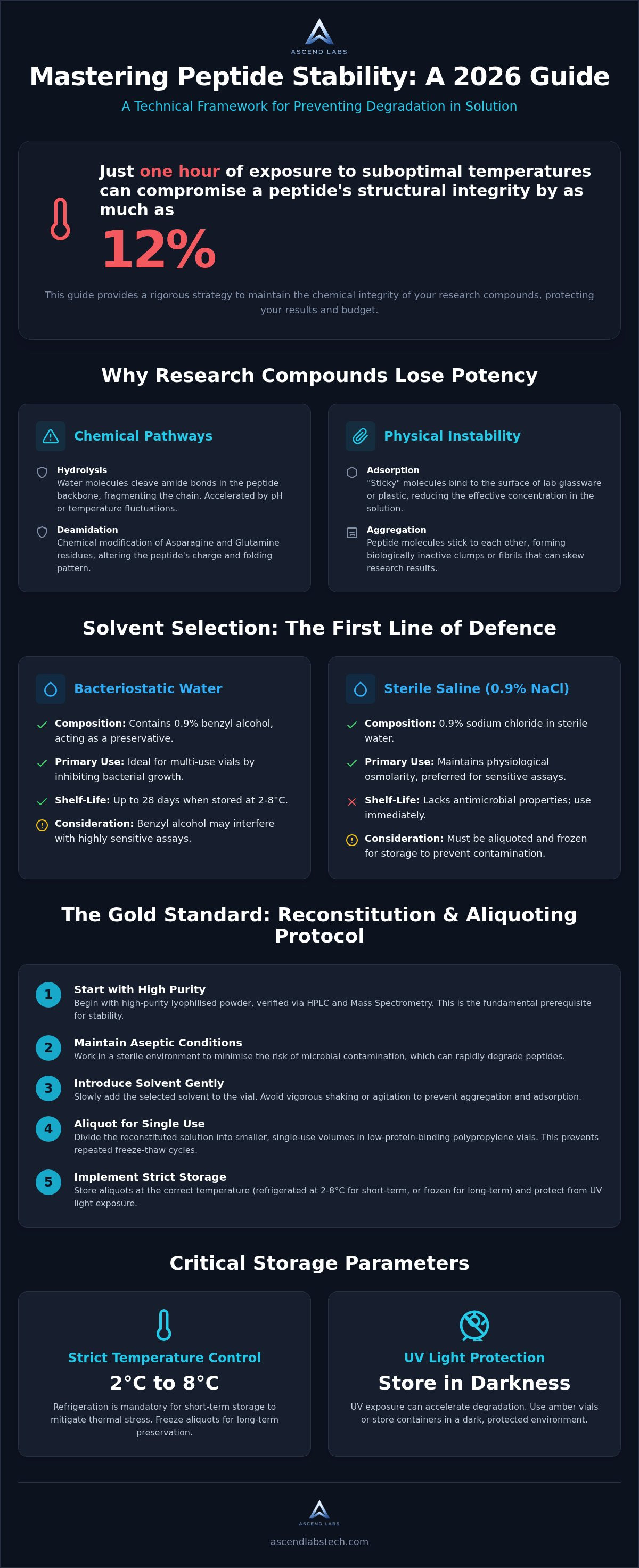
Did you know that just one hour of exposure to suboptimal temperatures can compromise the secondary structure integrity of a synthetic peptide by as much as 12 per cent? For researchers, the technical challenge of preventing peptide degradation in solution is often the thin line between a successful study and a significant loss of research budget. It's a common frustration to see inconsistent data emerge simply because a compound lost its potency within days of reconstitution. You need more than just high-purity lyophilised powder; you need a rigorous strategy to keep it stable once it's in a liquid state.
Ascend Labs presents this 2026 guide, offering a sophisticated framework for mastering the protocols required to maintain the chemical integrity of research peptides. We'll provide a repeatable protocol for reconstitution that ensures you achieve the maximum shelf-life for your solution-state compounds. By the end of this briefing, you'll have the technical confidence to manage specific pH levels, select the correct solvents for metabolic peptides, and implement storage standards that protect the accuracy of your findings. We'll move from foundational stability principles to the practicalities of laboratory handling to ensure your research remains precise.
Key Takeaways
- Understand the primary chemical triggers-hydrolysis, oxidation, and deamidation-that lead to the irreversible loss of structural integrity in research compounds.
- Identify the most stable reconstitution solvents for your specific metabolic peptides to ensure effective preservation while preventing peptide degradation in solution.
- Master the critical storage parameters, including strict temperature control and UV protection, required to mitigate thermal stress and maintain compound potency.
- Implement a rigorous step-by-step protocol for reconstitution and aliquoting that prioritises aseptic conditions and minimises the risk of microbial contamination.
- Recognise why starting with high-purity lyophilised powder, verified through HPLC and Mass Spectrometry, is the fundamental prerequisite for solution-state stability.
Mechanisms of Peptide Degradation: Why Research Compounds Lose Potency
Peptide degradation is defined as the irreversible loss of a compound's secondary or tertiary structure, a process that fundamentally compromises the chemical integrity of the research material. At its most basic level, peptide degradation occurs through the chemical cleavage of amide bonds, which effectively fragments the amino acid chain and renders the molecule biologically inert. For practitioners in Australian laboratories, preventing peptide degradation in solution is a critical operational requirement. When a compound begins to break down, the effective concentration of the active peptide decreases. This leads to inconsistent results and skewed data in metabolic studies. Understanding these triggers is essential for maintaining the rigorous standards required for high-level inquiry.
Chemical Pathways: Hydrolysis and Deamidation
The primary chemical threats to solution-state stability are hydrolysis and deamidation. Hydrolysis occurs when water molecules interact with the amide bonds of the peptide backbone, causing the chain to fragment into smaller, inactive sequences. This process is a central component of the Mechanisms of Peptide Degradation and is often accelerated by fluctuations in pH or temperature. Deamidation is equally problematic, particularly for peptides containing Asparagine and Glutamine residues. These specific amino acids are highly susceptible to chemical modification in aqueous environments, which can alter the peptide's charge and folding pattern. Advanced metabolic compounds, such as Retatrutide, require meticulous handling because their complex structures are particularly vulnerable to these reactive pathways once reconstituted.
Physical Instability: Aggregation and Adsorption
Beyond chemical changes, physical instability presents a significant risk to research accuracy. Peptides often exhibit a high degree of "stickiness," leading to adsorption where the molecules bind to the surface of laboratory glassware or plasticware. This reduces the actual concentration of the peptide available in the solution. Individual peptide molecules may also begin to stick to each other, forming fibrils or large aggregates. These aggregates are not only biologically inactive but can also trigger unwanted responses in research models. To ensure success in preventing peptide degradation in solution, researchers should prioritise the use of low-protein-binding polypropylene vials and minimise unnecessary agitation during the reconstitution process. Maintaining aseptic conditions and using high-purity solvents are the only ways to mitigate these physical risks effectively.
Selecting the Correct Reconstitution Solvent for Stability
The selection of a reconstitution solvent is a technical decision that dictates the chemical longevity of a research compound. While many practitioners default to sterile water, the chemical environment of the solvent directly influences the rate of hydrolysis and microbial proliferation. Success in preventing peptide degradation in solution requires an understanding of how different liquids interact with the amino acid backbone. For instance, the Step-by-Step Protocol for Reconstituting and Aliquoting Peptides provided by global standards agencies emphasises that solvent choice must align with the intended duration of the study and the specific hydrophobic properties of the peptide.
Bacteriostatic Water vs. Sterile Saline
Bacteriostatic water, containing 0.9 per cent benzyl alcohol, is the industry standard for multi-use vials. The alcohol acts as a preservative, inhibiting bacterial growth for up to 28 days when stored at 2 to 8 degrees Celsius. However, benzyl alcohol can interfere with certain sensitive assays, particularly in mitochondrial research involving compounds like MOTS-C. In these instances, 0.9 per cent sodium chloride (sterile saline) is often preferred to maintain physiological osmolarity. While saline provides a stable environment for short-term use, it lacks antimicrobial properties; this means the solution must be used immediately or aliquoted and frozen to avoid degradation.
Adjusting pH for Optimal Solubility
A peptide's isoelectric point (pI) is the pH at which it carries no net electrical charge. Solubility is typically at its lowest at this point, significantly increasing the risk of aggregation and precipitation. To avoid this, researchers must often shift the pH away from the pI using dilute acetic acid for basic peptides or sodium hydroxide for acidic ones. Maintaining a pH between 5.0 and 7.0 is generally ideal for metabolic research compounds because it balances solubility while minimising the rate of deamidation. For highly hydrophobic compounds that resist aqueous dissolution, a small volume of an organic solvent like DMSO may be required before adding the primary buffer. Ensuring you start with high-stability research compounds allows for more predictable results during these delicate pH adjustments. This meticulous control over the solvent environment remains the most effective method for preventing peptide degradation in solution during long-term laboratory experiments.
Critical Storage Parameters: Temperature and UV Exposure
Thermal stress is the most aggressive catalyst for the chemical breakdown of reconstituted compounds. Once in liquid form, peptides lack the rigid protection of the lyophilised state, making them highly susceptible to kinetic energy that drives bond cleavage. For researchers prioritising accuracy, preventing peptide degradation in solution requires maintaining a strict cold chain from the moment of reconstitution. Reconstituted research peptides must be stored at a constant refrigerated temperature between 2°C and 8°C to ensure maximum stability. Data indicates that exposure to suboptimal temperatures for even a single hour can decrease secondary structure integrity by as much as 12 per cent.
The Impact of Thermal Stress on Peptide Bonds
Storing compounds at room temperature can reduce their half-life by 50 to 70 per cent, with some peptides becoming completely inactive within 7 to 14 days. Even under ideal refrigeration, potency loss is inevitable; most peptides lose 5 to 10 per cent of their efficacy within the first 30 days and up to 20 per cent by day 60. Laboratory refrigerators often contain "hot spots" where temperatures fluctuate, necessitating the use of digital stability monitoring to ensure a consistent environment. It's also vital to avoid repeated freeze-thaw cycles, as each cycle can reduce active peptide concentration by 10 to 15 per cent. Establishing a baseline through peptide purity testing is essential for verifying that the starting material has the structural resilience to withstand these storage demands.
Preventing Photo-Degradation in the Laboratory
UV light exposure initiates free radical production, leading to rapid peptide oxidation and the modification of specific amino acid side chains. Residues such as Tryptophan and Tyrosine are particularly sensitive to light-induced damage, which can cause a 15 to 25 per cent reduction in potency within just 48 hours. To mitigate this risk, researchers should utilise amber glass vials or wrap clear vials in aluminium foil to provide a total light block. Preventing peptide degradation in solution also involves organising workflows to ensure vials are only removed from dark storage for the minimum time required for measurement. These meticulous environmental controls are non-negotiable for maintaining the fidelity of research findings in the Australian climate.
Step-by-Step Protocol for Reconstituting and Aliquoting Peptides
Before beginning the reconstitution process, the lyophilised vial must be allowed to reach room temperature. Opening a cold vial introduces atmospheric moisture, which can lead to immediate hydrolysis. A professional protocol follows a precise sequence: equilibrate the vial, sanitise the environment, and introduce the solvent. All surfaces should be cleaned with 70 per cent isopropyl alcohol to maintain aseptic conditions. Once the vial has equilibrated, the selected solvent should be introduced by aiming the needle at the glass wall rather than directly at the peptide cake. This method facilitates a gentle dissolution and is a foundational step in preventing peptide degradation in solution. Ensuring the vacuum is released slowly prevents the solvent from rushing in and causing unnecessary mechanical stress to the powder.
Proper Mixing Techniques to Avoid Shearing
Vigorous shaking is a primary cause of mechanical shearing, which results in the irreversible denaturation of complex amino acid chains. Mechanical stress can disrupt the delicate folding patterns of the peptide, leading to a complete loss of potency. Instead, researchers should employ the "gentle roll" method, slowly rotating the vial between the palms until the solution is clear. This level of care is especially critical in mitochondrial peptide research, where the structural requirements of compounds must be preserved to ensure biological activity. It's often helpful to allow the solvent to naturally wick into the lyophilised cake before any movement is initiated. Aggressive agitation often creates foam, which increases the surface area exposed to air and accelerates oxidation.
Effective Aliquoting Strategies for Long-Term Studies
The most effective strategy for preventing peptide degradation in solution is the immediate division of the master solution into single-use aliquots. This approach eliminates repeated freeze-thaw cycles, which are known to reduce active concentrations by up to 15 per cent per cycle. Aliquots should be stored in low-protein-binding polypropylene tubes to minimise concentration loss through surface adsorption. Using a pipette with low-retention tips can further reduce the loss of high-value compounds during the transfer process. Researchers must calculate aliquot volumes based on the specific requirements of the study protocol to ensure no material is wasted or refrozen. Each tube should be clearly labelled with the compound name, concentration, and date of reconstitution to ensure study reproducibility and data integrity. Standardising these procedures across all laboratory personnel ensures that data remains comparable across multiple trials.
Ensuring Integrity: Sourcing and Verifying Research Compounds
The stability of any reconstituted research material is fundamentally limited by the chemical purity of the starting lyophilised powder. If a compound arrives with pre-existing degradation precursors or residual impurities, the rate of chemical breakdown in the liquid state will be significantly accelerated. For researchers, preventing peptide degradation in solution begins long before the solvent is introduced; it starts with the selection of a verified, high-purity source. High-Performance Liquid Chromatography (HPLC) and Mass Spectrometry (MS) are the definitive tools for verifying that a peptide sequence is correct and that the purity levels meet the rigorous standards required for serious inquiry. These methods ensure that the compound is free from truncated sequences or chemical contaminants that could catalyse premature structural failure.
The Role of Purity in Solution Stability
Residual salts and trifluoroacetic acid (TFA) are common by-products of the peptide synthesis process that can negatively influence solution pH. Even trace amounts of these substances can shift the environment of the reconstituted solution, inadvertently creating conditions that promote hydrolysis or deamidation. A high initial purity level correlates directly with a slower rate of degradation during long-term storage. Researchers can refer to the Ascend Labs catalogue to source compounds that have undergone strict verification to ensure these precursors are minimised. Maintaining a clean chemical profile from the outset is the only way to ensure that the stability protocols implemented in the laboratory yield predictable results.
Procuring High-Grade Peptides for Australian Laboratories
Sourcing from a domestic supplier offers a distinct advantage for Australian researchers by reducing transit-related thermal stress. International shipping often exposes compounds to uncontrolled environments for extended periods, potentially initiating degradation before the vial even reaches the laboratory. Every compound should be accompanied by a Certificate of Analysis (COA) to confirm its chemical profile before reconstitution occurs. When reviewing the stability of GIP receptor agonist research compounds or other metabolic catalysts, the presence of independent verification is the only way to ensure data integrity. Ascend Labs maintains a disciplined approach to quality assurance, acting as a gatekeeper for the Australian scientific community. By prioritising HPLC and MS verification, we ensure that every compound provides a stable foundation for research. This meticulous sourcing, combined with the environmental controls discussed in previous sections, allows for the highest degree of confidence in preventing peptide degradation in solution.
Optimising Laboratory Protocols for Research Integrity
Maintaining the chemical integrity of research materials requires a disciplined approach to laboratory management. By mastering the selection of pH-balanced solvents and adhering to strict cold-chain parameters, researchers can achieve the consistent and reproducible data necessary for high-stakes inquiry. The technical success of preventing peptide degradation in solution ultimately rests on the synergy between high-purity starting materials and the meticulous handling protocols established in this guide. Implementing a rigorous aliquoting strategy remains the most effective method for eliminating the structural damage caused by repeated freeze-thaw cycles.
Starting your inquiry with HPLC and MS verified compounds ensures that your baseline stability is never in question. By procuring specialised metabolic and mitochondrial research compounds through a reliable domestic partner, you eliminate the thermal risks associated with international transit. We look forward to supporting the precision and integrity of your next laboratory study.
Frequently Asked Questions
How long do research peptides remain stable in a solution?
Stability in the liquid state is temporary, typically lasting between 30 and 60 days when maintained at 2 to 8 degrees Celsius. Most compounds experience a potency loss of 5 to 10 per cent within the first month. By the 60 day mark, degradation can reach 20 per cent even under ideal conditions. To ensure the integrity of your study, it's advisable to use reconstituted solutions within a four-week window or employ aliquoting for longer durations.
Can I use tap water or distilled water to reconstitute peptides?
You must never use tap or standard distilled water for reconstitution as they contain ions and microbial contaminants that catalyse chemical breakdown. Preventing peptide degradation in solution requires high-purity, laboratory-grade solvents like sterile bacteriostatic water or 0.9 per cent sodium chloride. Bacteriostatic water is generally the preferred choice for multi-use vials because the included benzyl alcohol inhibits bacterial proliferation for up to 28 days.
What happens if I accidentally shake the peptide vial during mixing?
Shaking a vial causes mechanical shearing, a process that can lead to the irreversible denaturation of the peptide's secondary or tertiary structure. This physical stress effectively renders the compound biologically inactive, compromising your research data. Instead of shaking, use the "gentle roll" technique by slowly rotating the vial between your palms. If the powder doesn't dissolve immediately, allow the vial to sit undisturbed in the refrigerator for several minutes.
Is it better to store reconstituted peptides in the fridge or the freezer?
Reconstituted peptides should be stored in a dedicated laboratory refrigerator at 2 to 8 degrees Celsius for short-term use. If the study requires the compound to last beyond 30 days, it's better to aliquot the solution into single-use volumes and store them in a freezer at -20 degrees Celsius. Storing the master vial in the freezer is counterproductive if you intend to repeatedly thaw it, as this causes rapid structural failure.
Why do some peptides become cloudy or form visible particles after reconstitution?
Cloudiness or visible particulates typically indicate peptide aggregation or precipitation, often caused by an incorrect solvent pH or the peptide reaching its isoelectric point. If the solution isn't clear, the peptide is no longer fully solubilised and its biological activity is likely compromised. This can also occur if the solvent is introduced too rapidly, causing mechanical shock. Ensuring the solvent pH is adjusted away from the peptide's pI is the standard corrective measure.
How many times can I freeze and thaw a peptide solution before it degrades?
You should aim for zero freeze-thaw cycles by utilising a single-use aliquoting strategy. Each cycle of freezing and thawing can reduce the active peptide concentration by 10 to 15 per cent due to the physical stress of ice crystal formation and temperature fluctuations. Repeatedly cycling a master vial will quickly lead to inconsistent research findings. Dividing the solution into individual doses immediately after reconstitution is the only way to preserve long-term potency.
Does the type of vial material affect peptide degradation rates?
The choice of vial material significantly influences the rate of concentration loss through a process known as adsorption. Peptides often adhere to the walls of standard glass or plastic laboratory equipment, which reduces the amount of active compound available in the solution. For preventing peptide degradation in solution, researchers should prioritise low-protein-binding polypropylene tubes. Additionally, using amber glass is essential for light-sensitive compounds to prevent the oxidative damage caused by UV exposure.
How can I tell if my peptide has already degraded in solution?
It's impossible to definitively confirm degradation through visual inspection alone, as chemical changes like deamidation or hydrolysis don't always change the solution's appearance. While cloudiness or precipitation are clear indicators of failure, a solution can remain perfectly clear while losing significant potency. The only way to verify integrity is through HPLC or Mass Spectrometry analysis. Researchers should rely on strict adherence to established storage protocols and use compounds within their validated stability windows.


