

The era of importing unverified research compounds through unpredictable international channels has reached a definitive end in 2026. As the TGA intensifies its regulatory focus on unapproved peptides, the margin for error in neuromodulator research australia has narrowed to zero. You likely understand the frustration of waiting weeks for a shipment only to receive a vial lacking transparent HPLC data or, worse, one that fails to meet basic purity benchmarks. Relying on opaque overseas vendors doesn't just jeopardise your timeline; it compromises the reproducibility of your entire study.
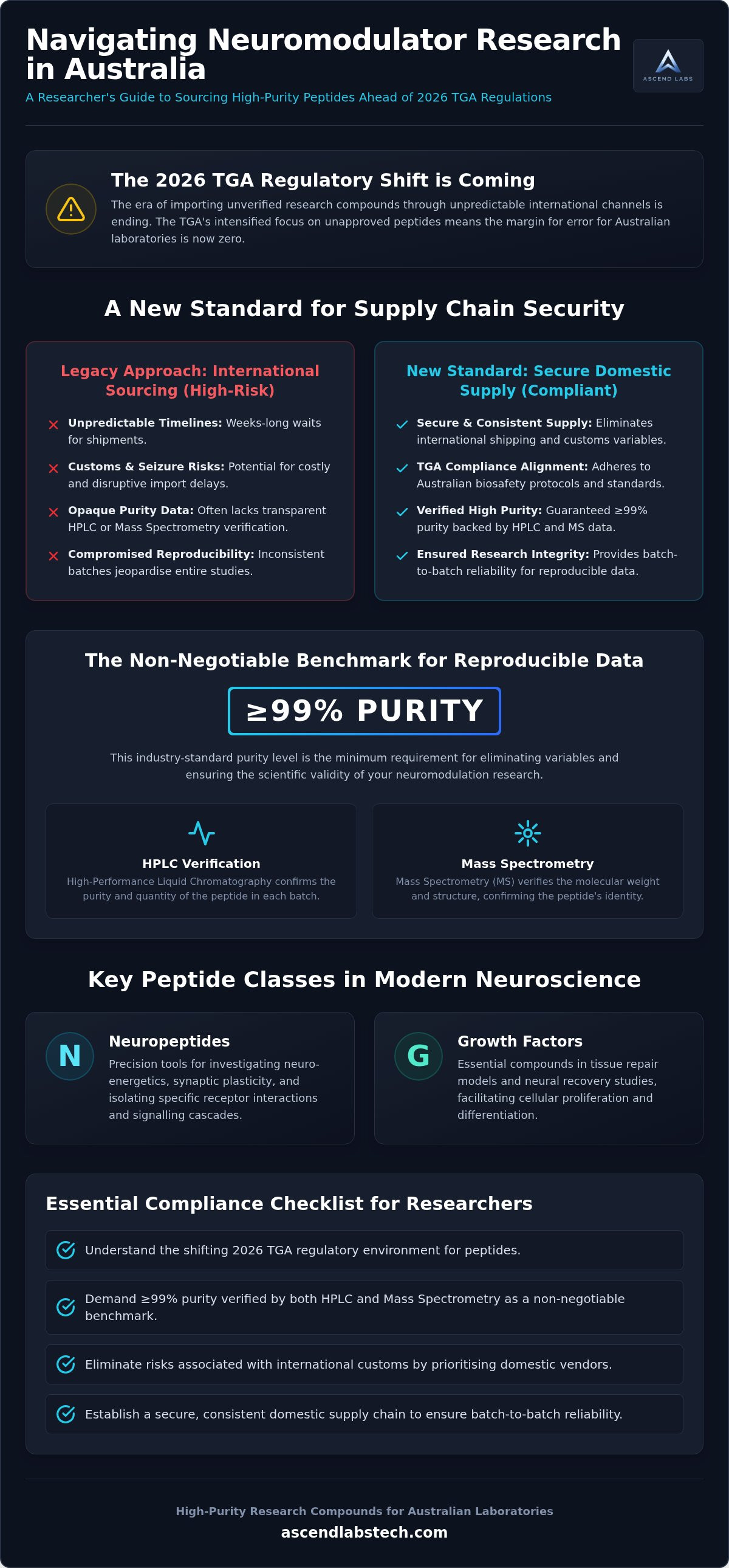
We recognise that maintaining the integrity of your laboratory's data depends entirely on the absolute precision of your reagents. This briefing provides a comprehensive framework for sourcing and verifying high-purity neuromodulator peptides within the Australian scientific community. We'll examine the technical requirements for HPLC and Mass Spectrometry verification, the logistical advantages of a secure domestic supply, and the operational standards necessary to ensure your research remains both compliant and scientifically sound. By prioritising verified purity over convenience, you can eliminate the variables that often hinder advanced neurosensing and neuromodulation inquiry.
Key Takeaways
- Understand the shifting 2026 regulatory environment in Australia and why domestic sourcing is now critical for maintaining laboratory compliance.
- Learn why industry-standard purity of ≥99% verified by HPLC and Mass Spectrometry is the non-negotiable benchmark for reproducible scientific data.
- Discover how to navigate the technical complexities of neuromodulator research australia by eliminating the risks associated with international customs and unverified vendors.
- Identify the primary classes of neuromodulator and growth factor peptides currently driving advancements in contemporary neuroscience and recovery studies.
- Establish a secure, consistent supply chain for high-purity research compounds to ensure batch-to-batch reliability across your technical protocols.
The Evolving Landscape of Neuromodulator Research in Australia
Neuromodulation in Australia has transitioned from a niche surgical interest into a cornerstone of contemporary neuroscience. In the laboratory, it involves the targeted alteration of nerve activity through either electrical or chemical stimuli. Understanding the physiological process of neuromodulation is essential for researchers exploring neural plasticity, chronic pain pathways, and metabolic regulation. The Australian Research Council (ARC) continues to fund significant initiatives in this field, recognising that basic science research provides the foundation for future therapeutic breakthroughs. This investment reflects a national commitment to decoding complex neurological systems through disciplined inquiry.
To better understand the operational complexities of conducting such trials in the local market, consider this perspective:
From Clinical Devices to Biochemical Inquiries
While device-led interventions like deep brain stimulation dominate clinical headlines, neuromodulator research australia is increasingly defined by sophisticated biochemical inquiries. Devices typically offer broad regional stimulation, which is effective for symptom management but often lacks the specificity required for basic science. In contrast, peptide-based methods allow for molecular-level precision. By utilising targeted peptides, researchers can isolate specific receptor interactions and signalling cascades. This granularity is vital for mapping the intricate pathways of the central nervous system without the confounding variables introduced by generalised electrical pulses. It allows for a "substance over style" approach where the chemical interaction itself is the primary focus of the study.
Regulatory Standards for Research Compounds
Adhering to the Australian regulatory landscape requires a clear distinction between clinical application and laboratory inquiry. Following the June 2026 TGA compliance update, which prioritised oversight of unapproved peptides, the need for rigorous documentation has never been higher. These compounds are designated strictly for research purposes; they aren't for human consumption. Adhering to these standards ensures that laboratories maintain their accreditation and ethical standing. Research-grade materials require a different verification rigour than pharmaceutical-grade products, focusing heavily on batch consistency and the absolute absence of cross-contaminants. Sourcing high-purity neuromodulator peptides through domestic channels simplifies this compliance. It ensures that every vial aligns with the strict biosafety protocols expected by Australian institutional review boards while maintaining a secure, transparent supply chain.
Key Peptide Classes in Modern Neuroscience Studies
The shift towards biochemical inquiry in neuromodulator research australia has highlighted several specific peptide classes that offer unprecedented control over cellular signalling. While clinical models often focus on macro-level stimulation, laboratory protocols now leverage neuropeptides to influence micro-level neural environments. These compounds serve as precise tools for investigating neuro-energetics, synaptic plasticity, and regenerative mechanisms. By selecting specific peptide classes, researchers can target distinct physiological pathways with a level of accuracy that device-based methods cannot replicate.
Neuropeptides and Growth Factor Applications
Growth factor peptides have become essential in tissue repair models and neural recovery studies. These compounds facilitate cellular proliferation and differentiation, providing a framework for investigating how the nervous system responds to injury or degenerative stimuli. The mechanism of action typically involves the activation of specific tyrosine kinase receptors, which triggers downstream signalling cascades vital for axonal growth and synaptic maintenance. To maintain the integrity of these cellular responses, researchers must ensure their reagents meet the highest standards of purity. Inconsistent batches or the presence of contaminants can lead to aberrant signalling, rendering study results unreliable. For detailed information on recovery-focused protocols, researchers may refer to this guide on growth factor peptides Australia for further recovery-based inquiry. Achieving reproducible data requires a commitment to using compounds that exhibit a verified purity of 99% or higher.
Metabolic Neuromodulators: KLOW and MOTS-C
The intersection of metabolic regulation and neural health is a burgeoning area of study. Mitochondrial-derived peptides, specifically KLOW and MOTS-C, have emerged as primary subjects of interest due to their influence on neuro-metabolic pathways. These compounds play a critical role in mitochondrial biogenesis and the regulation of cellular homeostasis. Researchers are increasingly examining the comparative effects of KLOW vs MOTS-C to understand how they modulate energy expenditure and proteostasis within neural tissues. KLOW is often studied for its potential in longevity and age-related cognitive models, whereas MOTS-C is frequently utilised to investigate metabolic flexibility and insulin sensitivity in the brain. Understanding these metabolic drivers is essential for neuromodulator research australia as scientists seek to uncover the energetic requirements of neural survival. Accessing a stable domestic supply of these neuromodulator peptides allows laboratories to maintain consistent experimental timelines without the disruptions typical of international procurement. This stability is vital for long-term longitudinal studies that require precise batch-to-batch alignment.
Navigating Supply Chain Security for Australian Laboratories
Securing high-purity compounds is a primary logistical challenge for neuromodulator research australia. The geographical distance between global manufacturing hubs and local laboratories creates a supply chain gap that often compromises research timelines and compound integrity. For many researchers, the procurement process is fraught with variables that can't be easily controlled, leading to significant delays in experimental schedules. Establishing a secure, domestic supply chain isn't just a matter of convenience; it's a prerequisite for maintaining scientific rigor and batch-to-batch consistency.
The Challenges of International Procurement
Importing research peptides from overseas involves significant regulatory and environmental risks. With the TGA's 2026 compliance priorities focusing heavily on unapproved peptides, international shipments face unprecedented scrutiny. This often leads to prolonged customs delays or total seizures, which can stall a project for months. Beyond regulatory hurdles, the physical journey poses a threat to peptide stability. Long-haul transit involves fluctuating temperatures and potential radiation exposure during air freight. These factors can degrade sensitive chemical bonds before the material even reaches the laboratory bench.
Batch verification presents another hurdle in the international model. If an independent HPLC result doesn't match the vendor's provided certificate of analysis, the researcher has limited recourse. Returning materials to an overseas vendor is logistically complex and often cost-prohibitive. This lack of accountability forces laboratories to absorb the risk of sub-standard reagents, which directly threatens the reproducibility of their data.
Advantages of a Domestic Research Partner
Partnering with a specialised Australian-owned entity like Ascend Labs mitigates these risks by providing a secure, domestic supply chain. Domestic procurement allows for a level of transparency and speed that international vendors can't match. When you source neuromodulator peptides locally, you eliminate the "Australian Gap" where compounds sit on hot tarmacs or in unconditioned customs warehouses. Instead, materials are held in climate-controlled domestic facilities and dispatched via rapid courier services.
- Local Warehousing: Compounds are stored within Australia, ensuring they aren't subjected to the environmental stresses of long-haul international shipping.
- Logistical Speed: Domestic shipping ensures that materials reach the laboratory within days, allowing for more agile research planning and execution.
- Technical Support: Access to Australian-based expertise means that technical enquiries are handled in the same time zone by professionals who understand local laboratory standards.
Maintaining the security of neuromodulator research australia also requires a commitment to discreet, temperature-controlled shipping. Domestic supply chains allow for more precise control over the "last-mile" delivery process. By utilising specialised domestic couriers, laboratories can ensure that their research compounds arrive in optimal condition, ready for immediate use in sensitive biochemical assays. This logistical stability allows researchers to focus on data collection rather than supply chain management.
Purity Verification: HPLC and Mass Spectrometry Standards
In the landscape of neuromodulator research australia, analytical precision isn't merely a preference; it's the only defense against experimental failure. The industry gold standard for research peptides is a purity level of 99% or higher. Achieving this benchmark requires a two-pronged analytical approach involving High-Performance Liquid Chromatography (HPLC) and Mass Spectrometry (MS). While HPLC measures the concentration of the target peptide relative to impurities, Mass Spectrometry verifies the molecular identity of the compound itself. Together, these methods provide the technical certainty required for advanced neurological inquiries where even minute contaminants can trigger unintended cellular responses.
Interpreting the Certificate of Analysis (COA)
A professional Certificate of Analysis is more than a summary; it's a technical map of the batch's chemical profile. Researchers must scrutinise the HPLC chromatogram for any secondary peaks or "shoulders" on the main peak. These anomalies indicate the presence of truncated sequences, residual reagents, or oxidised by-products. A single, sharp peak at the expected retention time is the hallmark of a high-purity compound. It's critical to demand batch-specific testing rather than relying on generic "typical analysis" reports. These generic documents often fail to reflect the specific nuances of the current production run. For a deeper understanding of these requirements, laboratories should consult established peptide purity testing protocols to ensure their internal verification steps are sufficiently rigorous.
Mass Spectrometry and Molecular Weight Confirmation
HPLC alone cannot guarantee that the substance in the vial is the intended peptide; it only confirms that the substance is pure. Mass Spectrometry solves this by measuring the mass-to-charge ratio of the ionised molecules. By comparing the observed molecular weight against the theoretical mass of the peptide sequence, researchers can definitively confirm the compound's identity. This step is non-negotiable for neuromodulator research australia, as many peptides have similar HPLC retention times but vastly different biological functions.
Using unverified materials in peer-reviewed research is a significant risk that can lead to the retraction of findings or the inability to replicate results across different laboratory settings. Third-party verification acts as an essential safeguard for research integrity. It provides an objective layer of quality assurance that transcends the vendor's internal data, ensuring that every project is built on a foundation of absolute chemical truth.
Sourcing Neuromodulator Peptides via Ascend Labs
Ascend Labs operates as a disciplined curator for the Australian scientific community, providing a bridge between advanced peptide synthesis and local laboratory requirements. Our commitment to neuromodulator research australia is grounded in the belief that scientific truth is only as reliable as the reagents used to uncover it. By maintaining a strictly domestic operation, we eliminate the logistical vulnerabilities associated with international transit. This ensures that every batch of neuromodulator peptides remains under controlled conditions from the point of verification to final delivery at your facility.
Crucially, our operation adheres to a strict regulatory mandate. All compounds within the Ascend Labs catalogue are intended for research purposes only and are not for human consumption. This distinction is fundamental to our professional ethics and operational discretion. We don't offer medical advice or international shipping. Instead, we focus our resources on being the premier domestic partner for Australian laboratories that value technical precision and batch-to-batch reliability above all else.
The Ascend Labs Product Catalogue
Our catalogue is meticulously curated to support diverse inquiries into neuro-metabolism, synaptic plasticity, and recovery. We provide high-purity metabolic research compounds such as Retatrutide and Tirzepatide, which are central to contemporary studies on energetic homeostasis. Beyond these, our specialised range includes mitochondrial-derived peptides like KLOW and MOTS-C, alongside a comprehensive selection of growth factor and recovery peptides. For established Australian laboratories, the procurement process is streamlined. This allows for rapid access to essential materials without the administrative burden or degradation risks of international import channels.
Security and Professional Integrity
We understand that laboratory privacy and compound security are paramount. Ascend Labs employs discreet packaging for all domestic shipments, ensuring that the nature of your inquiry remains confidential. This professional discretion is matched by our commitment to transparency. Every compound is supported by batch-specific analytical data, providing the technical weight necessary for rigorous peer-reviewed publication.
We invite researchers to explore the full range of research compounds available through our domestic facility. By prioritising a substance-over-style approach, we ensure that your research is supported by a partner that understands the high-stakes nature of neuromodulator research australia. Our focus remains entirely on delivering the purity and consistency required for advanced scientific inquiry.
Advancing the Integrity of Australian Neuroscience
The landscape of neuromodulator research australia demands a definitive transition toward uncompromising quality standards and secure, domestic procurement. As regulatory scrutiny increases and the technical requirements for peer-reviewed data become more stringent, relying on unverified international supply chains isn't a viable strategy for serious inquiry. Maintaining laboratory-grade purity standards through rigorous HPLC and Mass Spectrometry verification is the only method to ensure that experimental variables remain controlled and results are reproducible.
By prioritising domestic Australian shipping, researchers eliminate the environmental and logistical risks associated with long-haul transit. This focus on batch consistency and transparent analytical data allows scientists to dedicate their resources to discovery rather than supply chain management. Establishing a partnership with a disciplined curator ensures that your laboratory operates with the highest degree of professional integrity and technical precision.
We look forward to supporting your next breakthrough with the precision and reliability your research requires.
Frequently Asked Questions
What are the most common neuromodulator peptides used in Australian research?
Australian laboratories frequently utilise metabolic compounds such as Retatrutide and Tirzepatide for neuro-energetic studies. Specialised mitochondrial-derived peptides like KLOW and MOTS-C are also prominent in longevity and cellular homeostasis research. These compounds are often complemented by growth factor and recovery peptides to investigate neural tissue repair and synaptic plasticity. The selection depends on the specific signalling pathways being isolated within the broader framework of neuromodulator research australia.
Is it legal to purchase neuromodulator peptides for research in Australia?
It's legal to procure these compounds provided they are utilised strictly for scientific research within a laboratory setting. In 2026, the TGA clarified its compliance priorities, intensifying oversight of unapproved peptides to prevent illegal supply for human use. Researchers must ensure their sourcing aligns with institutional biosafety protocols and that all materials are designated as research-grade chemicals. Adhering to these standards protects the integrity of the study and the legal standing of the institution.
How do I verify the purity of a neuromodulator peptide batch?
Verifying purity requires a combination of High-Performance Liquid Chromatography (HPLC) and Mass Spectrometry (MS). The industry benchmark for neuromodulator research australia is a purity level of 99% or higher. HPLC identifies the concentration of the target peptide relative to impurities, while MS confirms the molecular identity. Researchers should always cross-reference the vendor's Certificate of Analysis (COA) with independent third-party testing to ensure batch consistency and the absence of truncated sequences or residual reagents.
What is the difference between HPLC and Mass Spectrometry in peptide testing?
HPLC and Mass Spectrometry serve distinct analytical functions in the verification process. HPLC separates the components of a mixture to determine the percentage of the target peptide, effectively measuring purity. Conversely, Mass Spectrometry measures the mass-to-charge ratio of the molecules to confirm the compound's specific molecular weight. While HPLC tells you how much of the substance is present, Mass Spectrometry confirms exactly what the substance is, which is vital for accurate neuromodulator research australia.
Why should Australian researchers choose domestic peptide suppliers over international ones?
Choosing a domestic supplier like Ascend Labs eliminates the "Australian Gap," where international shipments face prolonged customs delays and temperature fluctuations. Long-haul transit often compromises peptide stability through exposure to heat or radiation. Domestic supply ensures faster delivery via climate-controlled couriers and provides access to local technical support. Sourcing locally also removes the risk of compound seizures associated with the TGA's 2026 focus on the illegal importation of unapproved peptide products.
Are neuromodulator peptides suitable for human consumption in Australia?
Neuromodulator peptides are strictly not for human consumption in Australia. These compounds are produced as research-grade chemicals intended solely for laboratory and scientific inquiry. They lack TGA approval for therapeutic use, and any application outside of a controlled research environment is prohibited. Reputable suppliers clearly label all products with a "Research Only" mandate to ensure that practitioners and laboratories adhere to the necessary ethical and safety standards required by Australian law.
How should research peptides be stored to maintain stability in the Australian climate?
To maintain stability in the Australian climate, lyophilised peptides should be stored in a temperature-controlled environment, typically at -20°C for long-term preservation. Exposure to high ambient temperatures or direct sunlight can trigger peptide degradation and oxidation. Once reconstituted, peptides are significantly more fragile and should be kept refrigerated at 2°C to 8°C and utilised within a short timeframe. Using airtight, light-shielded vials is essential to prevent moisture ingress and maintain chemical integrity.
What documentation should I expect from a reputable Australian peptide supplier?
A reputable supplier must provide a comprehensive, batch-specific Certificate of Analysis (COA). This documentation should include an HPLC chromatogram showing a clear purity percentage and a Mass Spectrometry report confirming the molecular weight. Generic reports that reflect "typical" results rather than the specific batch being delivered are insufficient for rigorous scientific standards. Professional documentation ensures that every project within the field of neuromodulator research australia is built on a foundation of transparent and verifiable analytical data.


