

The assumption that a recovery stack is merely a collection of individual peptides ignores the fundamental complexity of biochemical synergy. For practitioners investigating tissue remodelling, sourcing klow peptide australia involves more than just finding a vendor; it requires a rigorous commitment to molecular integrity. You likely understand the frustration of inconsistent purity levels and the confusion surrounding various "Wolverine" stack iterations that saturate the research market. These uncertainties can compromise the precision of your data and the validity of your research outcomes.
This technical reference serves as a definitive guide to the KLOW multi-peptide blend, its synergistic mechanisms, and the rigorous standards required for Australian scientific inquiry. We'll provide a comprehensive breakdown of KLOW’s molecular architecture while establishing clear criteria for selecting high-purity domestic suppliers. By the conclusion of this briefing, you'll have a precise understanding of how this blend differs from related compounds like GLOW and how to ensure your laboratory remains compliant with domestic regulatory expectations.
Key Takeaways
- Understand the molecular architecture of the KLOW multi-peptide blend and its specific application in Australian tissue remodelling research.
- Analyse the synergistic pathways of BPC-157 and TB-500 within the klow peptide australia framework to ensure consistent experimental outcomes.
- Distinguish between 'Wolverine' stack variations, specifically comparing the KLOW architecture against GLOW and basic dual-compound protocols.
- Identify the essential laboratory verification standards, including HPLC and Mass Spectrometry, required to confirm batch purity and sequence accuracy.
- Recognise the advantages of domestic procurement to mitigate risks associated with international customs delays and the thermal degradation of sensitive research compounds.
Understanding the KLOW Peptide Framework in Australian Research
KLOW represents a sophisticated advancement in the study of tissue remodelling and cellular signalling. It's a multi-peptide research formulation engineered specifically to provide a technical framework for investigating complex regenerative pathways. Unlike isolated compounds, the klow peptide australia research landscape focuses on the interaction between multiple molecular sequences to observe cumulative biological effects. This architecture is designed for precision inquiry into how specific peptide chains influence inflammatory modulation and the acceleration of cellular repair mechanisms.
The scientific community often refers to this blend using the "Wolverine++" nomenclature. This distinction is necessary to separate the KLOW framework from more rudimentary peptide stacks. While basic combinations may pair two agents, KLOW incorporates a broader spectrum of metabolic and growth factor analogues. Researchers use this expanded profile to investigate multi-pathway signalling cascades that single-compound studies cannot replicate. By providing a more comprehensive molecular environment, KLOW allows for the observation of synergistic effects that are critical to modern regenerative science.
The Evolution of Multi-Peptide Blends
Laboratory methodologies have shifted away from isolated compound testing toward more integrated, synergistic signalling models. This transition reflects a deeper understanding of how biological systems respond to concurrent stimuli. Australian researchers are increasingly pivoting toward these complex multi-pathway investigations to better simulate the intricate environment of living tissue. This trend is particularly evident in mitochondrial peptide research, where the focus has moved from simple energy production to the broader implications of metabolic signalling and cellular longevity.
The rise of specialised mitochondrial and metabolic research in Australia has created a demand for high-purity, multi-component formulations. These blends allow for the simultaneous analysis of diverse cellular processes, such as actin-binding pathways and gastric-derived signalling. By utilising a pre-stabilised architecture like KLOW, laboratories can reduce the variables associated with manual titration, ensuring more consistent and reproducible data sets across long-term studies.
Research Use Only: Compliance and Standards
Maintaining the integrity of Australian scientific inquiry requires strict adherence to laboratory standards. KLOW is classified strictly as a research-only compound. It's vital to differentiate these clinical research chemicals from therapeutic medications intended for human consumption. This distinction ensures that the focus remains on data collection and the advancement of biotechnological understanding within a controlled environment. Domestic supply chains play a crucial role in this process by providing verified compounds that meet rigorous local quality benchmarks. Relying on domestic sources for klow peptide australia helps researchers avoid the risks of sequence degradation or contamination often associated with unverified international imports.
The Molecular Synergy: Analysing the Four-Component Architecture
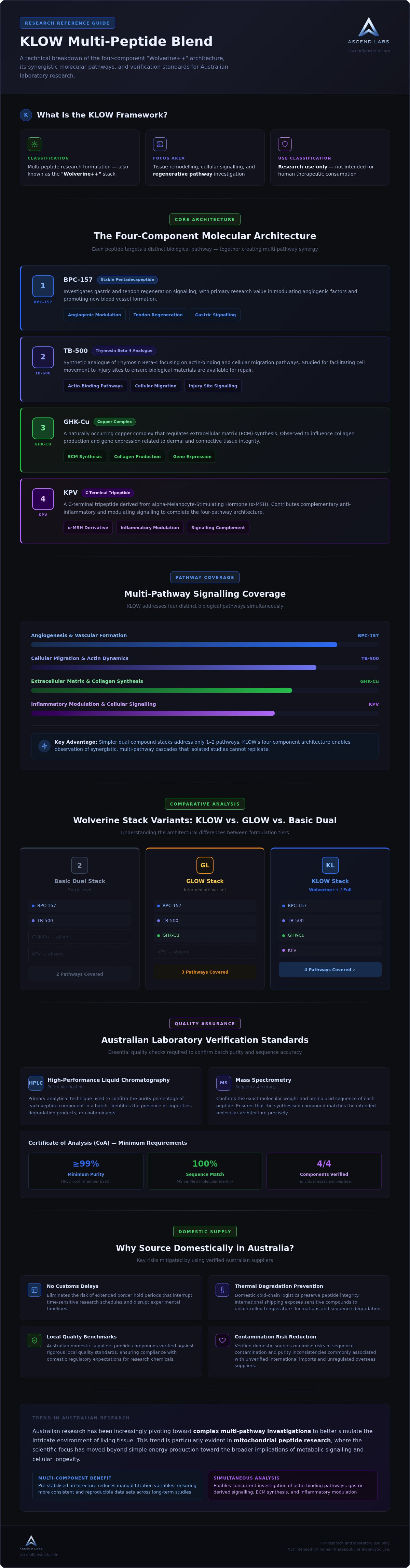
The efficacy of the klow peptide australia research model relies on the precise integration of four primary components: BPC-157, TB-500, GHK-Cu, and KPV. Each molecule addresses a specific facet of tissue remodelling, creating a layered signalling environment that simpler formulations cannot replicate. BPC-157, a stable pentadecapeptide, is frequently utilised to investigate gastric and tendon regeneration signalling. Its primary research value lies in its potential to modulate angiogenic factors and promote the formation of new blood vessels. TB-500, the synthetic analogue of Thymosin Beta-4, complements this by focusing on actin-binding and cellular migration pathways. It's often studied for its ability to facilitate the movement of cells to sites of injury, ensuring that the necessary biological materials are present for repair.
GHK-Cu, a naturally occurring copper complex, acts as a regulator for extracellular matrix (ECM) synthesis. In laboratory models, it's observed to influence collagen production and gene expression related to dermal and connective tissue integrity. Finally, KPV, a C-terminal tripeptide derived from alpha-Melanocyte-Stimulating Hormone (alpha-MSH), introduces a potent mechanism for inflammatory modulation. Unlike basic stacks, KLOW leverages these four distinct vectors to provide a robust, multi-dimensional platform for scientific inquiry.
The Role of KPV in Advanced Formulations
KPV serves as the critical differentiator between KLOW and standard recovery protocols. By mimicking the effects of alpha-MSH, KPV interacts with melanocortin receptors to influence cellular signalling without the pigmentary effects of the full hormone. This tripeptide is specifically valued for its compact molecular size, which facilitates easier passage through cellular membranes in in-vitro environments. In these models, KPV demonstrates a consistent ability to suppress inflammatory markers by inhibiting the translocation of pro-inflammatory transcription factors. This specific function allows researchers to isolate the effects of inflammatory suppression from broader growth factor signalling, providing a cleaner data set for analysis.
Synergistic Signalling Pathways
The interaction between BPC-157 and TB-500 remains a cornerstone of tissue stability studies. While BPC-157 focuses on the structural aspects of repair, TB-500 facilitates the cellular mobility required for those structures to form. GHK-Cu acts as a catalyst within this blend, regulating the gene expression necessary to maintain the extracellular matrix. This multi-layered approach mirrors the complexity found in mots-c research peptide investigations, where mitochondrial-derived signalling is used to influence broader metabolic homeostasis.
Understanding these interactions is vital for maintaining the integrity of experimental data. Researchers must ensure that the ratios of these four components are verified through rigorous laboratory testing. For those conducting advanced tissue studies, securing COA-verified research compounds is the only way to guarantee that the molecular synergy remains intact and reproducible.
Comparative Analysis: KLOW Blend vs. Individual Compound Protocols
Research consistency is the primary objective in any sophisticated laboratory environment. When investigating klow peptide australia, practitioners often face a choice between utilizing a pre-stabilised blend or performing manual titration of individual compounds. Manual mixing introduces a significant margin for error; even minor deviations in concentration can compromise the reproducibility of cellular signalling data. Pre-blended formulations eliminate these variables, ensuring that every aliquot contains the exact molecular ratio required for precise observation of synergistic effects. This standardisation is particularly critical in large-scale Australian laboratory studies where cost-efficiency and data integrity are paramount.
The "Wolverine" spectrum represents a hierarchy of regenerative research models. At the foundation, researchers utilize basic BPC-157 and TB-500 stacks to study structural repair. The GLOW variant introduces GHK-Cu to investigate extracellular matrix regulation. KLOW occupies the apex of this spectrum by incorporating KPV, which adds a layer of inflammatory modulation to the research framework. The presence of GHK-Cu within the KLOW architecture significantly alters the metabolic profile of the study, as this copper complex acts as a potent regulator of gene expression. This requires researchers to account for broader biological shifts rather than focusing solely on isolated tissue repair pathways.
KLOW vs. GLOW: Understanding the Distinction
The fundamental differentiator between KLOW and GLOW is the inclusion of KPV and the specific concentration of GHK-Cu. While GLOW is often sufficient for basic dermal or connective tissue studies, KLOW is engineered for research goals that require suppressed inflammatory markers alongside tissue remodelling. Some researchers raise concerns regarding the "edema" objection, where high concentrations of GHK-Cu can lead to fluid retention in certain biological models. KLOW addresses this by utilizing a calibrated ratio that balances gene regulation with tissue stability, making it a more refined tool for complex investigations into chronic inflammatory environments.
Protocol Design for Australian Researchers
Designing an effective research protocol involves distinguishing between loading phases and maintenance signalling. In cellular models, a loading phase often utilizes higher initial concentrations to saturate signalling receptors before transitioning to a steady-state maintenance level. Researchers investigating metabolic homeostasis may choose to utilize individual compounds like retatrutide alongside the KLOW framework to observe how triple-agonist signalling interacts with regenerative pathways. By utilizing pre-blended formulations, laboratories can standardise these variables across multiple test groups, ensuring that the only shifting metrics are the experimental catalysts themselves rather than the foundational peptide architecture.
Rigorous Standards for Australian Laboratory Verification
Verification protocols are the foundation of any credible scientific inquiry. When sourcing klow peptide australia, researchers must demand evidence of molecular identity and quantitative purity. Mass Spectrometry (MS) serves as the primary tool for identity verification; it identifies the specific arrangement of amino acids by measuring the mass-to-charge ratio of ions. This ensures the peptide sequence is correct. High-Performance Liquid Chromatography (HPLC) follows this by determining the exact purity percentage of the compound. For a multi-component blend like KLOW, these tests must confirm that the ratios between BPC-157, TB-500, GHK-Cu, and KPV remain consistent with the research design.
Interpreting a Certificate of Analysis (COA) requires a disciplined approach to data. Researchers should prioritise reports that include the full HPLC chromatogram rather than just a summary table. Key metrics include batch numbers, the date of synthesis, and the specific methodology used by the third-party laboratory. International procurement often bypasses these standards, introducing risks of cross-contamination and significant thermal degradation during transit. Peptides are fragile; exposure to unregulated temperatures during international shipping can lead to peptide bond cleavage before the compound even reaches the laboratory.
Domestic Quality Assurance Processes
Australian-based testing is essential for maintaining research integrity within the domestic scientific community. It allows for a transparent chain of custody and immediate accountability if a batch fails to meet specifications. Identifying "red flags" in reports is a critical skill; look for inconsistent fonts, missing laboratory contact details, or chromatograms with suspiciously clean baselines. HPLC verified peptides are the only acceptable standard for peer-reviewed studies because they provide a quantitative measure of purity that ensures experimental reproducibility across different laboratory environments.
Storage and Handling Protocols
The stability of klow peptide australia depends heavily on storage conditions. Lyophilised powders are relatively stable at room temperature for short periods, but long-term preservation requires storage at -20°C or below. Once reconstituted, the degradation rate increases significantly. In harsh Australian climates, maintaining a strict cold chain is non-negotiable. Best practices involve aliquotting the reconstituted solution into single-use vials to prevent repeated freeze-thaw cycles, which physically shear the peptide chains and reduce their biological activity.
For laboratories requiring verified documentation and domestic shipping, you can access our library of HPLC-verified research compounds to ensure your study remains compliant with high-purity standards.
Procuring High-Purity KLOW for Domestic Scientific Inquiry
Securing klow peptide australia for laboratory use requires a departure from the standard retail procurement model. Serious researchers understand that the transition from a vendor to a disciplined curator is essential for data validity. Ascend Labs serves as an authoritative scientific gatekeeper, providing the precision-engineered compounds necessary for advanced metabolic and tissue remodelling studies. By focusing exclusively on domestic supply, we remove the environmental variables that frequently compromise research integrity across the Australian scientific community.
Customs intervention is more than just a logistical inconvenience. It represents a period of environmental instability where sensitive peptide sequences are exposed to fluctuating temperatures and unregulated storage conditions. Thermal degradation is a silent variable; it can physically shear peptide bonds and alter molecular weight without visible changes to the lyophilised powder. Domestic shipping ensures a controlled chain of custody, delivering research compounds in their most stable state within a predictable timeframe that international suppliers cannot guarantee.
Transparency in verification is the hallmark of a principled institution. We provide batch-specific HPLC and COA data that confirm the quantitative purity of every formulation we supply. For a complex blend like KLOW, this verification is critical to ensure that the ratios between BPC-157, TB-500, GHK-Cu, and KPV are exact. This level of detail supports researchers by providing the reliable metabolic research tools needed for peer-reviewed studies. We're committed to ensuring that every vial meets the rigorous standards required for sophisticated biotechnological inquiry.
The Ascend Labs Operational Standard
The Ascend Labs operational standard involves a meticulous selection of specialised compounds, including KLOW and MOTS-C. Our approach is clinical and sophisticated, catering to practitioners who value data over hyperbolic marketing. We maintain a commitment to scientific truth and operational discretion, ensuring that our partners receive only the highest-purity materials for their inquiries. This disciplined curation process allows us to function as a reliable partner for serious research projects across Australia.
Next Steps for Your Research Project
For laboratories ready to advance their study protocols, consulting our catalogue provides access to the latest biotechnological developments. You can explore our technical roundup on peptides for connective tissue research for a deeper analysis of how these compounds influence extracellular matrix regulation. Establishing a partnership with a principled domestic institution ensures your laboratory remains at the forefront of Australian scientific research. We provide the streamlined procurement pathways necessary for maintaining a steady supply of verified research chemicals.
Advancing the Integrity of Tissue Remodelling Research
The evolution of regenerative science necessitates a move away from isolated compounds toward sophisticated, synergistic models. By integrating BPC-157, TB-500, GHK-Cu, and KPV, researchers can observe complex signalling pathways that simpler stacks can't replicate. Maintaining the validity of these observations requires a commitment to domestic quality standards. Sourcing klow peptide australia from verified domestic suppliers eliminates the variables of thermal degradation and customs delays that often compromise international shipments. It's the only way to ensure that your laboratory data remains precise and reproducible across long-term studies.
Ascend Labs operates as a disciplined curator for the Australian scientific community. Every batch undergoes rigorous HPLC and COA verification to ensure the molecular architecture remains intact. As an Australian-owned and operated institution, we provide the transparency and operational discretion required for serious laboratory inquiry. You can secure high-purity KLOW for your next research project at Ascend Labs and ensure your experimental outcomes are built on a foundation of chemical integrity. We're proud to support the continued advancement of your biotechnological investigations.
Frequently Asked Questions
What exactly is the KLOW peptide blend used for in research?
KLOW is a multi-peptide formulation designed for investigating synergistic tissue remodelling and cellular repair signalling. It allows researchers to observe how BPC-157, TB-500, GHK-Cu, and KPV interact to influence angiogenic factors and extracellular matrix regulation. This architecture is specifically engineered for multi-pathway investigations where single-compound studies provide insufficient data for complex biological models.
Is KLOW legal to purchase for research purposes in Australia?
Purchasing klow peptide australia is legal provided the compound is strictly utilised for laboratory research and scientific inquiry. These chemicals aren't approved for human consumption or therapeutic use in a clinical setting. Researchers must ensure they procure from domestic suppliers who comply with Australian standards for research-only compounds to maintain institutional integrity and regulatory compliance.
What is the difference between KLOW and the GLOW peptide stack?
KLOW includes the tripeptide KPV, which introduces a specific vector for investigating inflammatory modulation that GLOW lacks. While the GLOW stack focuses on structural repair through BPC-157, TB-500, and GHK-Cu, KLOW provides a more comprehensive framework for studying tissues within chronic inflammatory environments. This makes KLOW the preferred choice for advanced regenerative research models requiring suppressed inflammatory markers.
How should KLOW be stored to maintain its chemical stability?
Lyophilised KLOW powder should be stored in a freezer at -20°C or below to ensure long-term molecular stability. Once reconstituted with bacteriostatic water, the solution becomes significantly more susceptible to degradation and must be kept refrigerated between 2°C and 8°C. Researchers should avoid repeated freeze-thaw cycles to prevent physical shearing of the peptide chains, which reduces biological activity.
Why is KPV included in the KLOW formulation?
KPV is included to provide a precise mechanism for suppressing inflammatory markers within the research model. By mimicking the effects of alpha-MSH, KPV interacts with melanocortin receptors to influence cellular signalling without the pigmentary effects of the full hormone. This allows practitioners to isolate the effects of inflammatory suppression from the growth factor signalling provided by the other components in the blend.
How do I verify the purity of KLOW peptides from an Australian supplier?
Purity verification requires reviewing batch-specific High-Performance Liquid Chromatography (HPLC) and Mass Spectrometry (MS) data. A legitimate supplier will provide a Certificate of Analysis (COA) that matches the batch number on the vial. Researchers should prioritise domestic suppliers who offer transparent access to these chromatograms to ensure experimental reproducibility and batch-to-batch consistency.
Can KLOW be used alongside other metabolic compounds like Retatrutide?
KLOW is frequently utilised in research protocols alongside metabolic compounds like Retatrutide to investigate the cross-talk between triple-agonist signalling and tissue repair. This combination allows for the observation of how metabolic homeostasis influences the rate of cellular regeneration in in-vitro models. Utilising a pre-stabilised klow peptide australia blend ensures that the regenerative background remains constant while metabolic variables are shifted.
What are the common side effects observed in research models using KLOW?
In cellular and animal research models, observations often include localised irritation at the administration site or minor fluid retention related to GHK-Cu concentrations. Some models have indicated transient shifts in blood pressure or lethargy depending on the specific dosage titration and the biological system's sensitivity. It's essential to document these variables meticulously to understand the compound's safety profile within a controlled laboratory environment.


